
Consumer Price Index and Producer Price Index
This lesson will cover the following
- What is the Consumer Price Index?
- How do traders read the Consumer Price Index report?
- What is the Producer Price Index and how do traders read it?
The Consumer Price Index in general
 The Consumer Price Index (CPI) is a major gauge of inflation for an economy. This index is based on a basket of goods and services purchased and used by consumers on a daily basis. In the United States, the Bureau of Labor Statistics (BLS) surveys the prices of 80,000 consumer items in order to calculate the index. The index reflects the prices of commonly purchased items by primarily urban households, which represent about 87% of the US population. The Bureau processes price data from 23,000 retail and service businesses.
The CPI includes sales taxes but excludes income taxes, prices of investments such as stocks and bonds, and selling prices of homes.
 The CPI report is usually released monthly (approximately in the middle of the month) and covers data for the preceding month. The BLS publishes this report at 13:30 GMT (8:30 a.m. EST).
The most-watched figure is the Core CPI, which does not include food and energy prices. It is usually presented as a seasonally adjusted figure, because consumer patterns vary widely depending on the time of year.
The Core CPI is an important measure, because this is the gauge that the Federal Reserve examines when adjusting its monetary policy. The Fed focuses on the Core CPI because prices of food, oil and petrol are highly volatile while the central bank’s tools are slow-acting. If petrol prices surge considerably, this could lead to a high rate of inflation, but the central bank will not take action until this increase affects the prices of other goods and services.
More reflective
Another type of CPI, released alongside the Core CPI, is the Chain-Weighted CPI. It reflects the effects of consumer choice. Chain-weighted CPI figures are considered by many analysts to be more reflective of actual consumer patterns than fixed CPI figures, because the chain-weighted index takes into account the substitution and new-product bias present in the fixed CPI.
If a consumer purchases one product over another because of an increased price of the first product, chain-weighted indices will reflect this buying shift, whereas the Core CPI will not. The Core CPI will still measure the price of the product as it rises, without considering the fact that fewer people are purchasing it.

- Trade Forex
- Trade Crypto
- Trade Stocks
- Regulation: NFA
- Leverage: Day Margin
- Min Deposit: $100
How do traders read the Consumer Price Index report?
 The CPI is an indicator with a predictive nature. The CPI report often moves stock, currency and bond markets, both on the day of the release and thereafter. It may even set a new course in the markets for future periods. After digesting the CPI report, traders and analysts are usually provided with clues about what actions may be considered by the Federal Reserve or the European Central Bank at their upcoming policy meetings.
In the case of an expanding economy, if the annualised Core CPI accelerates more than projected during a given period and approaches the inflation target set by the central bank, this may be taken as a sign that economic recovery is gathering pace; traders therefore tend to support the national currency.
Conversely, if the economy is sluggish and the annualised Core CPI rises at a slower-than-projected pace, this may signal that inflationary pressure remains weak and accommodative monetary policy is still needed to spur growth; traders would therefore be inclined to sell the national currency.
On the other hand, a rate of inflation well above central banks’ inflation objectives, which provide price stability, can be harmful to an economy.
Example
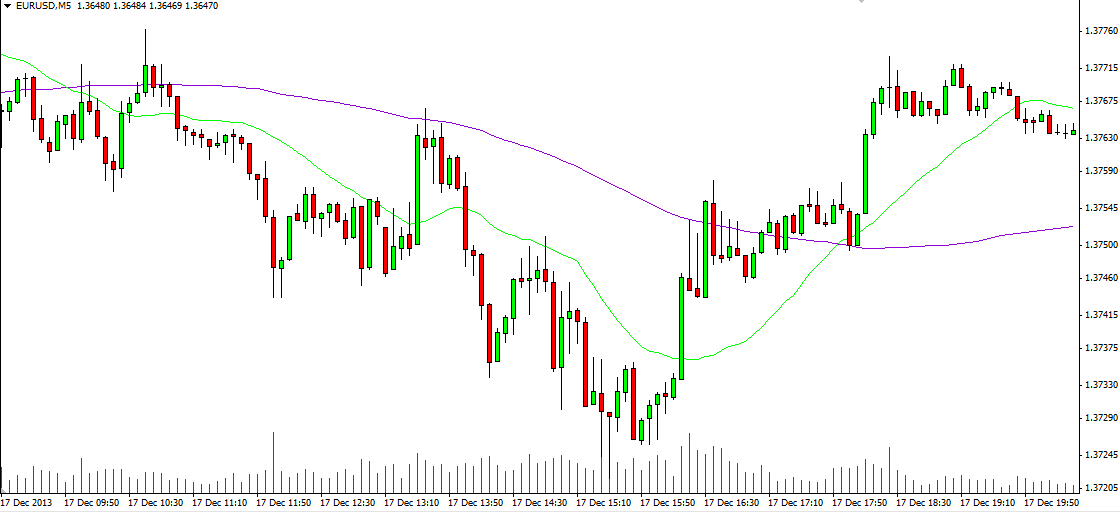
Source: MetaTrader 4 by MetaQuotes Software Corp.
The chart above visualises how EUR/USD reacted to the release of the CPI in the United States at 13:30 GMT on 17 December. According to the report, the overall CPI remained flat in November compared with October, while the annualised CPI increased to 1.2% in November, meeting preliminary estimates. Annualised Core CPI was reported to have risen to 1.7% in November, again in line with expectations. These data points were regarded as positive by market participants, and the EUR/USD pair retreated by about 30 pips (see the sequence of five red candles on the chart).
The Producer Price Index in general
The Producer Price Index (PPI) measures the average change over time in the selling prices received by domestic producers for their output. The PPI report is released during the second or third week of each month by the Bureau of Labor Statistics (BLS) and covers data for the preceding month. The Bureau publishes this report at 13:30 GMT (8:30 a.m. EST).
The PPI reveals trends within the wholesale, manufacturing and commodity markets. All of the physical goods-producing industries that comprise the economy are included, with the exception of imports. The prices included in the PPI relate to the first commercial transaction.
Because the Producer Price Index reflects prices of consumer goods and capital equipment, a portion of the inflation at the producer level is usually passed through to the Consumer Price Index (CPI).
While the PPI used to include only the “physical goods industries”, such as mining and manufacturing, many service-based industries have been added to the index over time.
Three figures
The US PPI report shows three headline index figures – one for crude, one for intermediate and one for finished goods at the national level:
The PPI Commodity Index (crude) shows the average price change during the current month compared with the previous month for commodities such as energy, coal, crude oil and steel scrap.
The PPI Stage of Processing Index (SOP) (intermediate) represents goods that have undergone some manufacturing but will be sold to other manufacturers to create finished goods. Examples of SOP products include lumber, steel, cotton and diesel fuel.
The PPI Industry Index (finished) represents the final stage of manufacturing and is used as the source of the Core PPI.
Most significant
 The Core PPI figure is of greatest importance. It represents the finished-goods index minus the volatile food and energy components. The PPI is intended to reflect only the prices that are being paid during the survey month. It is common for companies that do regular business with large customers to have long-term contract rates that may be known at present but not paid until a future date. The PPI excludes these future values or contract rates.
Like the CPI, the PPI uses a base year during which a basket of goods was measured and the index had a value of 100. The PPI uses 1982 as its benchmark year. Each subsequent year is compared with this base year.
How do traders read the Producer Price Index report?
Traders and analysts regard the PPI for finished goods as a precursor of consumer-price inflation. If the prices that manufacturers pay for their raw materials surge, producers will have to increase the prices that consumers pay for finished goods in order to sustain their profit margins.
As the CPI is the key indicator of inflation, traders try to gain an early insight by examining the PPI report. The Federal Reserve also studies this report closely to clarify future policy moves that might be needed to manage inflation.
 The PPI report does not directly affect currency pairs, but because it is released before the CPI report it serves as a valuable tool for predicting the rate of inflation. Since inflation is a sign that the purchasing power of a nation’s currency is declining and each unit of local currency buys fewer goods and services, a rise in the rate of inflation (well above the target set by central banks) usually has a negative effect on that currency.
If a local currency becomes less valuable because of inflationary pressure, demand for that currency decreases. This is especially evident if the country in question imports a large quantity of essential goods from a country with low production costs. These goods become more expensive as the local currency loses value against the exporting country’s currency, while the inflation rate rises as prices surge.
Example
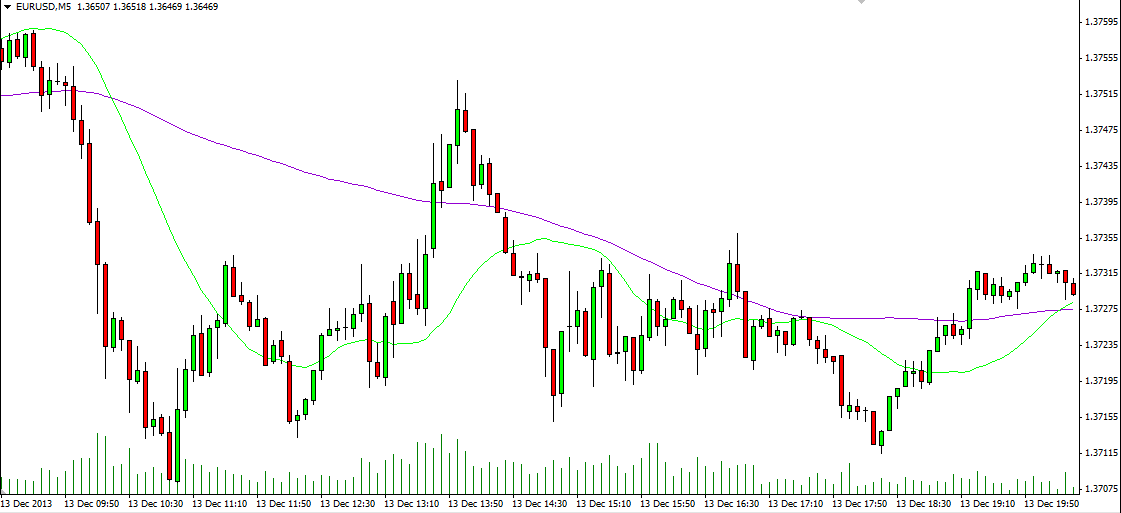
Source: MetaTrader 4 by MetaQuotes Software Corp.
The chart above visualises how EUR/USD reacted to the release of the PPI report in the United States at 13:30 GMT on 13 December. The annualised PPI rose to 0.7% in November, below forecasts for an increase to 0.8%, while the annualised Core PPI ticked down to 1.3% in November from 1.4% in October. Experts had expected the Core PPI to remain steady in November. These data points triggered the greenback’s retreat, with the EUR/USD pair gaining about 15-20 pips. A possible explanation? As the annualised Core PPI remained almost unchanged in November compared with October, the result suggested that the Core CPI might either slow or remain unchanged as well.