
 | Updated:
 Commodity Channel Index
This lesson will cover the following
- What is the Commodity Channel Index?
- How can it be used for trading?
- How can we change the settings of the CCI?
Explanation
 The Commodity Channel Index (CCI) was developed by Donald Lambert, who described it in the October 1980 issue of Commodities magazine. It can be used in any market. The CCI belongs to the group of so-called oscillators and measures the deviation of an instrument’s price from a moving average. The CCI is usually relatively high when prices exceed their average value significantly and, conversely, relatively low when prices remain well below their average value. Traders can use the CCI to identify overbought and oversold levels.
The Commodity Channel Index may help identify peaks and troughs in the price of a tradable instrument, indicate the exhaustion or end of a trend, and signal a possible change in direction.
Here we can see how the CCI is displayed on the 1-hour chart of USD/CAD (the black line oscillating between the two extreme levels).
The CCI provides a slightly different picture from the stochastic indicator and, in some cases, the signals it produces are more reliable. The difference between the CCI and the stochastic is minimal, so using both is likely to duplicate effort. Moreover, employing both indicators could create false confidence.

- Trade Forex
- Trade Crypto
- Trade Stocks
- Regulation: NFA
- Leverage: Day Margin
- Min Deposit: $100
How can it be used in trading?
 The CCI can be used as either a leading or a coincident indicator. A distinguishing feature is that it is not a bounded indicator: it can rise above +100 or fall below -100. As a coincident indicator, a reading above +100 usually signals strong price action and the potential start of an up-trend. Conversely, a reading below -100 usually signals weak price action and the potential start of a down-trend.
As a leading indicator, the CCI can be used to identify overbought and oversold conditions.
In addition, bullish and bearish divergences can be used to detect early changes in momentum and possible trend reversals.
Identification of a new trend
 In most cases the CCI moves between the -100 and +100 levels. Any move beyond this range signals unusual strength or weakness and may herald an extended move. The CCI reflects bullish sentiment when it is positive and bearish sentiment when it is negative. However, relying on a zero-line crossover alone can lead to whipsaws. Waiting for a move above +100 before entering a long position, or below -100 before entering a short position, reduces the likelihood of whipsaws.
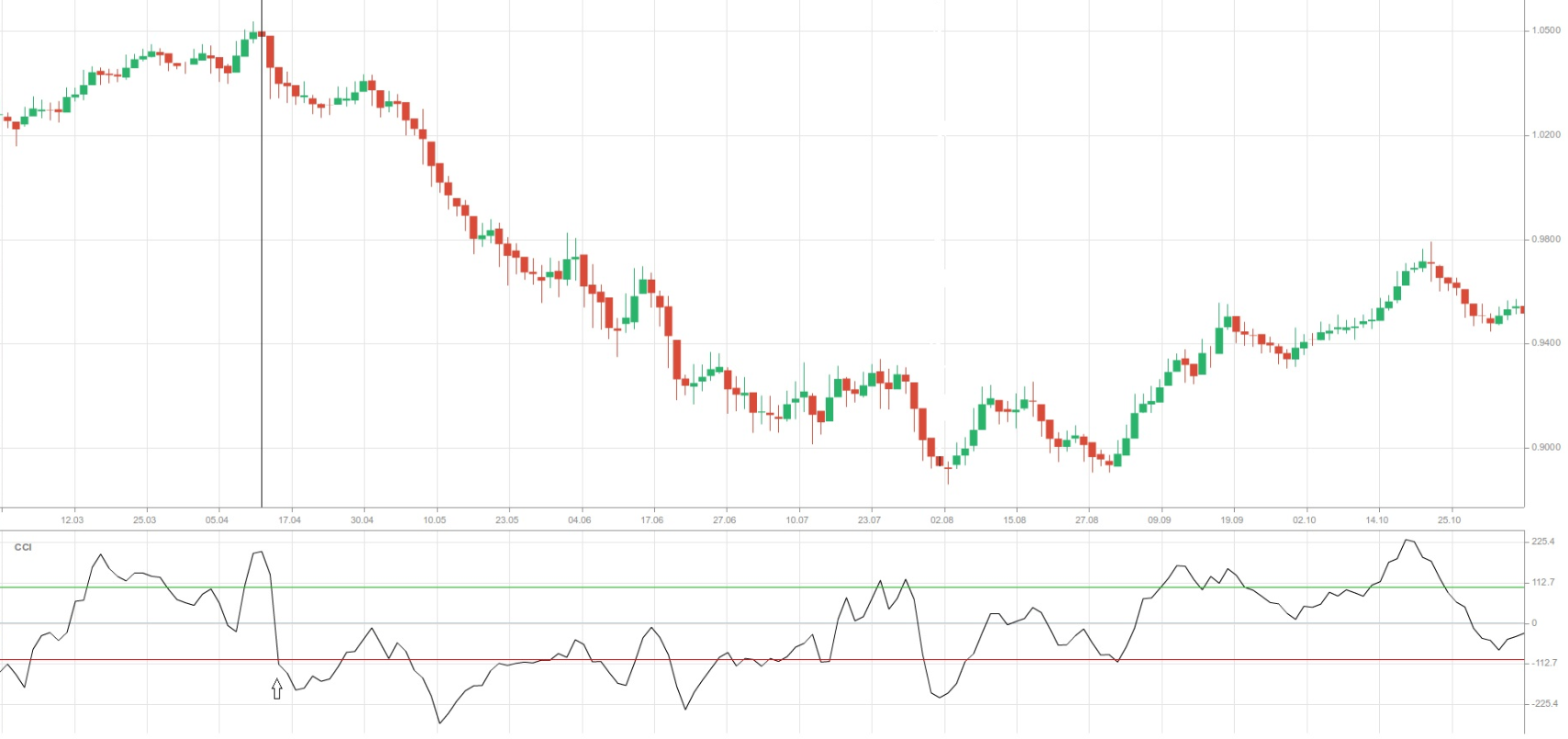
Here we can see a 1-day chart of AUD/USD with CCI (20), overbought level (+100) and oversold level (-100). On 12 April AUD/USD reached a peak and turned lower. The CCI moved below -100 on 15 April, indicating the start of an extended downward move.
Overbought and oversold
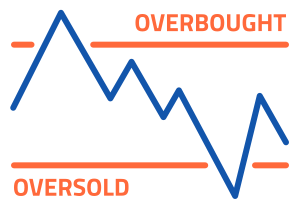 As mentioned earlier, the CCI is an unbounded indicator; theoretically there are no upper or lower limits. Consequently, the assessment of overbought and oversold levels is subjective.
In a trading range (flat market) the -100/+100 band can usually be used to define overbought and oversold conditions. In strongly trending markets, however, traders may need more extreme levels, for example -200 for oversold and +200 for overbought. These levels are considerably harder to reach and represent extreme conditions more accurately.
A CCI reading above +200 suggests the tradable instrument is overbought and that the price may begin to fall. In this case, a trader would look to enter a short position when the CCI crosses back below +200.
A CCI reading below -200 suggests the tradable instrument is oversold and that the price may begin to rise. In this case, a trader would look to enter a long position when the CCI crosses back above -200.
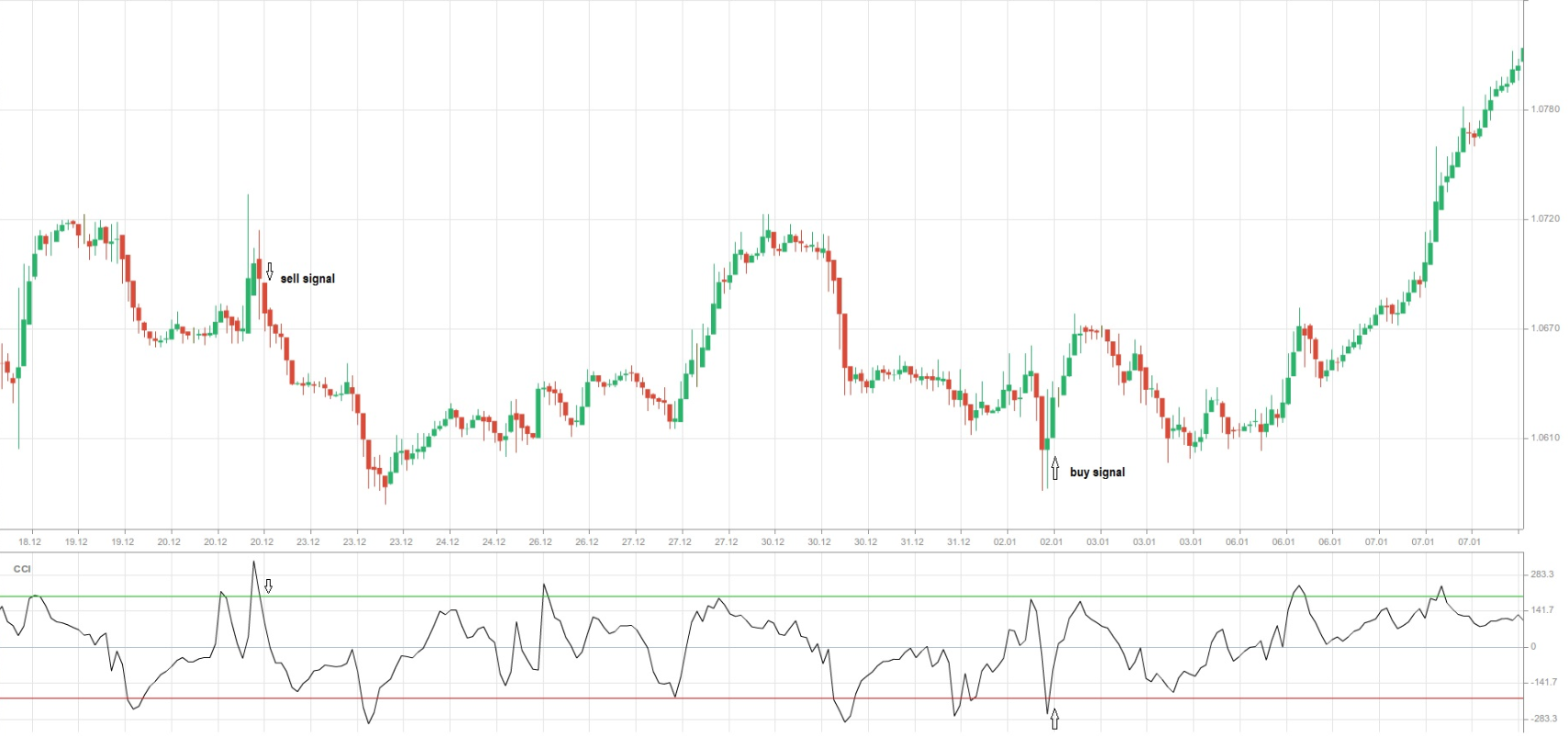
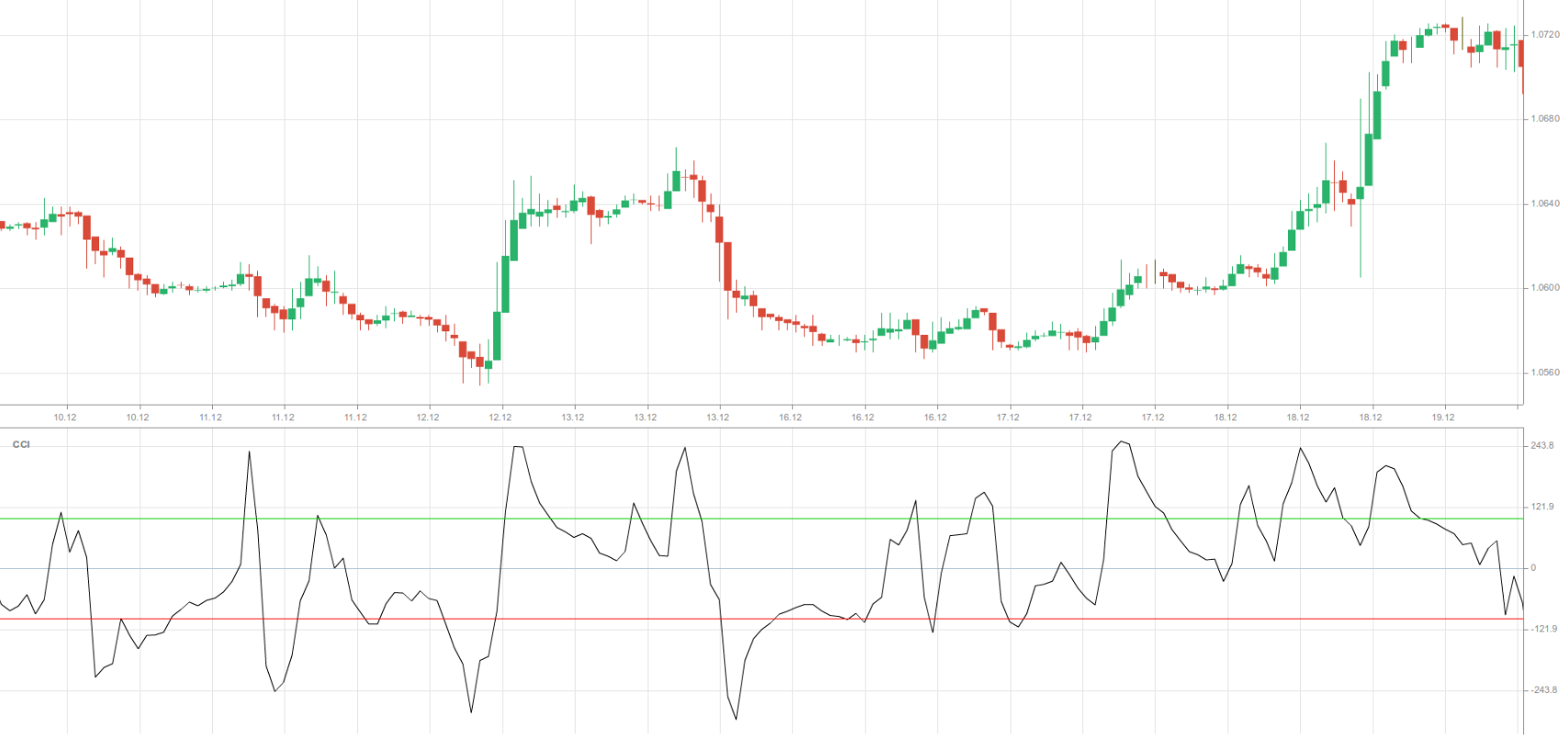
Here we can see a 1-hour chart of USD/CAD with CCI (14), overbought level (+200) and oversold level (-200). On 20 December, after crossing the overbought level, the CCI moved back below it, signalling a sell entry. On 2 January, after crossing the oversold level, the CCI moved back above it, signalling a buy entry. It is crucial to wait for these crosses in order to reduce whipsaws.
Bullish and bearish divergences
 Divergences usually indicate a potential reversal level, as momentum fails to confirm price action. A bullish divergence occurs when the price of the tradable instrument makes a lower low while the CCI makes a higher low, implying that downside momentum is weak. A bearish divergence occurs when the price of the tradable instrument registers a higher high while the CCI makes a lower high, implying that upside momentum is weak.
However, as reversal indicators, divergences can provide false signals during a strong trend. A resilient up-trend can often produce a number of bearish divergences before a peak is actually seen. A strong down-trend can often produce a number of bullish divergences before a bottom actually occurs.
As divergences reflect a shift in momentum, which can signal a trend reversal, technical analysts need to establish a confirmation level for the CCI. A bearish divergence could be confirmed with the CCI breaking below the zero line, or a breach of the support level on the price chart. A bullish divergence could be confirmed with the CCI breaking above the zero line, or a breach of the resistance level on the price chart.
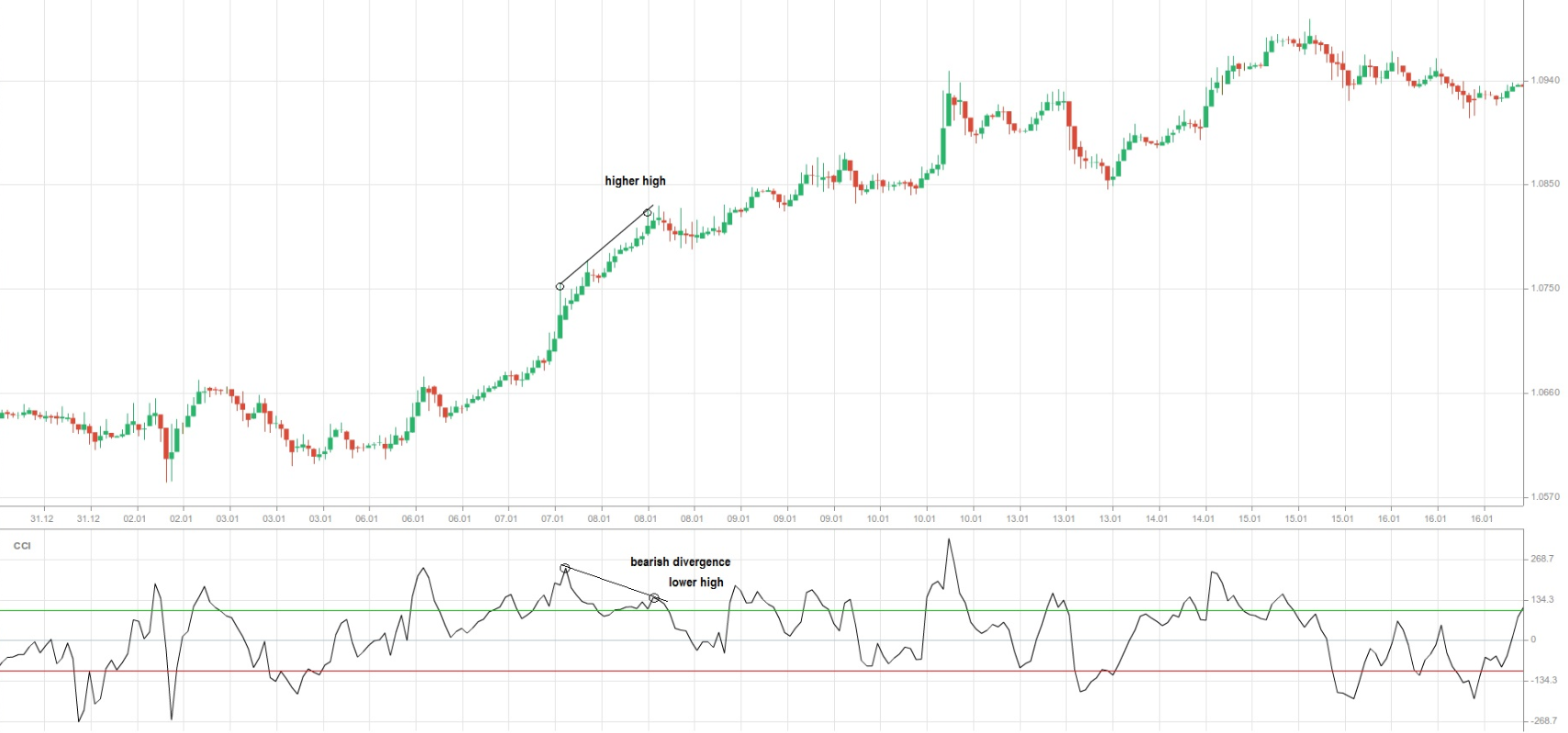
Here we are looking at a 1-hour chart of USD/CAD with CCI (14).
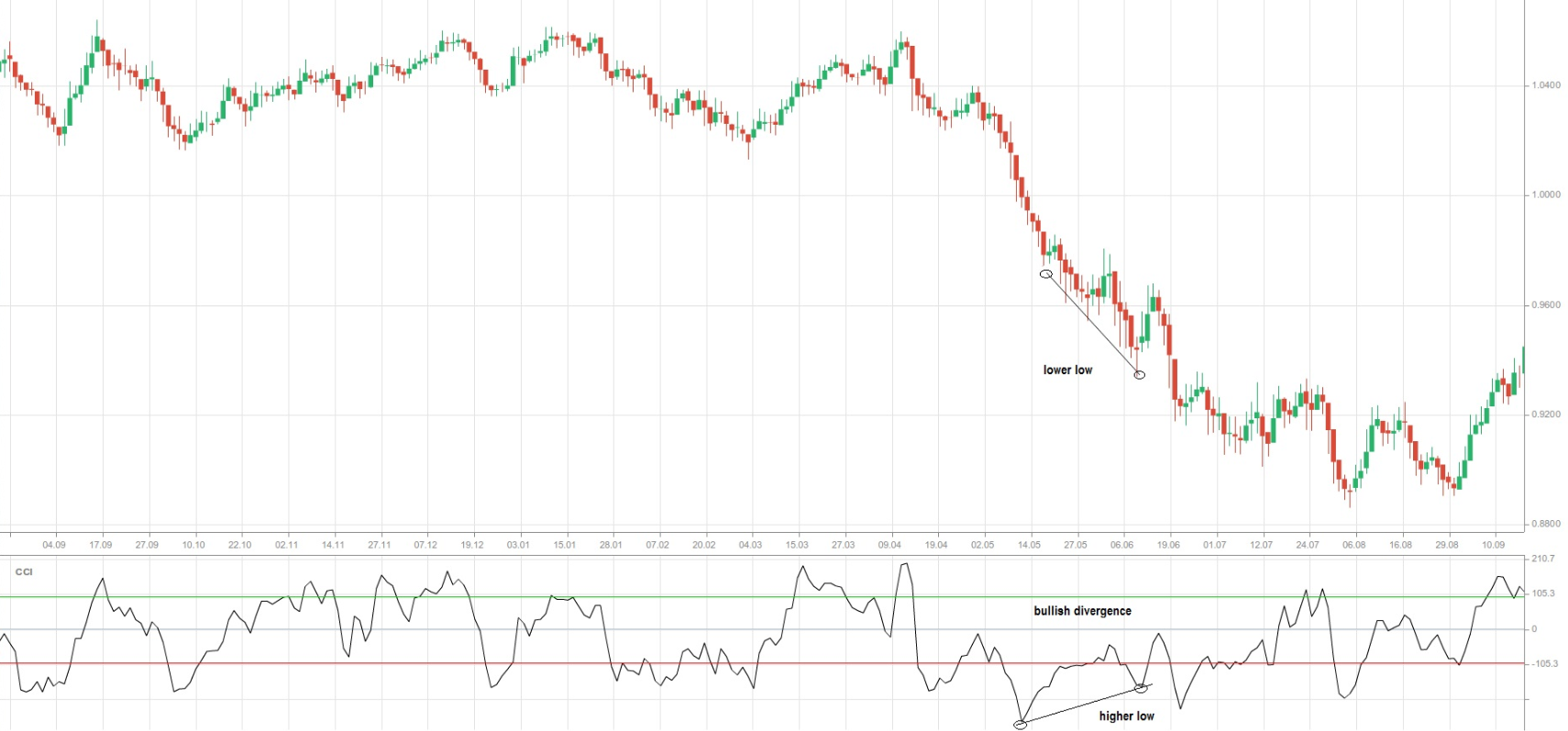
Here we are looking at a 1-day chart of AUD/USD with CCI (20).
Changing the settings of the CCI
 The CCI is usually set to 14, which means that the indicator compares recent price changes with the average price change over 14 periods (depending on the time frame currently used). This setting can be increased or decreased in accordance with a trader’s preferences.
When the CCI is set to fewer than 14 periods it produces a more reactive line, which oscillates within the -100 to +100 range more frequently and does not stay in the extremes for long. When it is set to more than 14 periods the line is less reactive; it touches or exceeds the extreme levels less often, but when it does reach them it tends to remain there for longer. Let us now look at two different settings of the CCI – a low value and a high value.
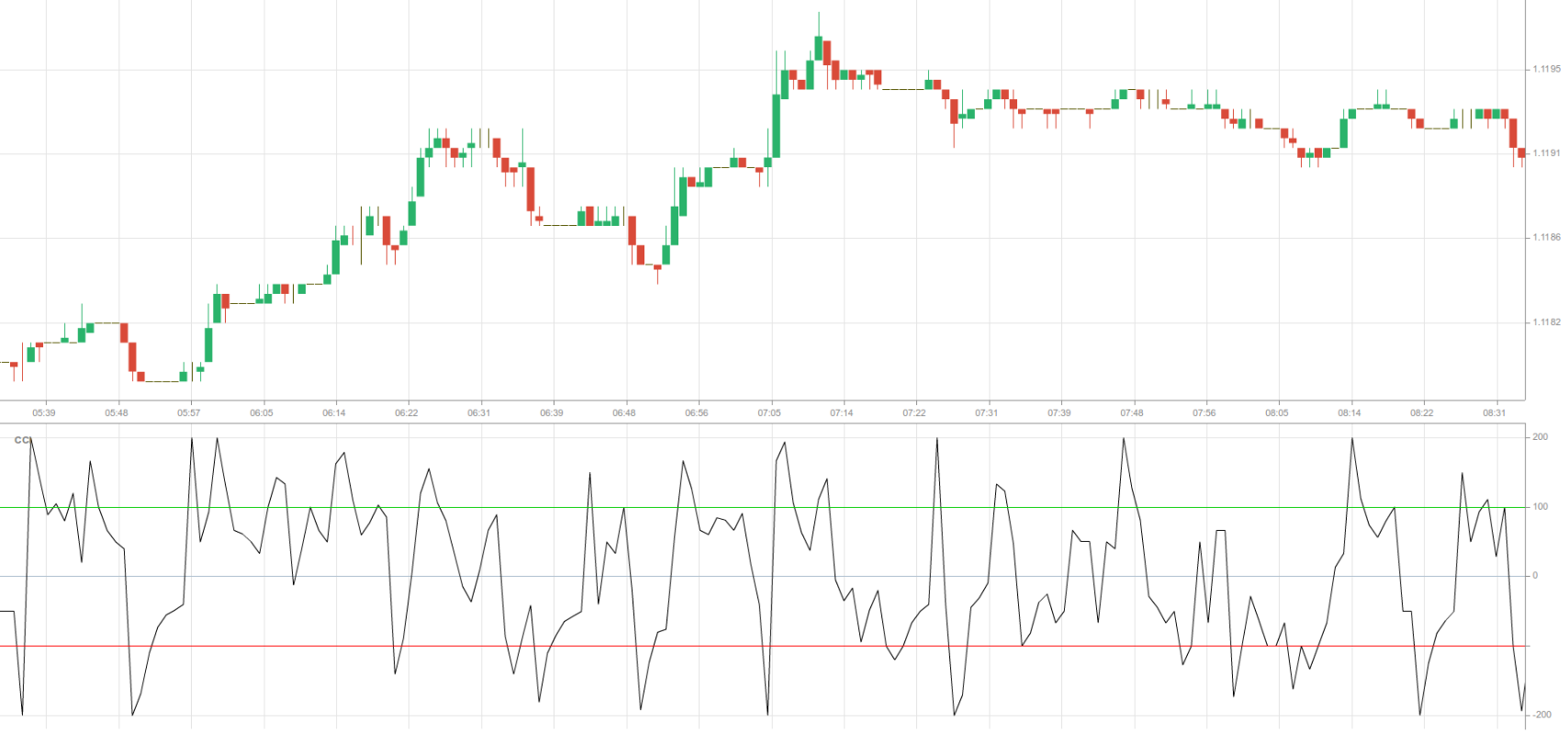
Here we use a CCI setting of 6 (less than 14). Notice how many times the average line (black line) moves above and below the +100 and -100 levels and how it does not remain there for long.
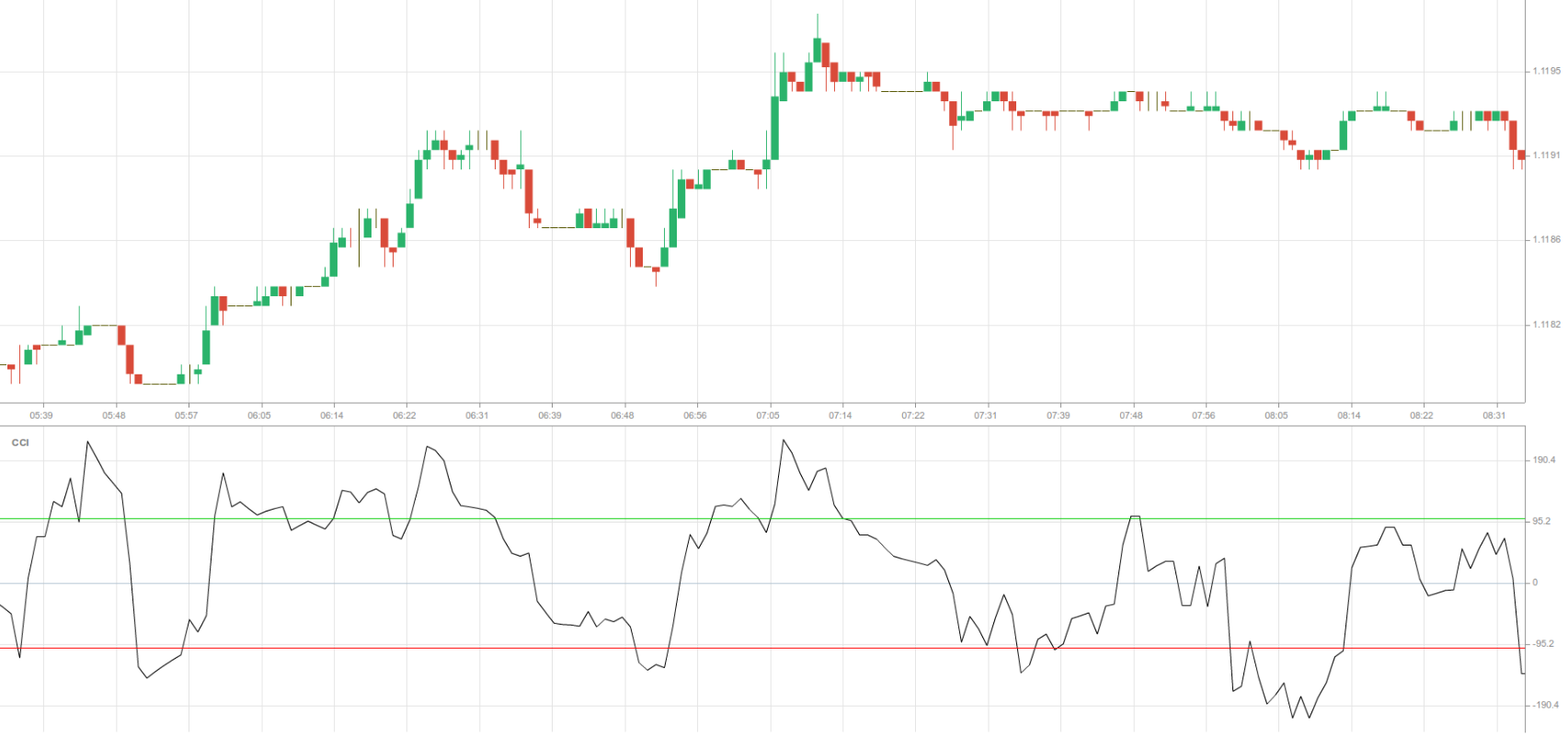
Here we use a CCI setting of 26 (more than 14). We can see how the average line (black line) moves beyond the extreme levels only a few times and how it tends to remain at or outside these levels for a longer period.