
Channels
This lesson will cover the following
- What is a channel and how does it work
- How is a channel drawn
- What are the different types of channels
- How can you trade a channel
Channels are a concept in technical analysis that are successfully used by many traders. A channel is a trading range bounded by a trend line and a concurrent line plotted through the opposite peaks or troughs. There are three types of channel, depending on price direction: an ascending channel, a descending channel or a sideways channel, also known as a ranging channel.
How is a channel drawn
 In order to draw a channel, we first need to establish whether we have an up-trend or a down-trend. Forming an ascending channel requires the market to be creating higher highs and higher lows at roughly the same pace. Similarly, to draw a descending channel, the market must be forming lower highs and lower lows at a similar speed.
Plotting a channel is very straightforward if you know how to draw a trend line, something we have already explained in the article “The Trend – a Trader’s Best Friend”. Once you’ve successfully placed your trend line, you need to draw a parallel line of roughly the same length, set at the same angle, and extend it into the future.
As you already know, up-trend lines should be plotted between support troughs, which means that when the market is trending up, the trend line lies below the price action. Logically, down-trend lines should be plotted between resistance peaks, meaning that when the market is trending down, the trend line appears above the price action.
This means that the parallel line we need to draw should run through the most recent high in the case of an up-trend, or the most recent low if prices are trending down.
 Don’t forget that, as when plotting trend lines, you should not force the parallel lines if they do not match the market action. If the market has created lows and highs in such a way that the two lines running through them are not concurrent, then this is not a channel and you should not try to fit them to illustrate parallel movement.
How do channels actually work?
Channels are essentially sustained by traders who have identified them and use them to enter and exit trades. The following example illustrates the general principle of channel movement.
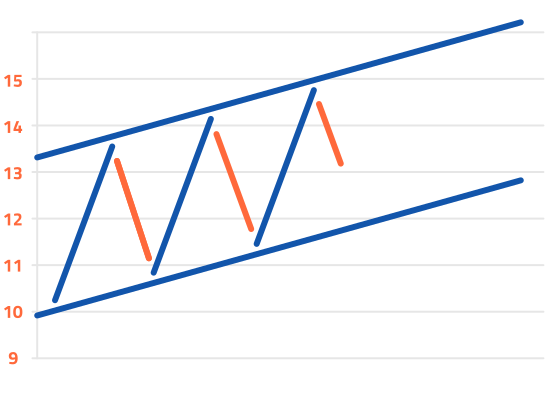
Let’s assume that the asset stood at $10 at some point and that overall market sentiment is bullish. As more people begin buying, demand exceeds supply, causing the price to rise.
However, at $13.50, those buyers feel that the price has risen enough and they’ve made sufficient profit, so they decide to close their positions, which means they are effectively selling. At this point, supply begins to exceed demand, which drives prices down to, let’s say, $11.
After the asset becomes cheaper, market players decide this is an appropriate moment to enter into a long position and benefit from an expected price gain.
 As demand once again outstrips supply, it lifts the price to, say, $14. However, at this point traders might decide that the price has risen too much and that a further advance is unsustainable because it has exceeded the previous high of $13.50. This will prompt many market participants to begin selling in order to secure their profit, thus applying downward pressure on the market.
As prices commence another drop and fall to, say, $11.50, broad market sentiment shifts as most traders assess that the asset has fallen too far. This spurs a series of long entries, which again pushes the price up and continues the upward spiral. Logically, this principle works the other way around as well, thus forming a descending channel.
However, eventually we might see that a resistance reversal point begins to converge on the underlying trend line and is no longer aligned with the upper channel line. This is evidence that sellers are becoming more anxious, which means that the price is approaching a reversal point. Inevitably, a breakout will occur.

- Trade Forex
- Trade Crypto
- Trade Stocks
- Regulation: NFA
- Leverage: Day Margin
- Min Deposit: $100
Types of channels
In accordance with the market trend, you can have an ascending channel (up-channel), a descending channel (down-channel) or a sideways channel (ranging channel).
Ascending channel
An ascending channel is an upward-tilted trading range that surrounds the price movement as the market forms higher highs and higher lows at the same pace. You can see one illustrated on the screenshot below.
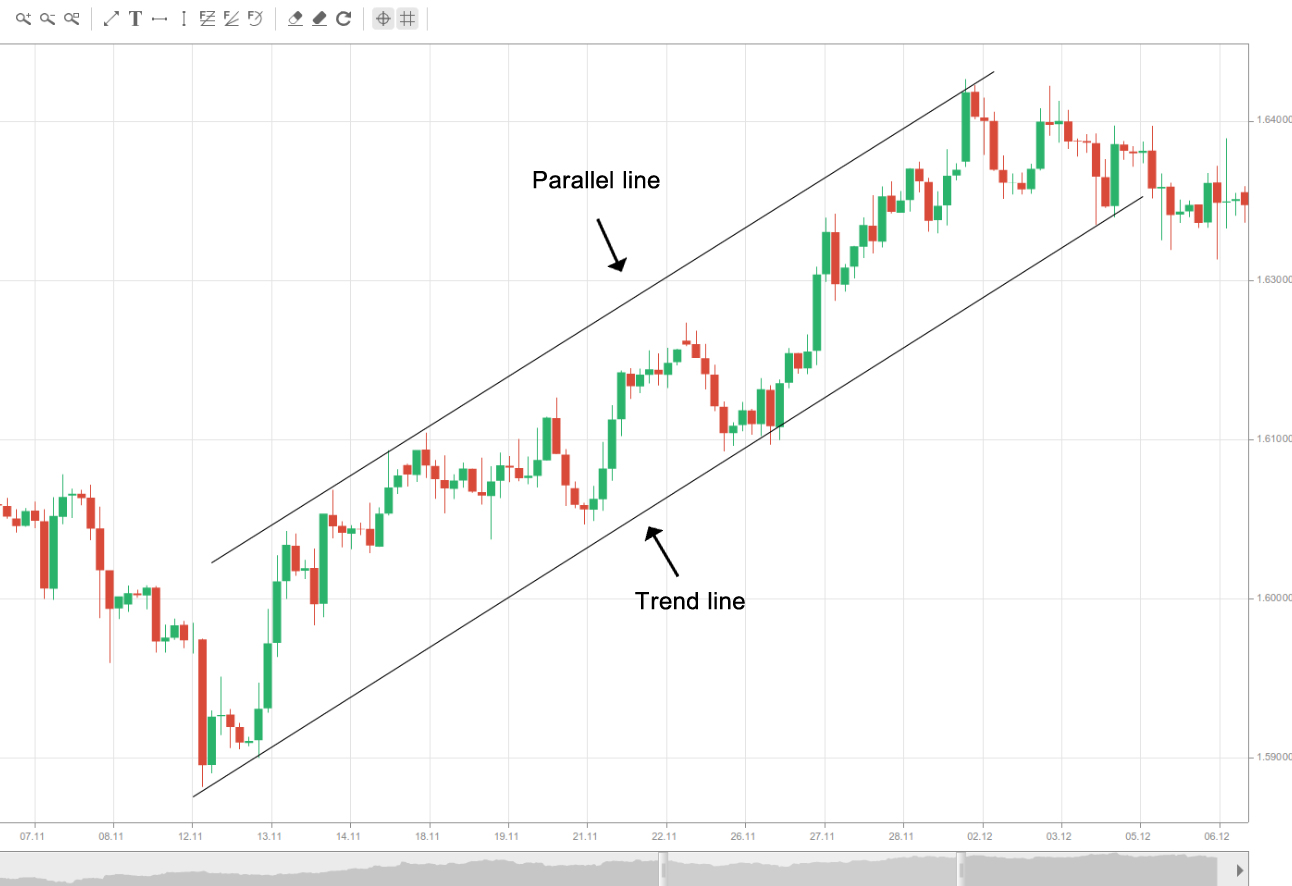
As you can see from the example, the market is forming new highs and new lows with an equal amount of price movement to the upside, which renders the lines going through them (the trend line and its clone) parallel.
In order to draw an ascending channel you need to do the following:
1. Draw a trend line, as described earlier.
2. Draw another line, tilted at the same angle, and adjust its length in accordance with the projected channel.
3. Drag the parallel line and place it so that it runs through the most recent high.
4. If this is a genuine ascending channel, all previous highs should lie on the cloned line, or deviate only very slightly at most.
5. Do not attempt to force the second line to become parallel to the trend line. If they do not match, then you simply do not have a channel.
Descending channel
A descending channel is a downward-tilted trading range that surrounds the price movement as the market forms lower highs and lower lows at the same pace. You can see a down-channel visualised below.
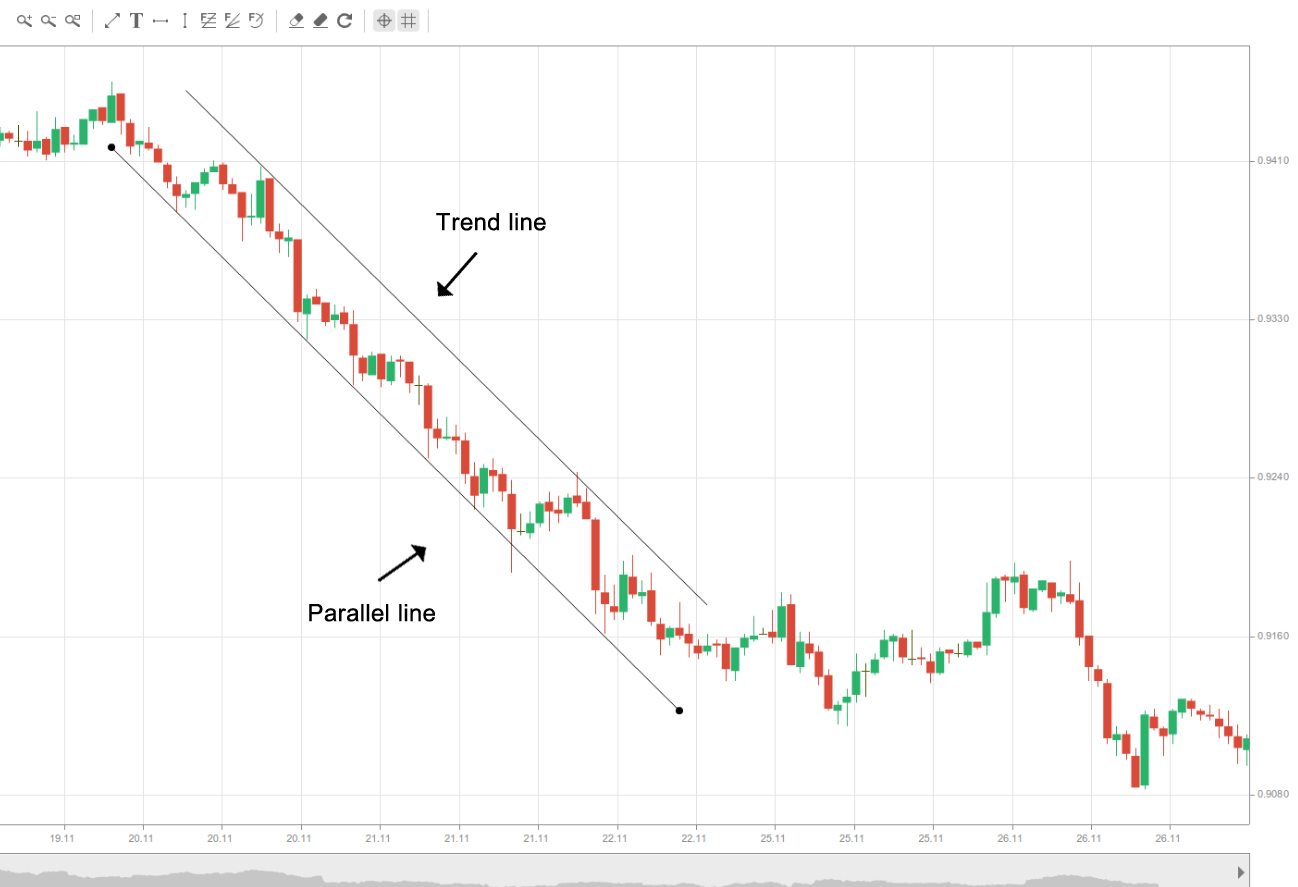
To draw a descending channel, follow the same steps as when plotting an ascending one, with the difference that the trend line lies above the price action while the cloned line is below.
Ranging channel
A ranging channel, also known as a sideways or horizontal channel, is a trading range in which there is no difference in the angle between the nearest peaks and troughs. Essentially, the price oscillates within a horizontal support and resistance zone, as illustrated below.
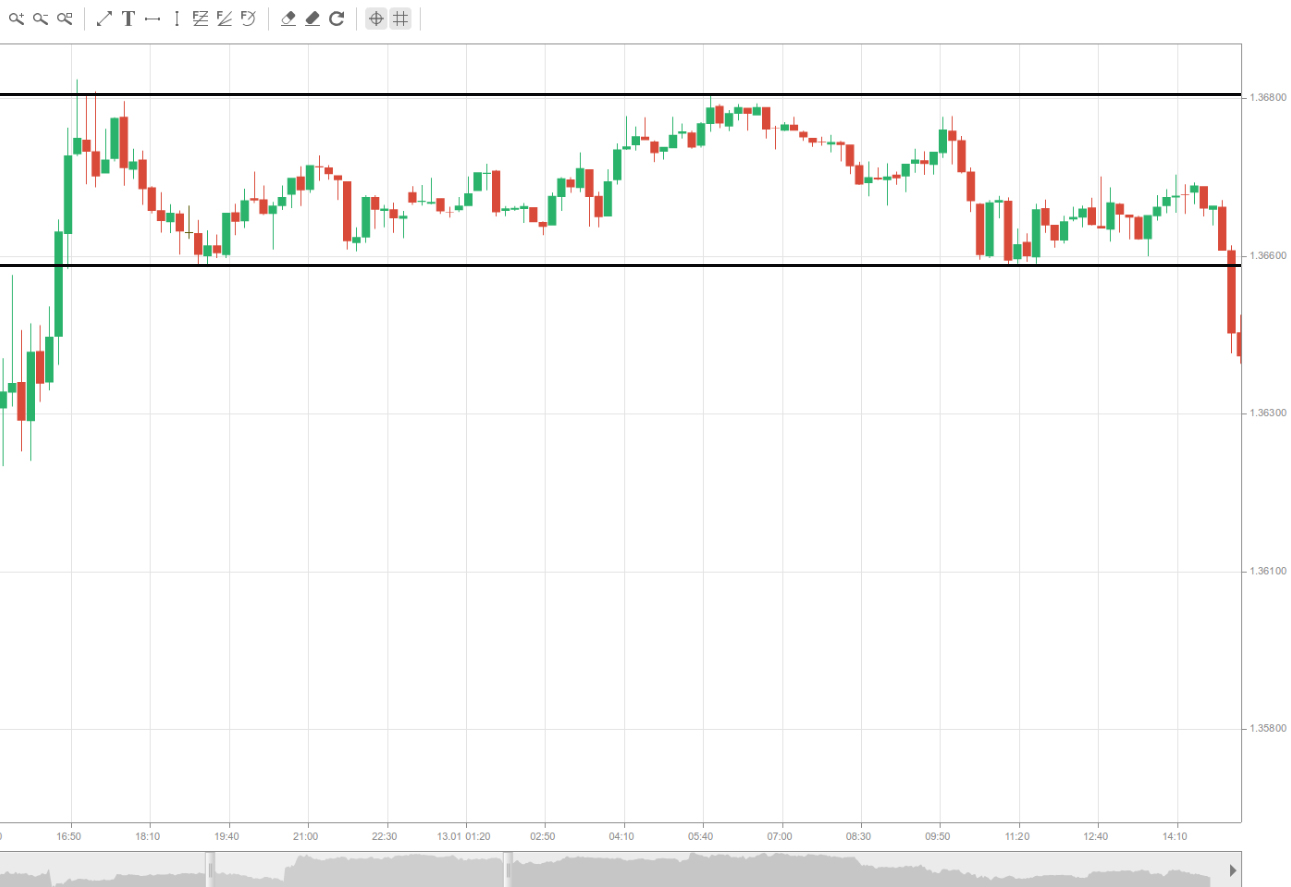
To draw a horizontal channel, follow the same steps as with the previous two types, but here you can choose which side to start from – you can draw your trend line either below or above the price action.
How to trade channels
There are two ways to trade based on channel price movement. You can either trade the range, or you can trade the breakout once it occurs.
Trading the range
Since the boundaries of any type of channel act as support and resistance (which we explained in the articles “Support and Resistance, Part I” and “Support and Resistance, Part II“), we can use the signals generated when the price meets those levels.
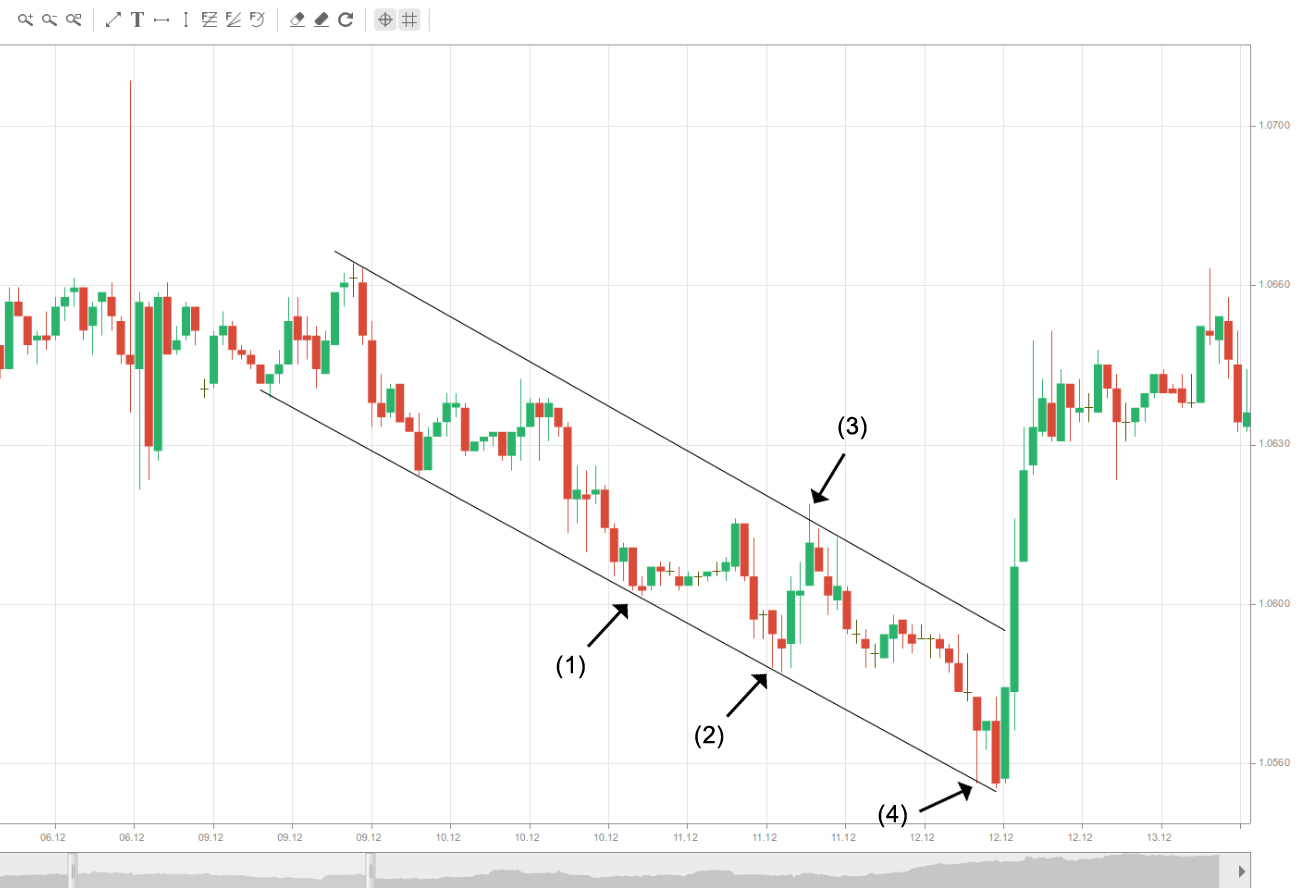
In the screenshot above you can see that (1) has generated a buy signal, and our upper boundary acts as resistance, so this should be our profit target. At (2), we are provided with another buy signal, after which at (3) we exit our long position, thus securing profit, and place a short order. As prices continue to decline through the channel, the market again touches the lower boundary at (4), where we exit our short position and enter a long one, guided by the generated buy signal.
Trading the breakout
As you’ve already learned from the previous articles, breakouts produce very strong and widely used trading signals due to their high profitability. As with every other support or resistance level, prices can break through the upper or lower boundary of a channel, thus generating an entry signal.
In the example above you can see that the price broke through the upper boundary and then continued to edge higher, providing a strong signal for a long entry. As we’ve already learned, however, the possibility of a breakout turning false always lurks around the corner, which is why it is best to wait for confirmation. It would be wise to wait for a candle to close outside the channel before placing an order, or in some cases, wait for a retest of the line.
 A potential signal for an upcoming breakout of the channel is an acceleration that pushes the price above the upper boundary in an ascending channel or below the lower boundary in a descending channel. Most often this is due to pure emotionalism and is therefore a potential sign of a price reversal. A trader, however, especially a beginner, must never bet against the current market conditions in anticipation of a price reversal, as a wrong move could be devastating. As noted above, it is best to wait for breakout confirmation and then enter a position with the comfort of trading in line with the new trend.