
Bollinger Bands
This lesson will cover the following
- What are the Bollinger Bands?
- How are they calculated and visualised?
- What is the Bollinger Squeeze?
- What value do they carry?
Bollinger Bands are an oscillating indicator used to measure market volatility. They help you anticipate whether a price may reverse after it has become relatively high or low compared with its recent average. This could serve as a signal when deciding whether to buy or sell an asset.
Bollinger Bands consist of three bands – upper, middle and lower – that are used to identify extreme short-term prices in a security. The upper band represents overbought territory, while the lower band indicates when a security is oversold. The centre line is the price’s simple moving average. Most technicians will use Bollinger Bands in conjunction with other analysis tools to get a better picture of the current state of a market or security.

- Trade Forex
- Trade Crypto
- Trade Stocks
- Regulation: NFA
- Leverage: Day Margin
- Min Deposit: $100
Overbought, Oversold
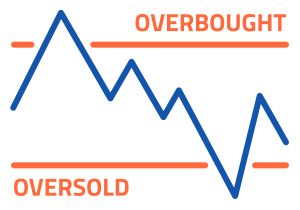 As stated above, Bollinger Bands comprise three main bands or lines. The outer boundaries indicate levels where the price is considered relatively high or low compared with its recent moving average, while the central one represents the price’s simple moving average. The distance between the boundaries and the simple moving average is calculated using standard deviation, based on the same data used for the middle band.
Example

In the screenshot below, you can see the price touching the upper Bollinger Band.
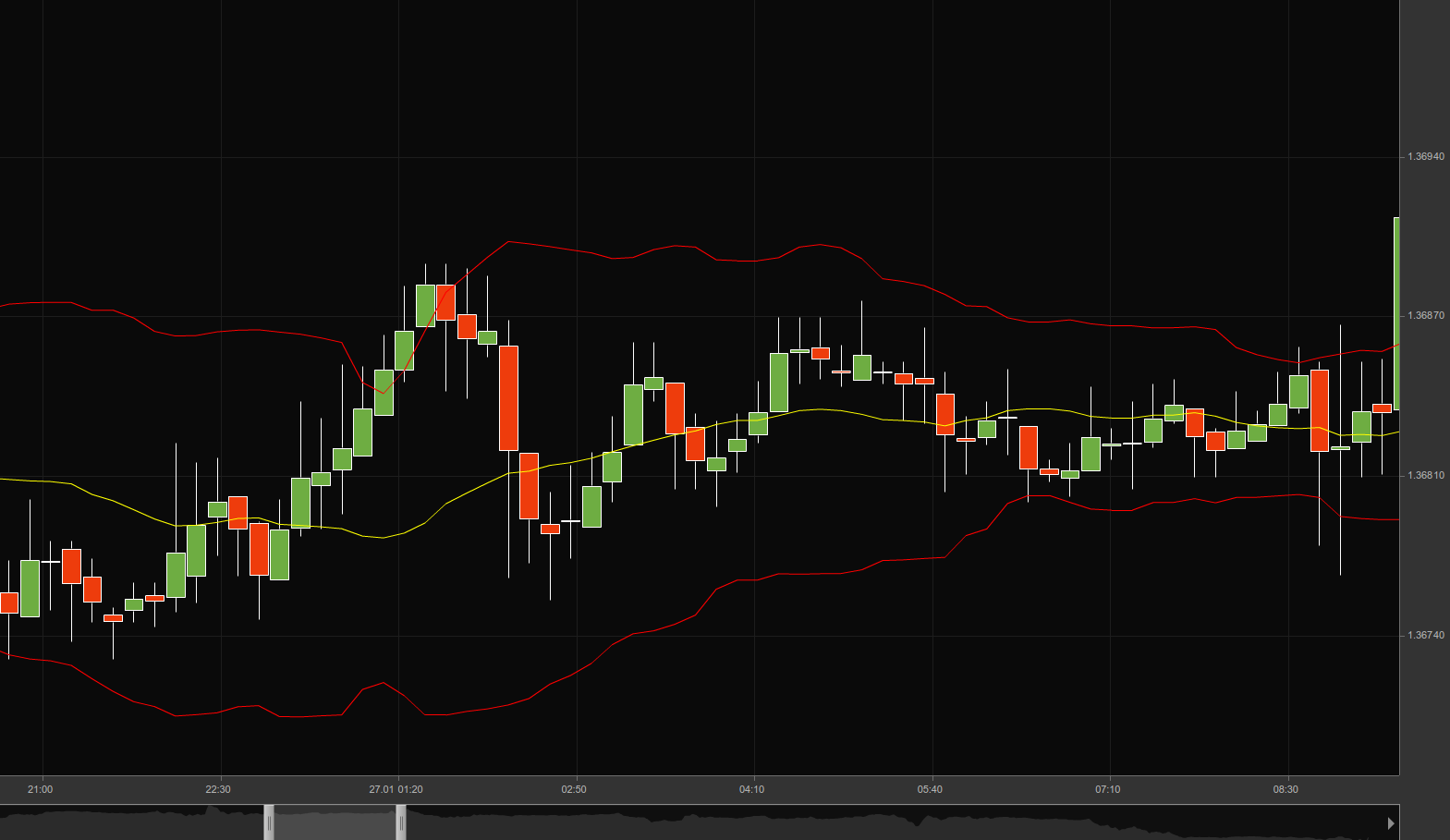
As the price reaches the upper band, the asset is considered overbought since it is trading at a relatively high price. This condition generates a bearish signal amid expectations that the price will retreat towards the moving average; therefore, you should, in general, exit all long positions and go short. The following screenshot illustrates the opposite situation.
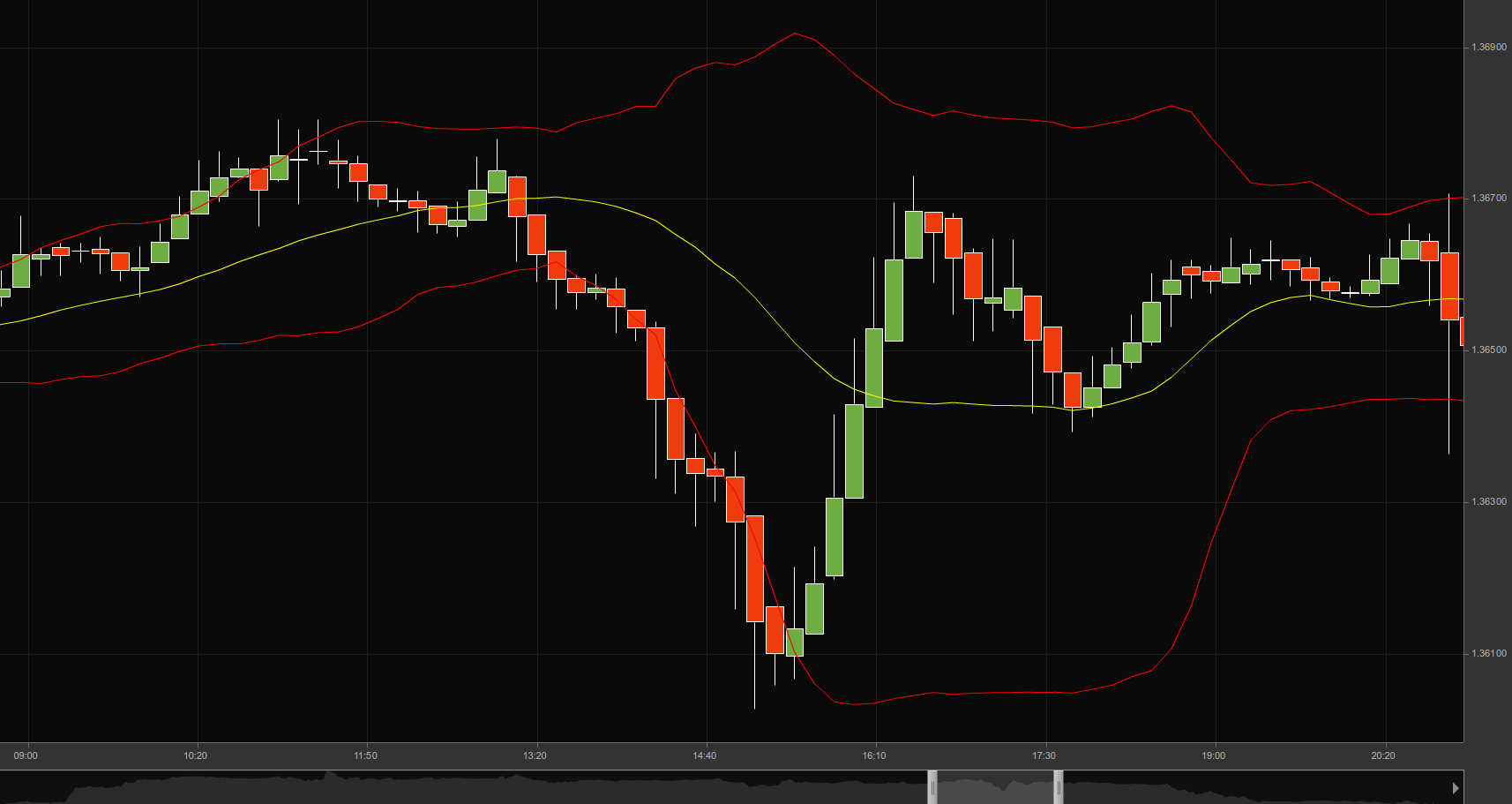
Conversely, when the price approaches the lower band, the asset is considered oversold since it is trading at a relatively low price compared with its recent average. This, logically, is deemed a bullish signal because the price will likely rebound and retrace to the moving average. The most logical action here is to close your short positions and place long orders.
However, as a trader, you should be cautious when taking positions based solely on overbought and oversold signals. Just because the price has reached the upper or lower band doesn’t ensure a reversal. Further confirmation is required, using patterns or another indicator, to show that the price is reversing before you place an order.
Bollinger Squeeze
 The name of this situation pretty much speaks for itself. When the bands narrow the distance between them, it usually means that a breakout is imminent. If the candles start to break out above the top band, then the price movement will likely continue to edge higher. Conversely, if the candles break out below the lower band, then the price is generally expected to continue moving down.
In the picture below you can easily see the squeeze of the bands and the subsequent breakout.
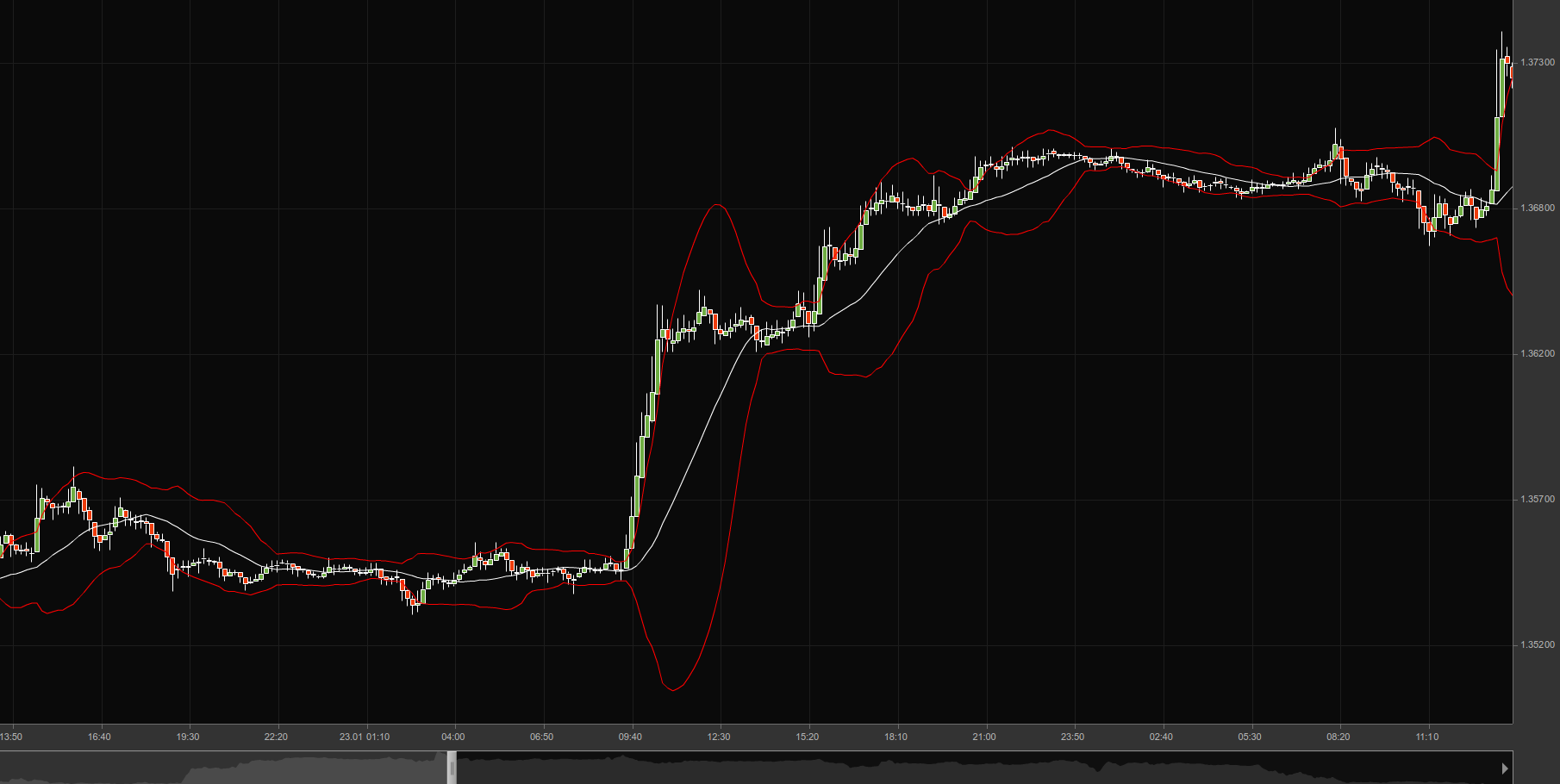
This setup allows you to catch a move as early as possible, but it doesn’t occur every day. However, on small time frames such as 10 or 15 minutes you can probably see a Bollinger Squeeze several times per week.
Changing the settings
 As with many other indicators, Bollinger Bands’ settings can also be fine-tuned so that each trader can adjust the indicator to best suit their unique trading system.
Using a smaller number of periods for the middle band makes it more reactive and results in choppier upper and lower bands. The price breaks the bands more often, giving more trading opportunities. However, it also generates more false trading signals.
Setting a higher number of periods will make it less reactive and result in a smoother line. The price breaks the upper and lower bands less often, giving fewer but more reliable signals.
The Middle Band
 The middle band is usually set as a 20-period simple moving average by default in many charting applications. Every trading instrument is different and some will respect the 20-period SMA, while some will not. In some cases you will need to modify the simple moving average to a look-back period that the instrument respects. This is a form of curve-fitting, but we want to put the odds in our favour.
Value
 Bollinger Bands derive their value from their tendency to contract and expand. Market trends usually form after periods of low volatility, plotted on the chart as sideways movement, which allows us to identify with relative accuracy when a trend is about to emerge. During range-bound market movement, the Bollinger Bands will squeeze in because each period’s closing price is close to the average.
You can often observe that the market is waiting for the release of key economic indicators or central bank announcements before trending in any direction. Prices can begin moving into a sustained trend upon the release of the economic figures.
Conversely, during a trend Bollinger Bands tend to expand – the opposite of the Bollinger Squeeze, which happens in range-bound conditions. In the beginning of a new trend, the two Bollinger Bands will move in opposite directions, thus confirming the formation of a trend. However, as the price continues to trend, any decrease in momentum will cause the boundary moving away from the trend to turn back towards it. This is the first clue of a deceleration in momentum, suggesting you should scale out of the trade or close all of your positions.
The next indication that the trend is coming to an end is when both Bollinger Bands begin to contract, alerting you that the market is entering a range – an advisable point at which to exit the entire trade.
A challenge you will encounter when using Bollinger Bands is that you must wait for the period to close (the candlestick/bar to be completely plotted) before you can determine their final values. This means that the value of the Bollinger Bands fluctuates with the live bar.