
The process of becoming an accomplished Forex trader
This lesson will cover the following
- How to set out a plan for your trading goals
- How to develop your psychological strategy
- What are the steps to becoming an accomplished trader
Every trader pursues a long-term goal – to make a substantial amount of money in the financial markets. Many traders are willing to trade all day and quit their full-time jobs. Well, these are quite good objectives to have as a trader, but not many traders actually achieve them.
One of the main reasons why most people fail to achieve their long-term goals is that they lack a plan of action that outlines the entire process until the goal is achieved. We shall take the time to discuss how a trader can reach his or her long-term goals in Forex.
Decide the purpose of your trading
 It is up to each person to decide whether he or she wishes to be a full-time trader working from home, or to remain mobile – trading and living anywhere in the world. Does he or she intend simply to supplement monthly income from a regular job? Is he or she willing to manage other people’s money while trading for a particular company?
Every person first needs to clarify what his or her ultimate trading goal is. He or she may write it down in a trading plan or on a whiteboard. Either way, a trader must ensure that the ultimate objective is clearly defined.

- Trade Forex
- Trade Crypto
- Trade Stocks
- Regulation: NFA
- Leverage: Day Margin
- Min Deposit: $100
Break up goals into short-term checkpoints
 A great deal of effort can be saved if a trader breaks down a long-term goal into shorter-term objectives that can be accomplished within, say, one month. The final trading goal can thus be envisaged as a series of smaller goals to be achieved each month. Whenever a trader meets these smaller goals, they should be marked as “accomplished”. Doing so bolsters natural optimism and builds confidence that the ultimate goal is drawing nearer.
Many traders focus so intently on their long-term objective – be it becoming a professional trader or growing their trading account as quickly as possible – that they make little or no effort to determine how to achieve it in a realistic manner. At first, most traders experience a surge of anxiety that causes them to lose patience and make poor market decisions as they become obsessed with achieving their goals.
Over time, all the short-term goals will accumulate and methodically build into the long-term objective. It is therefore best to work backwards: begin with the final trading objective and then divide it into realistic smaller goals that can be achieved within a relatively short period. With each realistic short-term goal achieved, the trader’s confidence will likely improve, and this will be reflected in overall gains. Step by step, the trader moves closer to achieving the ultimate trading goal, whatever it may be.
Example
 Let us consider an example of a short-term trading goal. It rests on a few simple rules. First, strive to make a fixed number of trades – say, ten per month – and no more. This smaller goal helps prevent over-trading, which is often a major cause of long-term losses.
Second, risk the same amount of money on every trade, and never more than you are comfortable losing.
Third, look for a risk-reward ratio of at least 1:2 on every trade.
Fourth, keep a record of every trade in a trading journal.
Fifth, take only those price-action trading set-ups that comply with the guidelines in your trading plan.
Trading as a psychological process
 There are five basic stages through which every trader should pass in order to develop knowledge and gain a feel for market psychology. These five stages can be presented as follows: unconscious incompetence, conscious incompetence, a moment of awakening, conscious competence and unconscious competence.
Unconscious incompetence
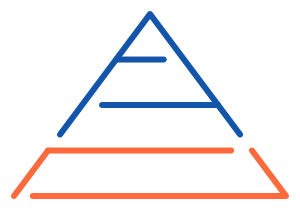 It is the initial stage that every trader goes through, as he or she is not yet aware of a lack of knowledge. At this stage, beginners usually take introductory steps such as downloading the chosen platform, opening an account with a broker and making their first entries into the market.
It is worth mentioning that beginners are heavily influenced by emotion. They are usually quite tempted by the prospect of making a substantial profit within a short period of time.
Conscious incompetence
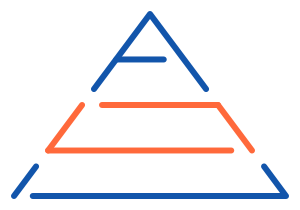 At this stage, beginners gradually come to understand that they need to amass knowledge. They appear to be guided by the thought that the more they know about trading, the more successful they will be in the market. Beginner traders usually attempt to put into practice every piece of information or advice they obtain – books, forums, studies or media articles. They may seek the assistance of “expensive experts” and even come to believe so-called “get-rich-fast” strategies. Therefore, this stage can be considered the most perilous for every beginner.
The moment of awakening
 At this stage, beginner traders realise that effective trading has much to do with trader psychology and the individual’s approach to the global markets.
On a basic level, traders begin to understand that they will never be able to predict with certainty which direction the market will take. They realise that, in order to grow their account, they must endure a series of winning and losing trades. It takes practice and strict market discipline for a trader to follow an established strategy, cut losses and allow gains room to develop.
Conscious competence
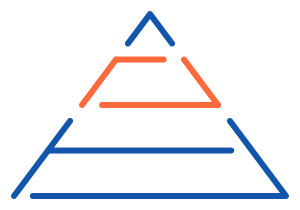 By this stage, a trader has progressed to the point where he or she stops trying to cherry-pick only winning trades. Whenever the system signals an entry opportunity, the trader acts immediately, regardless of personal feelings.
During conscious competence, traders are still subject to emotion; therefore, greater effort is required to maintain discipline. On the bright side, traders now handle losing trades more easily because they finally understand that losses are simply part of the process of making money.
Moreover, risk management becomes a cornerstone of trading. What matters now is to grow the account gradually over time and, above all, not to attempt to become rich overnight.
Unconscious competence
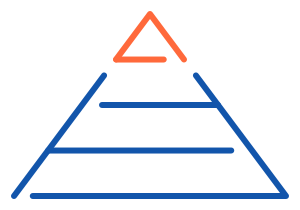 A trader is expected to reach this stage after opening and closing a large number of positions and, more importantly, acquiring valuable skills through continuous practice. The trader is already able to make trading decisions almost automatically. Following market discipline now requires little conscious effort. Discipline is now his or her second nature.