
Trading channels using Andrews’ Pitchfork
You will learn about the following concepts
- What is Andrews’ Pitchfork
- How is it drawn
- Trading within the pitchfork formation
- Trading outside the lines
Andrews’ Pitchfork is a widely used method for defining robust support and resistance lines in a trending market, together with a median line that itself serves as a support/resistance area. Its inventor, Dr Alan Andrews, believed that price gravitates around the median line 80% of the time, while isolated shifts in market sentiment account for the remaining 20%.
Our strategy will not be based solely on the pitchfork; rather, we will use it in conjunction with an oscillator to filter out the best possible trades. We will discuss those details later. There are two ways to trade the pitchfork – you can either enter positions while price movement is contained within the lines, or initiate trades when breakouts occur outside the pitchfork formation. First, let us say a few words about how Andrews’ Pitchfork is plotted.
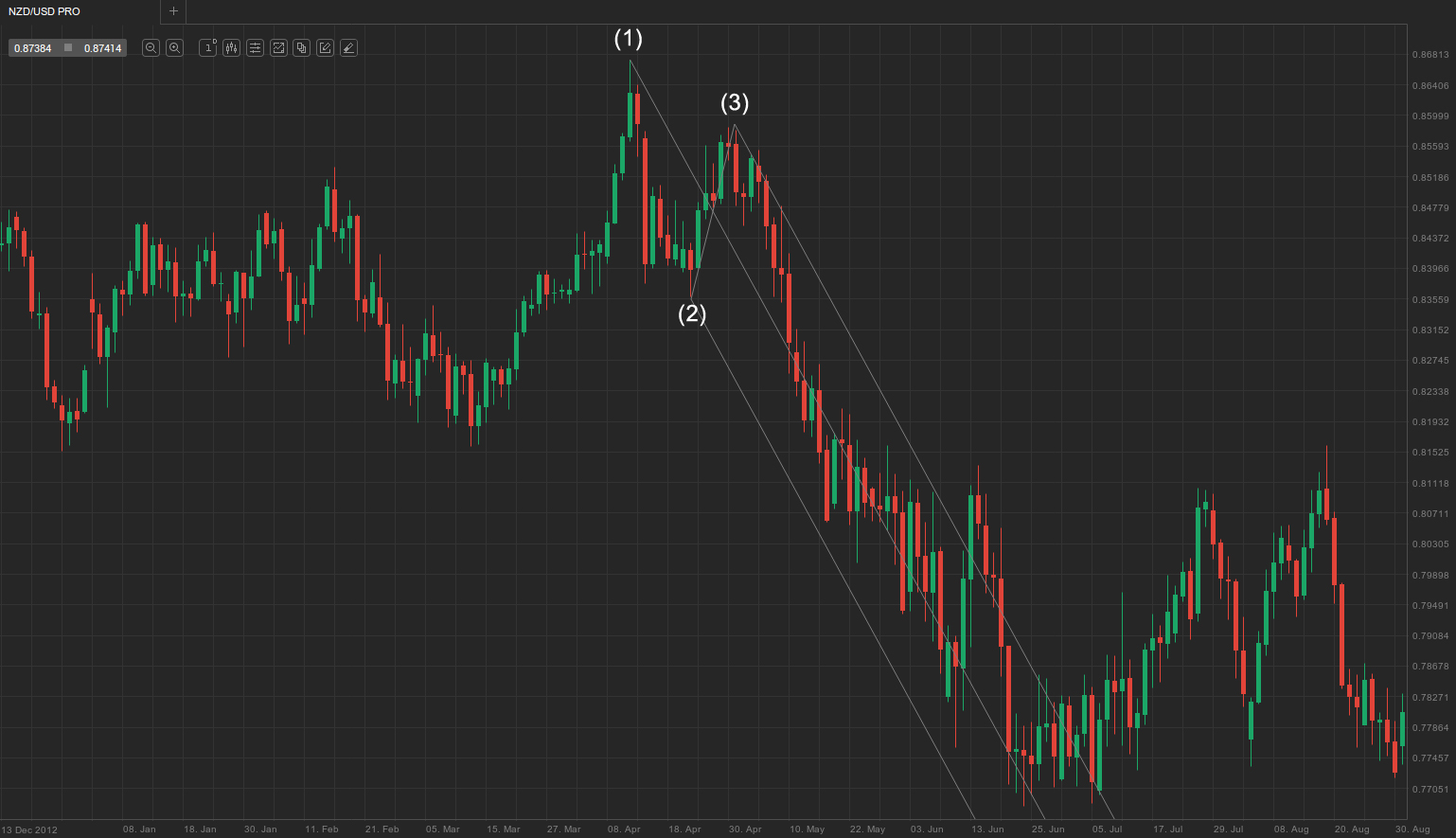
Applying the pitchfork begins with determining a pivot point, which is simply a high or low that has formed on the chart. Once that point has been selected, we need two extensions on its right-hand side. The second point is the result of a move opposite to the first one, which ended with the pivot point, while the third one will be in the direction of the pivot point. Thus, we can have a trough, followed by a peak and a trough (forming a bullish pitchfork), or a peak, followed by a trough and a peak, which forms a bearish pitchfork. Here is an example of a bullish Andrews’ Pitchfork.

- Trade Forex
- Trade Crypto
- Trade Stocks
- Regulation: NFA
- Leverage: Day Margin
- Min Deposit: $100
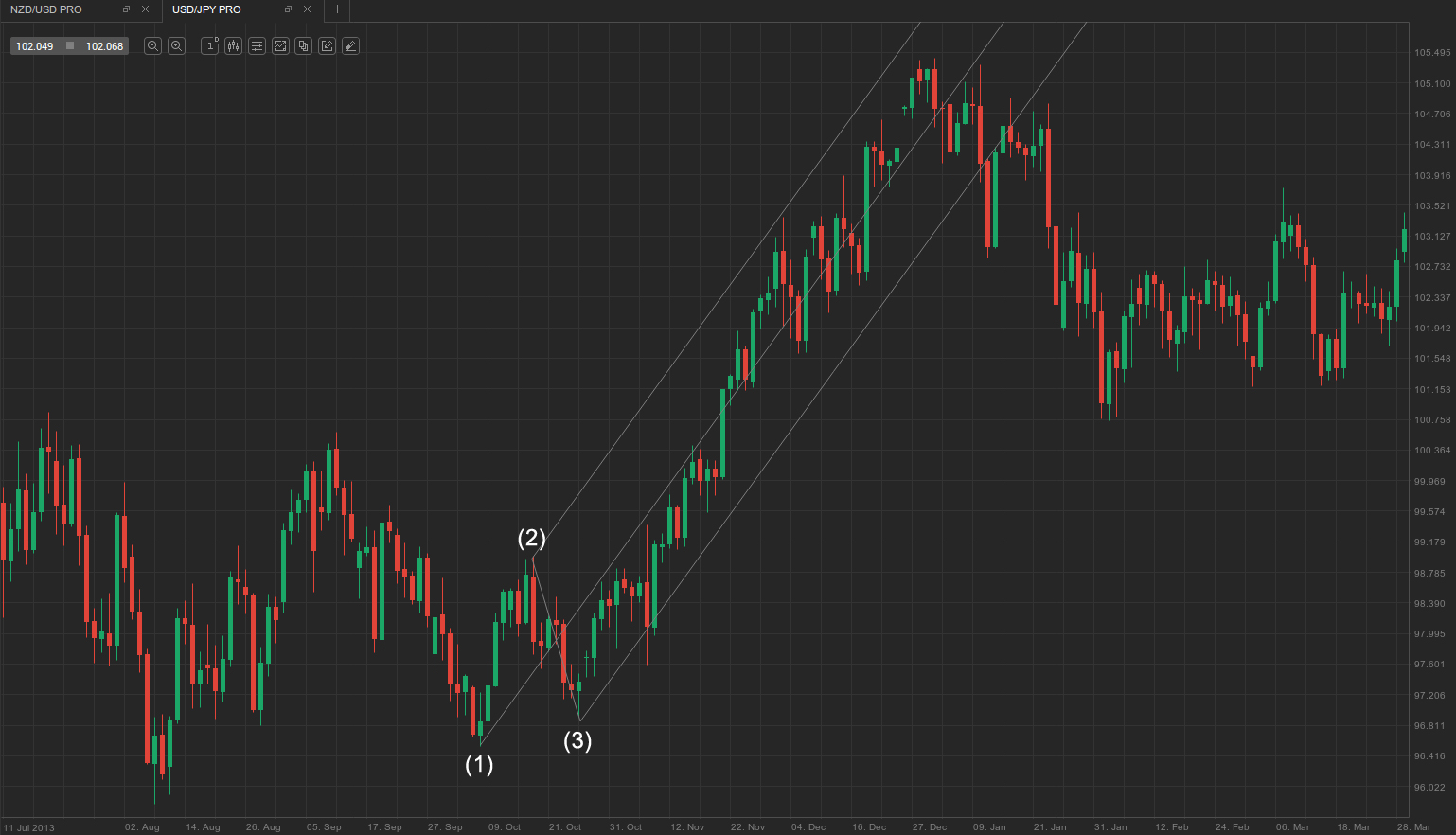
Here is what a bearish pitchfork looks like.
We said that there are two ways to trade Andrews’ Pitchfork – you can enter positions while the price action is contained within the formation and bounces between the support and resistance lines, or you can focus on breakouts, thus trading outside the lines. We will discuss each separately.
Trading within the pitchfork’s lines
 This approach takes advantage of the in-channel price fluctuations. There are several steps that need to be followed. Let’s assume that the market is moving down and we will be preparing for a short entry (entering in the direction of the general trend is preferred and safer).
First, we need the price to have broken through the median line and to be edging higher towards the upper channel line.
As soon as it reaches and tests the resistance level, we need to identify a bearish reversal bar pattern – bearish engulfing, evening star, etc. The formation of such a pattern will reflect waning strength in the up-move, increasing the odds of a successful reversal.
Once the reversal pattern is evident, we need to confirm that the price is declining via an indicator – you can use the stochastic oscillator, MACD, etc. If, for example, the reversal bar pattern is confirmed by a bearish cross of the stochastic’s fast and slow lines (the fast line crosses the slow line from above and edges lower), then we have confirmation.
As soon as the reversal is confirmed, we can proceed with the trade itself. We enter short several pips below the low of the reversal pattern’s last bar (thus it is our signal bar, while the next one is our entry bar). Our initial stop-loss should be placed around 40-50 pips above the entry point.
Our profit target should be at least 1:2 the amount risked, ideally even more. A more conservative money-management strategy would be to exit half of our position once a 1:1 risk-reward ratio is achieved (if the price has fallen 50 pips), at which point we would also trail the stop to breakeven for the remainder of our position. As soon as double the amount risked is earned (the price has declined by 100 pips), you can choose either to fully exit the market, or to scale out once again and leave a small portion on the market, trailing your stop even further. However, these are situational tips and may be irrelevant to certain scenarios. Check out the following example.
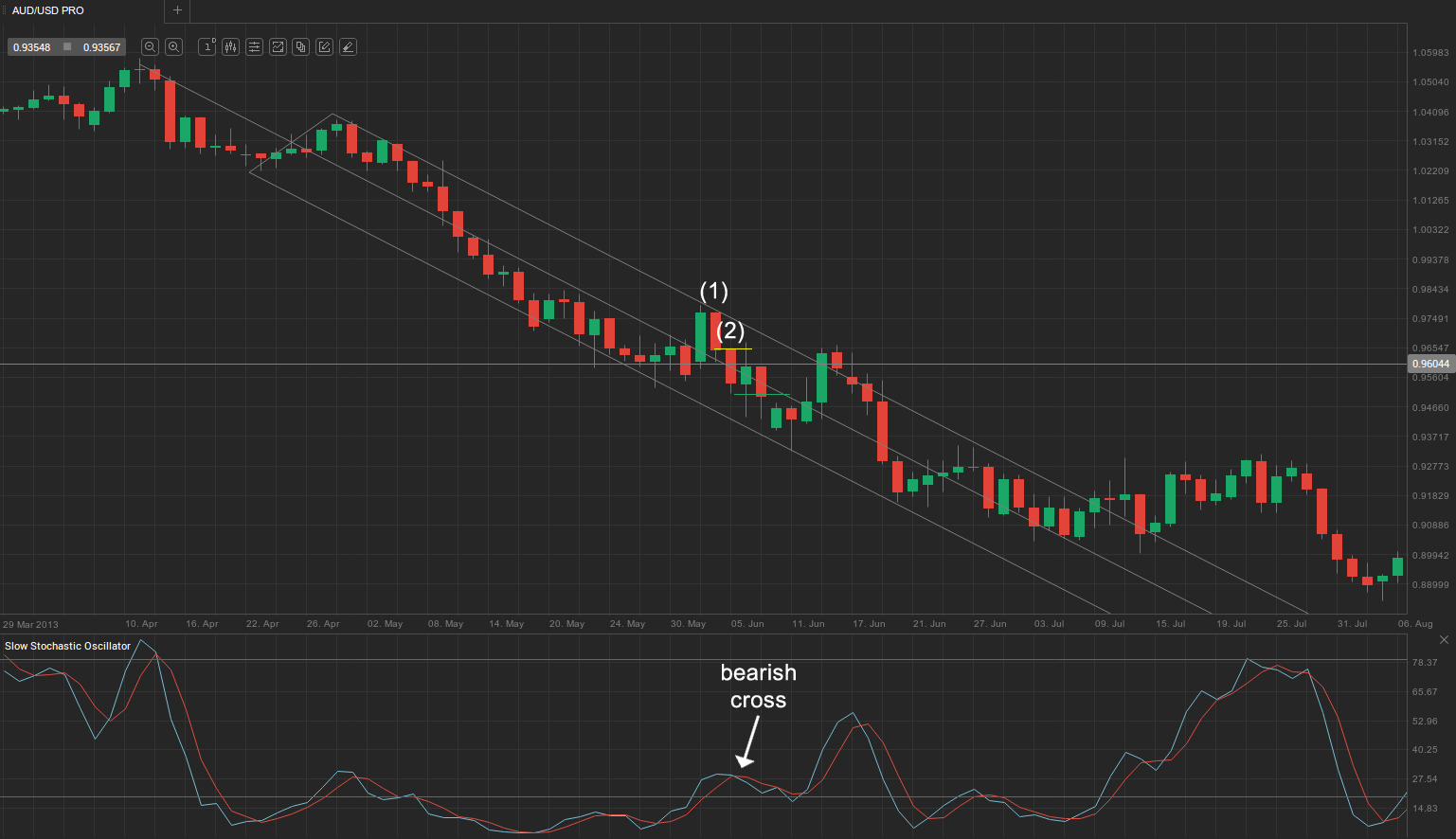
You can see that the market has entered a bearish pitchfork formation and it presents several trade opportunities once it has been identified. We decide to enter short after bar (1), since all the required conditions were met – the market had previously rebounded from the lower channel line, penetrated through the median line and continued to edge higher, touching the upper pitchfork line. Bar (1) and the previous bull trend bar formed a two-bar reversal (bar 1 reversed the previous bar and was more than 75% the size of it). Confirmation came as the stochastic oscillator performed a bearish cross (the fast line crossed below the slow line).
Thus, as bar (1) closed and the two-bar reversal was fully formed, it became our signal bar. We then wait for bar (2) to fall below bar 1’s low and enter several pips beneath it. Bar 1’s low was at 0.9610, so we enter short at 0.9604. Our stop-loss is placed 50 pips above the entry point, at 0.9654, as marked by the yellow horizontal line. Our profit target should be at least double the amount risked, or 100 pips, so we aim to reach at least 0.9504 (the green horizontal line). Upon reaching it we might choose to scale out half of our position and trail our stop to breakeven in an attempt to reach a 1:3 risk-reward ratio with the remainder of our position.
Trading outside the lines
Trading outside the pitchfork formation occurs less frequently and is trickier, but it can also yield more substantial profits. The logic is that once the price has broken out of the pitchfork, it will most likely be pulled back to the median line. However, the possibility also exists that a new trend has formed, which calls for a set of rules we must follow to reduce the chance of incurring heavy losses.
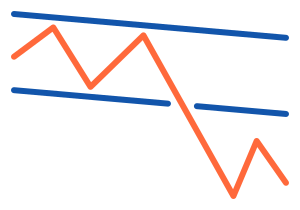 Let us assume that we intend to join the market with bearish momentum.
First, we need to identify a situation where the price action has been above the upper pitchfork line (resistance line) for some time.
Next, we want to see that the price has reversed, penetrated the upper line, re-entered the channel and is heading down towards the middle line.
Third, we need to have identified a significant support/resistance line, which falls between the upper line and the median line. This support/resistance line needs to have been broken by the price action, because that will confirm that significant bearish momentum has built up, enough to keep driving the price down towards the median line and our profit target. Such significant support/resistance lines can be recent swing highs or lows that have been retested multiple times, round numbers, etc.
Once the support/resistance line has been broken, we need confirmation from an oscillator – the stochastic oscillator can do the trick. Once confirmed, we can enter the market with greater confidence. We place a sell order 30 pips below the support/resistance line with a stop several pips above the previous session’s high (as usual, we leave a distance of 5-10 pips between the stop and the swing low/high so that random noise doesn’t trigger it).
The profit target should be double the amount risked. However, similar to the previous type of Andrews’ Pitchfork trading, we can adopt a more conservative money-management style. Upon achieving a 1:1 risk-reward ratio, you can exit half of the position, move the stop for the remainder of the position to breakeven, and carry out the last part of the trade until you achieve profit that is double the amount risked. See the following example.
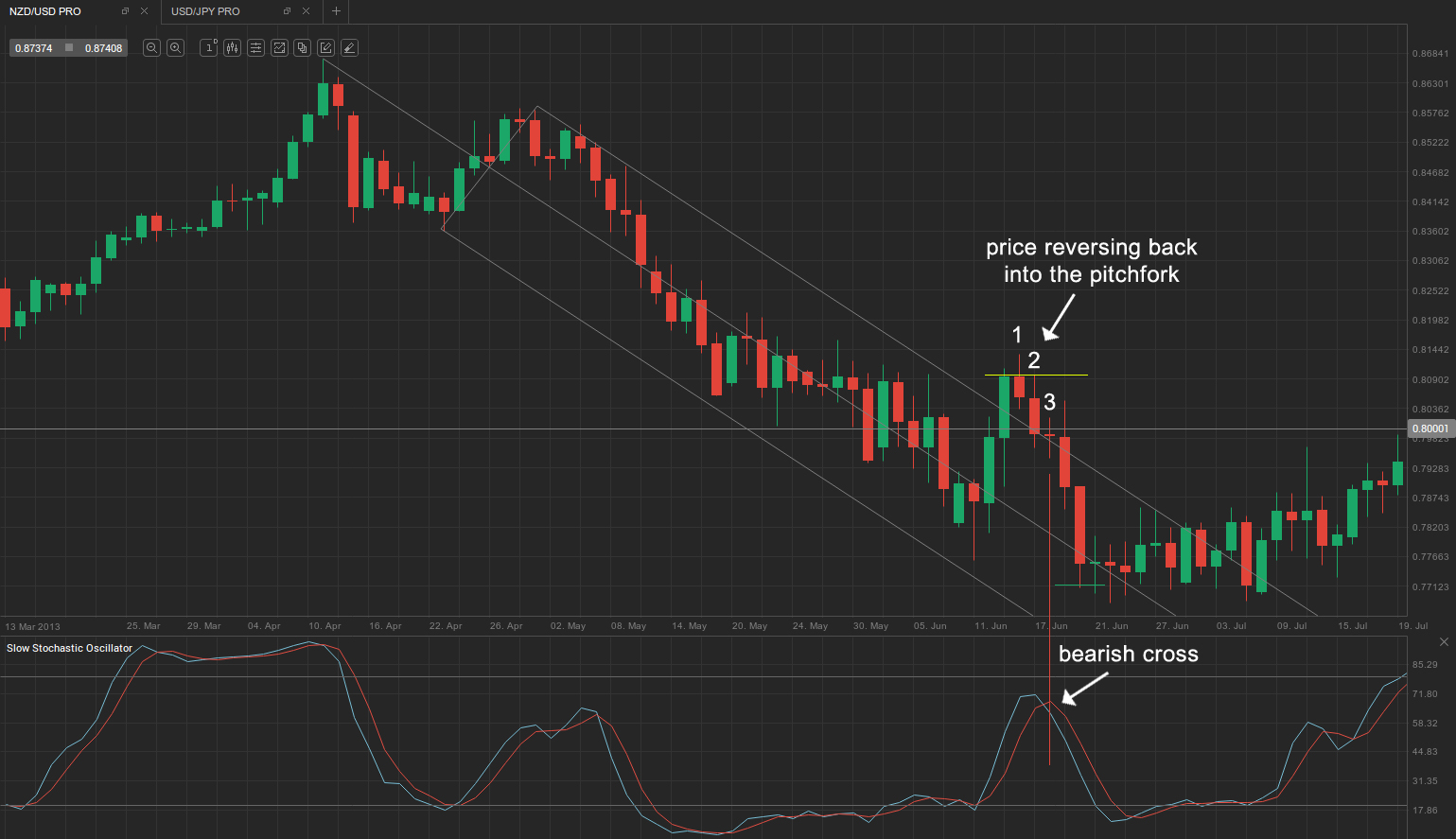
As you can see in the example above, the market reversed an outside move at bar (1). Another bear trend bar followed at bar (2), which led the price action back into the pitchfork formation.
On its way down, the market also broke a major support line at 0.8000 US dollars. The only thing left for us was to wait for confirmation from our indicator of choice – the stochastic oscillator. At bar (3), the fast stochastic line crossed the slow line from above, generating a bearish signal, so we enter short 30 pips below the major support line, at 0.7970. Our stop-loss is at the high of the previous session, thus the high of bar (2) at 0.8098 (visualised by the yellow horizontal line). Our capital exposure is therefore 128 pips. Our profit target will be double that amount, or 256 pips, and it will be reached at 0.7714 (marked by the green horizontal line).