
Trading stochastic and RSI divergences
This lesson will cover the following
- Slow Stochastic Oscillator
- Relative Strength Index
- Divergences between the two and the price
In this article, we will discuss two relatively similar trading strategies: one based on divergences with the slow stochastic, and another that generates trading signals from RSI divergences.
The first strategy combines the use of the Average Directional Movement Index, a 30-minute stochastic and a five-minute stochastic. It can be applied to trading both index futures and Forex.
First, determine the direction of the trend and its strength. Check the direction of the short-term trend by using the slow stochastic indicator on the 30-minute time frame. Its strength is determined via the Average Directional Movement Index, with either the default look-back period or a modified one. If the ADX indicates a strong trend, you should enter only with-trend positions.
Once you have gathered the required information, drop down to the 5-minute chart and apply a 21-period slow stochastic. Here we will look for entry signals generated by a divergence between the slow stochastic and the price. The first point of the divergence must be in the overbought or oversold area (80 and 20 respectively, although these levels can be adjusted according to market volatility – if the market is less volatile you can switch to 70-30 or 75-25). The second point of the divergence does not need to be inside an extreme area. Occasionally, you may encounter three-point divergences; these are rarer but produce more reliable signals. When the divergence occurs, enter only if it generates a signal in the direction of the higher-time-frame trend, as confirmed by the ADX.

- Trade Forex
- Trade Crypto
- Trade Stocks
- Regulation: NFA
- Leverage: Day Margin
- Min Deposit: $100
The stop-loss order should be placed several pips below the most recent swing low (5-10 pips) for a long position, or above the most recent swing high for a short position. The stop must then be trailed as the market moves in your favour – again to 5-10 pips below the next swing high or low – which should also be accompanied by a new swing high or low in the stochastic.
You should exit the position when your trailing stop is triggered or, if you are trading stocks, at the market’s close. See the example below.
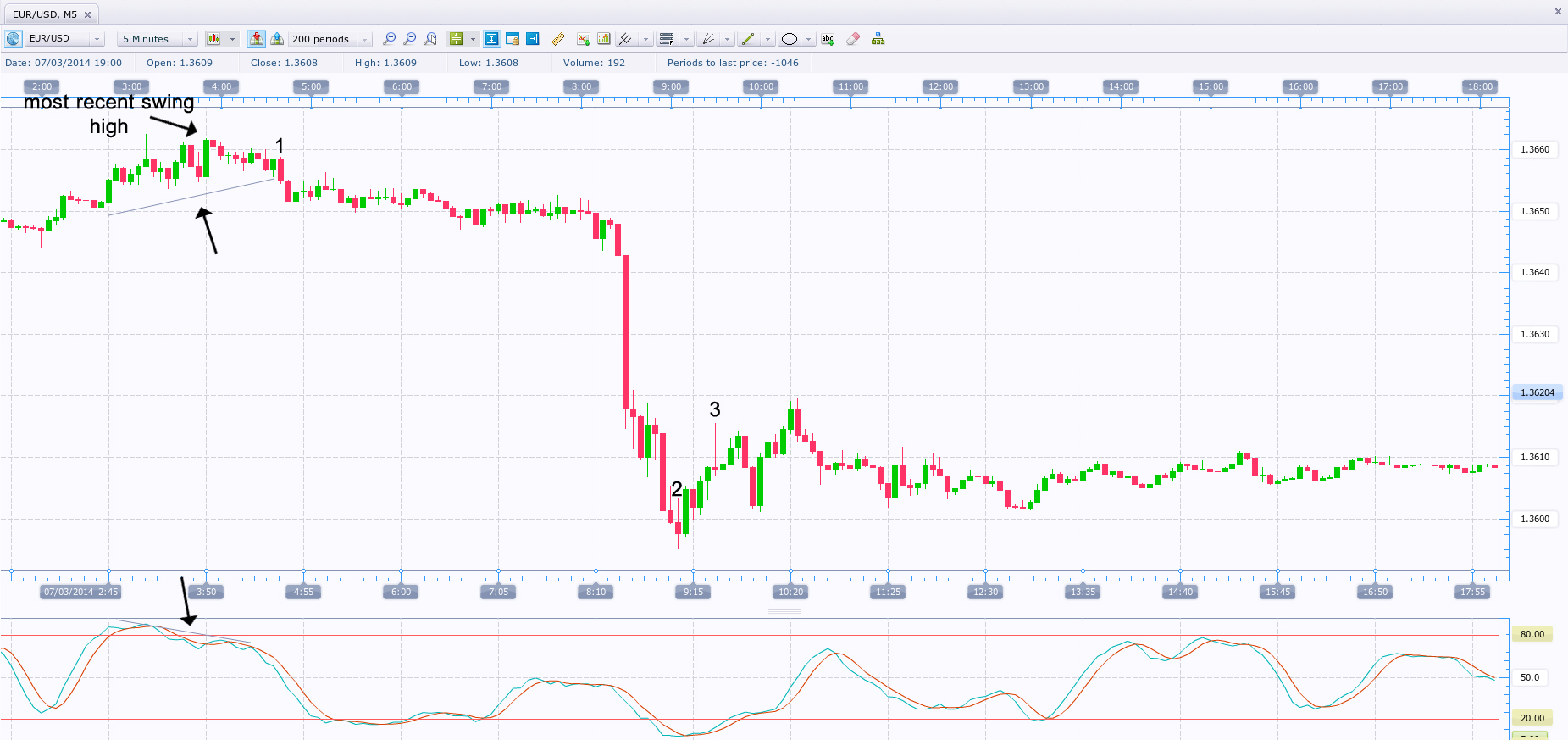
You can see that there was a divergence between the slow stochastic and the price, with its first point in the overbought area. We had previously checked on the 30-minute time frame that the market was in a bear trend, with the ADX recording a value a little over 25, suggesting a sufficiently strong down-trend is in motion. Thus, we will enter only short positions.
We go short below the low of bar 1 at 1.3654, while our stop-loss is placed 10 pips above the most recent swing high, at 1.3663. The market then entered a tight trading range, but there were no reversal moves that could trigger our stop.
As the market sold off later and fell to a new swing low, which was accompanied by the stochastic falling to a new low as well, we began to trail our stop to 10 pips above the high of each successive bar that had dropped to a new low. Following that principle, our final stop would be trailed to 10 pips above the high of bar 2, which would be triggered at 1.3613 US dollars on bar 3.
RSI divergence
 The following trading strategy is based on RSI divergences and is used to spot potential highs and lows in stock-index futures. Although the signals it generates are not very frequent, they compensate by being more accurate than many other strategies. Like the stochastic strategy discussed above, you must aim for entries in the direction of the higher-time-frame trend. This can again be confirmed by using the Average Directional Movement Index.
For this strategy, we will use a 30-minute time frame with a 6-period Relative Strength Index. As with the previous system, we will be looking for divergences between the RSI and the price. The first peak or trough of the divergence should be in one of the extreme areas (overbought above 70-80 and oversold below 30-20), while the second does not have to be. You need to enter as soon as the divergence is confirmed by the close of a bar in the signal’s direction.
The stop-loss should be placed according to the same principle as in the previous strategy, and then trailed below or above the next swing low or high respectively. Profit should be taken when the trailing stop is hit or, if you are trading stocks, at the close of the market (also, do not enter new trades within the stock market’s final trading hour).