
Using moving averages in conjunction with the ATR
You will learn about the following concepts
- Indicators used with this strategy
- Signals to look for
- Entry point
Trends are your best friends. We have said this many times and will continue to emphasise it because it is simply true. This article explains another trend-following trading strategy that uses a 10-period Exponential Moving Average as the key support and resistance level on which to base your entry points, together with slower EMAs for trend identification and the Average True Range for stop placement and adjustment.
We have spoken a lot about trends, trend lines, trend trading, etc., so we shall not spend much time here. If you want to read more, you can browse through Trading Pedia’s “Forex Trading Academy“, “Price Action Trading Academy” and “Day Trading Academy“.
The strategy we are about to discuss is based on the widely accepted idea that moving averages act as extremely strong support and resistance levels, and because they are closely monitored and acted upon by institutional traders, as well as individual ones, pullbacks to the MAs provide reliable with-trend entry points. It works best on a higher time frame (hourly charts or larger). In our case, we will use a 10-period Exponential Moving Average in conjunction with an hourly time frame. Keep in mind that institutional investors are most active on higher time frames, such as the daily chart, so the best results are most likely achieved there.

- Trade Forex
- Trade Crypto
- Trade Stocks
- Regulation: NFA
- Leverage: Day Margin
- Min Deposit: $100
As you know, being trend-following indicators, moving averages require a trending market to be effective. In addition to using indicators such as the Average Directional Movement Index (ADX) and other similar tools, we can rely on the relative positions of different moving averages to determine trend direction.
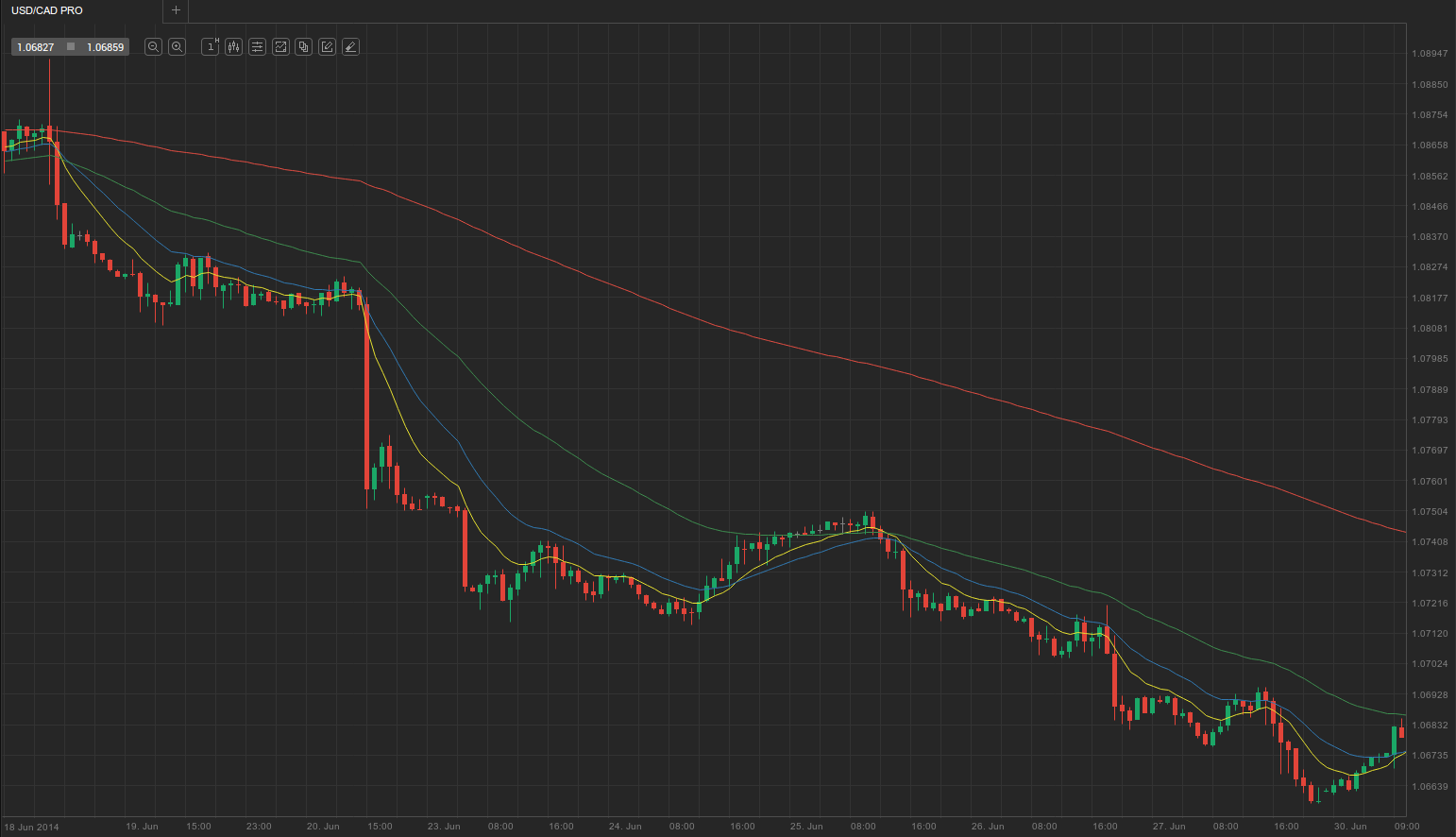
As you can see in the example above, the USD/CAD pair was in a very strong downtrend for the visualised period (the price ran diagonally from the upper left-hand corner to the lower right-hand corner). Not only that, but the EMAs are in the right order, indicating a strong downward movement. As you can see, the 10-period EMA (yellow) was the one closest to the price, acting as a resistance zone, except for a short pullback period between 24 and 25 June. The 20-period EMA (blue) was above it, and the 89-period and 200-period EMAs (green and red respectively) were also properly aligned above the faster EMAs, confirming the strong bearish trend.
However, the trading strategy we are about to use works only with the strongest trends; therefore, the proper alignment of multiple EMAs is not enough as the sole condition that needs to be met. In order to further filter weak or medium-strength trends from the most decisive ones, we will incorporate one last requirement – the 10-period EMA must have acted as an obvious support/resistance area for at least 10 bars.
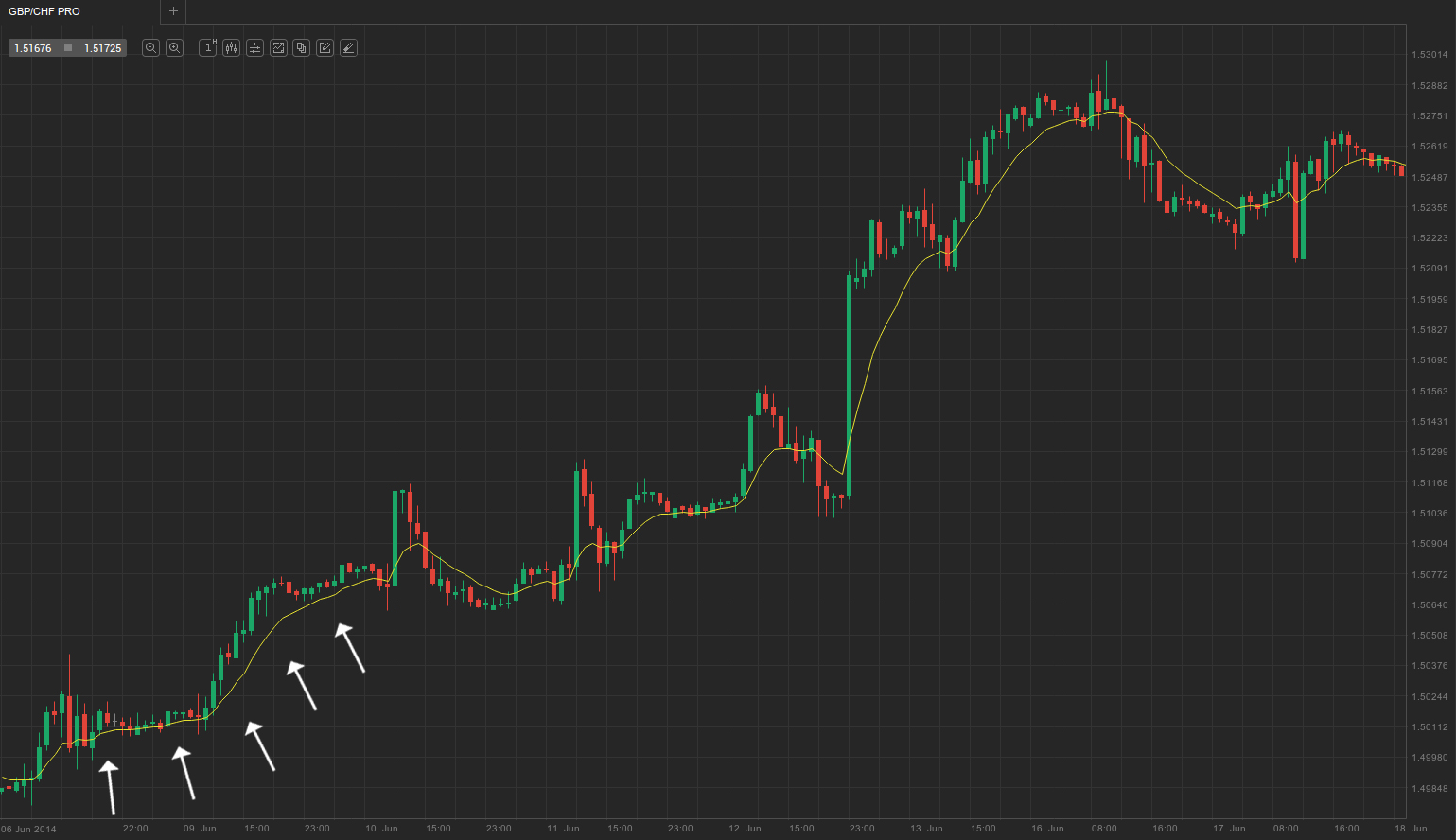
In the example above you can see how the market, which had shortly before been in a trading range (not shown), accelerated into a bullish trend, and the 10-period EMA acted as a strong support zone for almost the next 50 bars. This is exactly the type of trend we are looking for. If the price keeps bouncing off the EMA and continues to advance, it shows that institutional investors are buying the dips and reflects their bullish sentiment (you definitely want to be trading in the same direction as institutional market players). Very often such decisive trends are fuelled either by major economic releases, such as US non-farm payrolls, GDP growth, etc., or by interest-rate decisions, especially when they create opportunities for carry trades. If you want to learn more about carry trades, read our article “Using Carry Trades to Maximise Profit“.