
Using moving averages in conjunction with the ATR
You will learn about the following concepts
- Measuring the stop
- Trade management
Measuring the stop
 Our strategy will use a stop-loss determined on the basis of volatility. There are different volatility indicators, but we will use one of the most popular – the Average True Range (ATR) – with a default lookback of 14 periods. It shows what the average daily range over the last 14 periods was; for example, an ATR value of 0.00125 means that the average daily range over the past 14 periods was 125 pips. If you want to learn more about this indicator, check out our article ‘Average True Range’.
However, because currency pairs have different volatility, we can’t use the same protective stop for each one. For more volatile crosses, with an ATR of 100 for example, a stop-loss order placed 40 pips away from the entry might be fine, but for a currency pair with an ATR of 50, that would be too wide.
Therefore, we will use our knowledge of ATR and devise a better stop-loss system. Our protective stop will be placed at a distance of 50% of the ATR from the EMA, on the opposite side. The idea is that because the EMA is a support/resistance area, you would wait for it first to play its role as such, and if it fails, you will then rely on your stop-loss to cut your losses. Therefore, in a bull trend our stop-loss will be placed 50% of the ATR below the EMA, while in a bear trend it will be placed above the EMA.
Because we know that the entry point will be at the EMA, as soon as we have our stop-loss figured out we can proceed with the trade. If all the previously laid conditions are met (a strong trend confirmed by the proper positioning of the EMAs and the 10-period EMA acting as support/resistance for at least 10 bars), we enter as soon as the price pulls back to the EMA and touches it, without waiting for the bar to close.

- Trade Forex
- Trade Crypto
- Trade Stocks
- Regulation: NFA
- Leverage: Day Margin
- Min Deposit: $100
Next, we calculate 50% of the ATR and project it beyond the opposite side of the EMA, which is where our stop-loss will be. This might seem too wide in some situations, but keep in mind that this strategy aims to exploit strong trends which, on our larger time frames, might extend for days and weeks; thus, the profit potential is huge. If the trade moves in our favoured direction, i.e., the market rises in consonance with our long position, we will trail our stop upwards. As soon as a bar closes, we will calculate the ATR and the 10-period EMA’s latest value and move our stop accordingly.
If the trade goes against our expectations, we should never move our stop lower (or higher for a short position), so that our capital exposure is fixed to the predetermined amount. If all goes according to plan and we continuously trail the stop higher as the EMA rises, at a certain point it will surpass the break-even point, thus ensuring that our trade will be profitable.
Because our position might remain open for a protracted period of time, especially on a daily time frame, the profit potential is huge – hundreds of pips (the bull trend in the second example had a range of 300 pips). At the same time, our maximum capital exposure is the distance to the initial stop-loss, which makes up a risk-reward ratio of 1:3 and possibly much more. Another advantage of this trading system is the fact that it requires very little maintenance. Once you have entered the trade and set your stop-loss, all you need to do is trail your stop until it is hit. Because you will be adjusting it according to changes in the EMA and ATR, and because they change when a bar closes, you will need to adjust your stop-loss once every hour on an hourly chart, or once per day on a daily chart – it’s all up to you. If you are using the daily chart, the trade will not be time-consuming at all, yet it can still yield plenty of pips.
Example
Let us look at an example and follow the whole trend from beginning to end. We will revisit the example provided in the previous article.
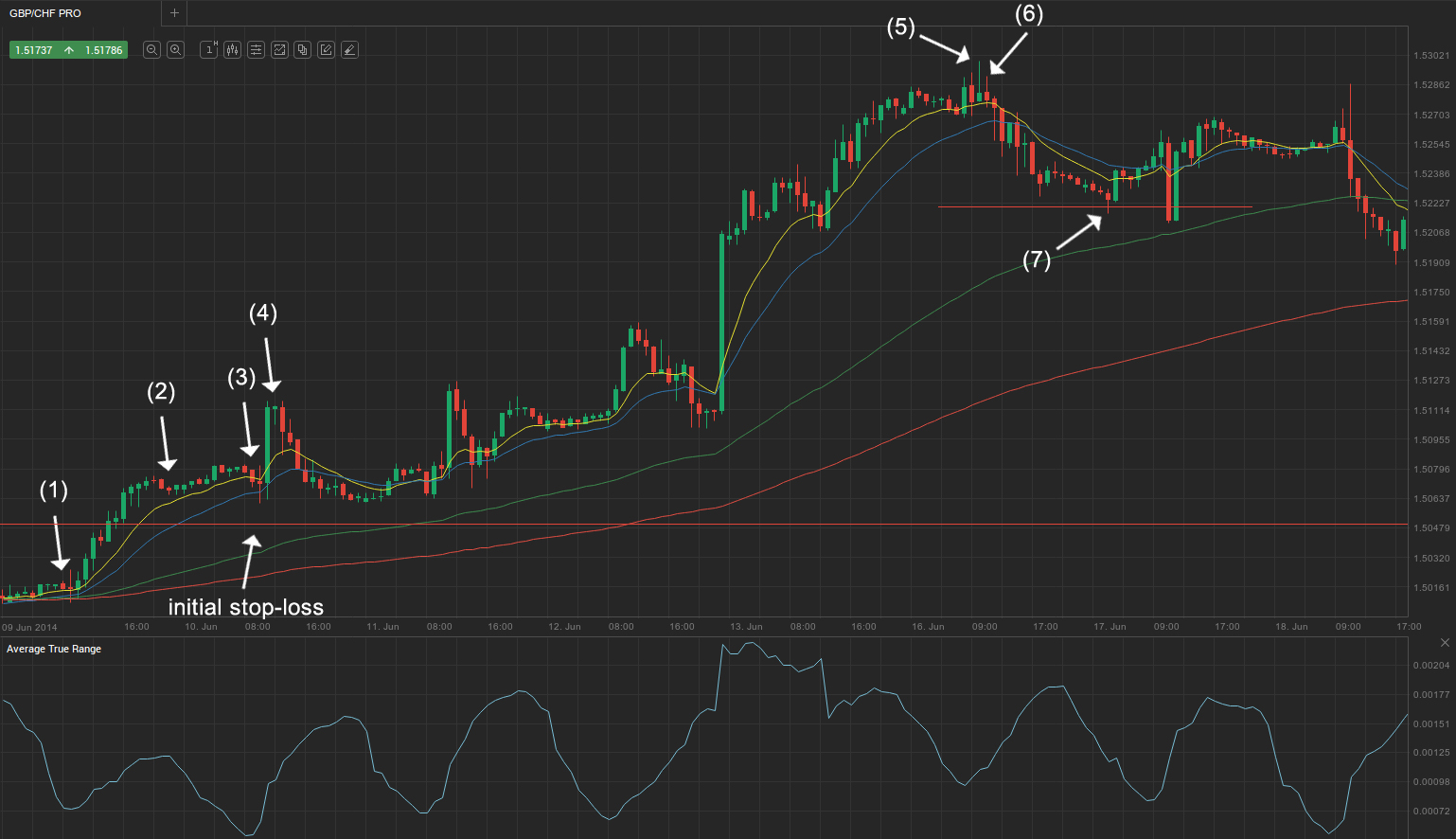
The market was previously in a trading range, as evidenced by the slow EMAs being flat (the 89 EMA is in green and the 200 EMA is in red). However, by bar (1) the faster EMAs (10 EMA in yellow and 20 EMA in blue) had crossed the slower ones from below and edged higher. As we know, moving-average crossovers, especially when a 200-period average is crossed, provide very strong entry signals.
After the crossover, the four EMAs positioned themselves according to our strategy’s criteria and the only thing left to do was to have the 10-period EMA act as a support zone for at least 10 bars. As you can see from the screenshot, it played that role before the crossover, but for our example we will begin counting those 10 bars after the crossover. If we follow the rule to enter at the first possible dip, we must go long at bar (3). However, another possible entry would be at bar (2) because it was a minor pullback in what seems to be the start of a strong trend, although the price did not touch the EMA.
For our example we will stick closely to the rules and enter at bar (3), which is at 1.5075. At that point the ATR had a value of 0.00051; thus, our stop (50% of the ATR) should be placed 26 pips below the EMA, at 1.5049.
During the next hour the price dipped and penetrated both the 10- and 20-period EMAs but remained well above our protective stop. Over the next couple of bars, the market staged a strong rally that pushed the 10-period EMA up, which called for an adjustment of our stop. As soon as the large bull trend bar (4) closed, we recalculated and trailed our stop. The EMA was at 1.5871, while the Average True Range was 0.00091. Therefore, we needed to widen the stop. Having done the maths, we moved our stop-loss up to 46 pips below the EMA, at 1.5825.
We needed to trail our stop higher on the same principle after the next two bars. The following pullback below the 10- and 20-period EMAs was only a minor one and reached 1.5062 at its lowest level, remaining far from our protective stop. The market then began rising again and we had to adjust our trailing stop after each period when the 10-period EMA rose.
The strong bull trend continued for seven days and reached its extreme level at bar (5) at 1.5299, which was 224 pips above our entry point. However, every good trend is bound to come to an end. Our last stop-loss adjustment was after the close of bar (6). The 10-period EMA was at 1.5277, while the ATR was 0.00111. We therefore placed our stop-loss 56 pips below the moving average, i.e., at 1.5221. The subsequent down-move triggered our stop at bar (7) and our position was closed with a profit of 146 pips, delivering a risk-reward ratio of around 1:3 relative to the widest stop level. Keep in mind that this is certainly not the strongest trend we have seen, and it is only on an hourly chart; there is plenty of potential for even greater profits.
Trade management
 In the course of trading we might employ additional techniques to boost our performance and secure gains if we are uncertain about the trade’s success. One such method is the scaling-out technique. As we know, scaling-out allows you to lock in some of your profit earlier, while leaving the remaining portion of your position in the market to gain more if the market continues to move in the desired direction. This yields a smaller potential return compared with exploiting the trend with the entire position, but it also carries less risk.
If you want to reduce risk, you can scale out of your trade by exiting a portion of your position (less than half at most) when the price hits or undershoots the trend-channel line. The remainder of your position (half at minimum) should be held and managed according to our initial strategy – by trailing the stop below the EMA in conjunction with the ATR. This can be a viable trading approach because trend-channel lines are strong resistance zones in uptrends and strong support areas in downtrends, and a retracement often follows. However, you should not scale out of the trade too early and it is advisable to aim for a risk-reward ratio of at least 1:2 before you decide to take partial profits. As mentioned, the remainder should be held until the price triggers your protective stop.
Because this strategy is used in strong, protracted trends, it will often provide opportunities to re-enter the market after we have scaled out. Therefore, if we have closed part of our position but believe that the trend will continue for an extended period, we can expand our position to its original size on a pullback.