
 | Updated:
 Combining the Average True Range and the Simple Moving Average envelope
You will learn about the following concepts
- Indicators used in this strategy
- Signals to look for
- Entry point
- Stop-loss
- Profit target
For this strategy, we will examine the daily chart of EUR/AUD. We will use the 20-period Simple Moving Average (SMA) with a 0.5% envelope and the 14-period Average True Range (ATR).
The trader should examine the price action, looking for potential breaches of either bound of the envelope. If a candle breaks and closes above the upper bound of the envelope, the trader will go long at the open of the next candle. The protective stop will be placed in accordance with the ATR of the signal candle; if the ATR is 70, the stop will be 70 pips below the entry price. If the stop is triggered, the trader will wait for another signal (buy or sell) to appear. If the trade moves in their favour, the trader will keep the position open until the opposite signal (sell) appears.
If a candle breaks and closes below the lower bound of the envelope, the trader will go short at the open of the next candle. The protective stop will be set in accordance with the ATR of the signal candle; if the ATR is 110, the stop will be 110 pips above the entry price. If the stop is triggered, the trader will wait for another signal (buy or sell) to appear. If the trade moves in their favour, the trader will keep the position open until the opposite signal (buy) appears.

- Trade Forex
- Trade Crypto
- Trade Stocks
- Regulation: NFA
- Leverage: Day Margin
- Min Deposit: $100
Let us take a look at the daily chart of EUR/AUD below.
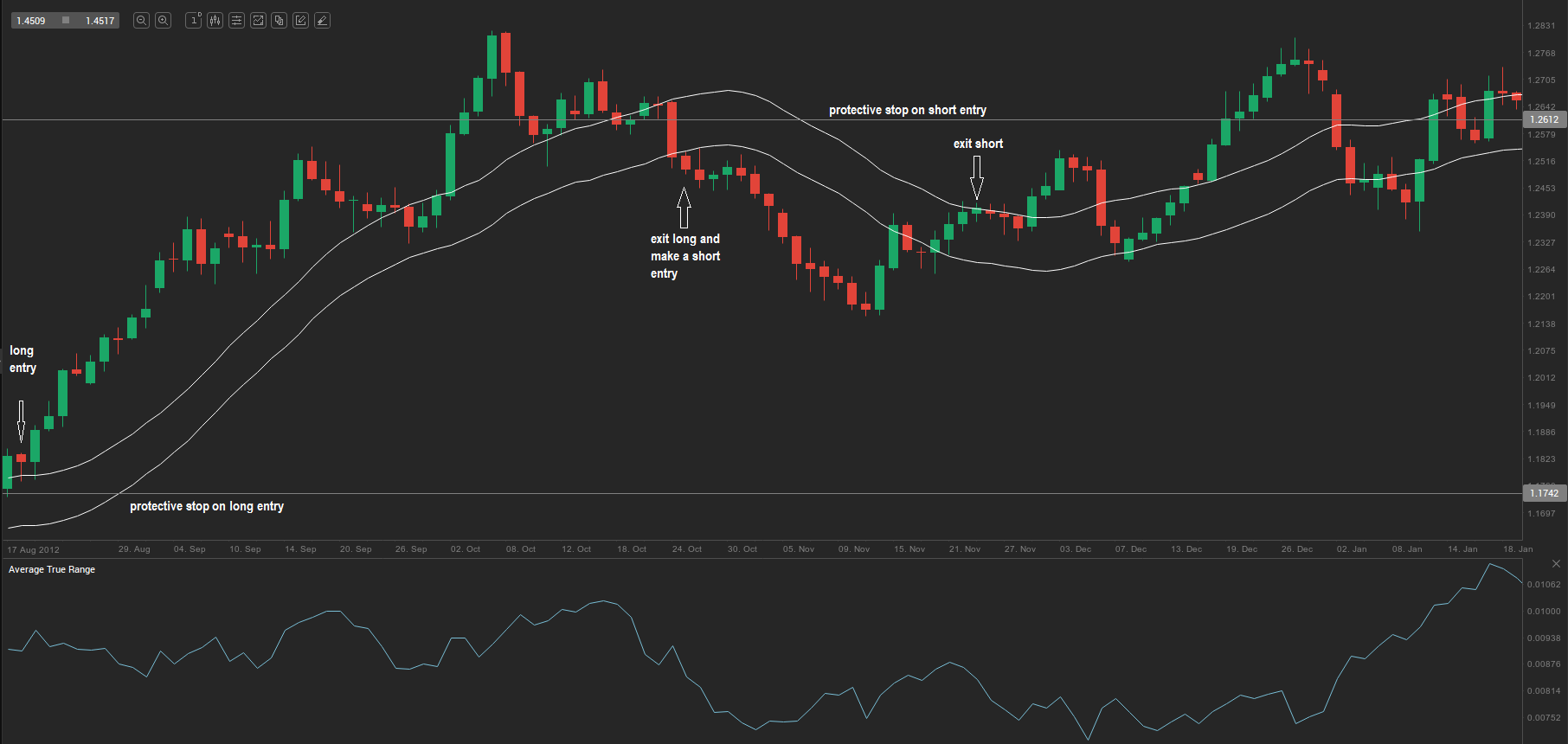
On 19 August 2012, the price breached the upper bound of the envelope. This was the signal candle, with an ATR of 91. We entered long at the open of the next candle (20 August 2012) at 1.1833. The protective stop was placed 91 pips below the entry, at 1.1742. On 24 October 2012, the price breached the lower bound of the envelope. This was the signal candle, with an ATR of 85. On 25 October 2012, we closed our long position at 1.2527 for a profit of 694 pips and opened a short position at the same price level. The protective stop was set 85 pips above the entry, at 1.2612. On 22 November 2012, the price breached the upper bound of the envelope, and we closed the short position on the next candle (at the open of 23 November 2012, at 1.2394) for a profit of 133 pips.