
Fast moving average crossovers
You will learn about the following concepts
- Fast moving average crossovers
- Using them to your advantage
We have discussed moving averages extensively throughout our trading guides, particularly in the articles “Introduction to Moving Averages“, “Simple Moving Average” and “Exponentially Smoothed Moving Average“, so now we will turn our attention to moving average crossover strategies. You can have crossovers between fast moving averages, between slow moving averages, or a mix of the two. Here we will discuss fast moving average crossovers.
For this strategy, we will use a 15-minute time frame and three exponential moving averages – a 10-, a 25- and a 50-period one. The entry and exit rules are simple. Once the 10-period EMA penetrates the 25-period EMA and then crosses the 50-period one, you enter in the 10-period EMA’s direction. However, before executing the trade you need to wait for confirmation, which comes after a bar closes on the other side of the 50-day EMA.
You hold on to your position until one of the following two scenarios occurs: either the 10-period EMA crosses back below the 25-period EMA, or its retracement extends further to the 50-period EMA. The latter exit strategy offers the possibility of better results because the price might reverse and head back in the desired direction before crossing the 50-day EMA. However, if it doesn’t, your profit would be smaller compared with a 25-period EMA exit. In both cases, the position should be closed after confirmation, i.e. after a bar closes beyond the 25- or 50-period EMA.

- Trade Forex
- Trade Crypto
- Trade Stocks
- Regulation: NFA
- Leverage: Day Margin
- Min Deposit: $100
Trend required
 Moving average crossovers are a reliable trading strategy, but only in trending markets. They have little to no value in sideways conditions. Because of the EMAs’ short periods, their crossovers achieve good results during strong breakouts and generally strong moves. Their main disadvantage is that they produce many false signals during trading ranges and, secondly, because moving averages are a lagging indicator, they have little predictive value. Thus, the trader needs to keep a constant eye on their open position and act as market conditions shift. Check out the following example.
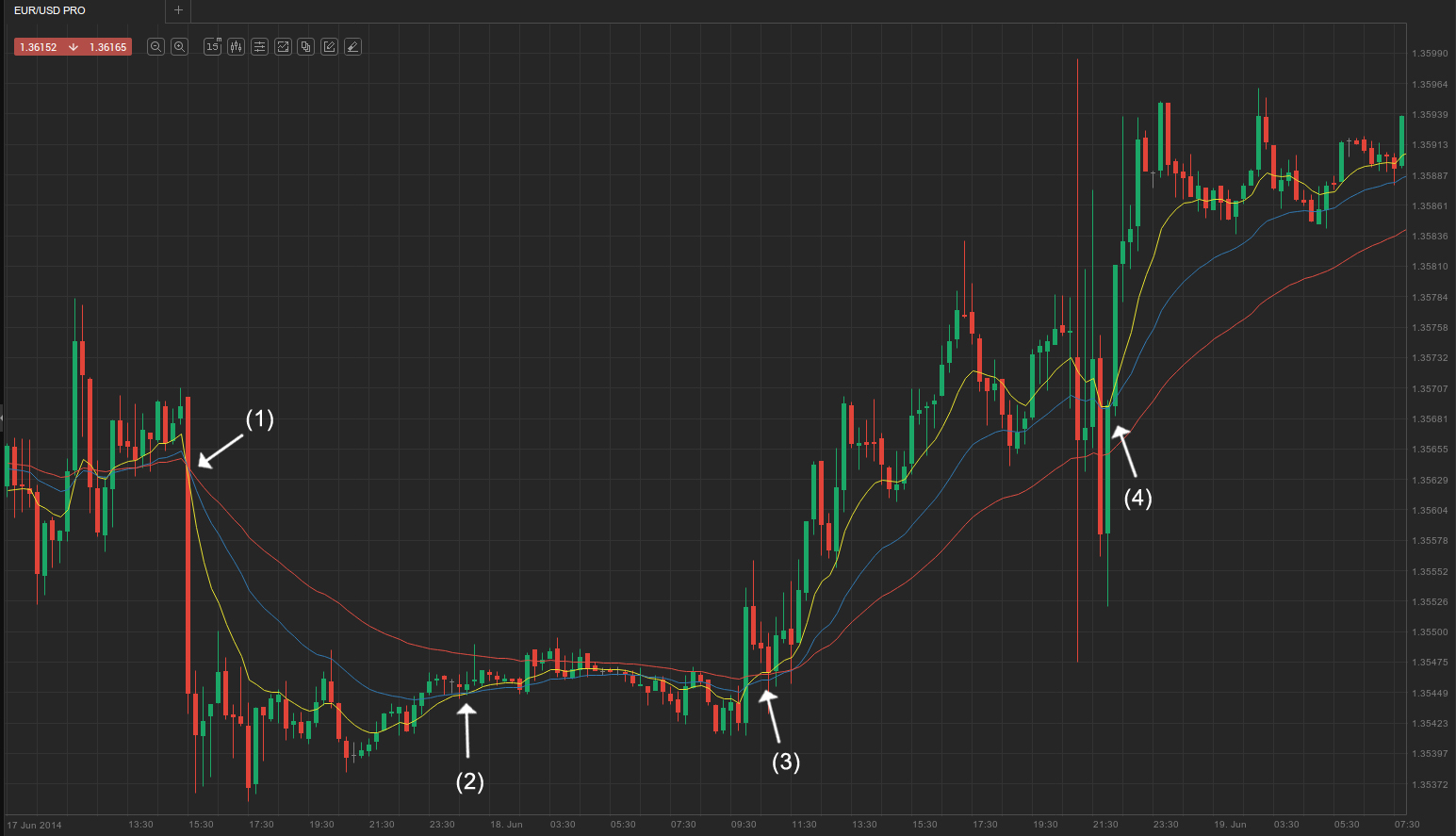
As you can see on the 15-minute chart above, the 10-period EMA (yellow) crossed the other two (blue – 25-period, and red – 50-period) on several occasions. First, at (1), the EUR/USD cross marked a major decline on the back of an economic data release, causing a fast moving average crossover. Traders who waited for confirmation (a bar closing below the 50-period EMA) would enter at the close of the large bear trend bar, while others may have dropped to a lower time frame (10 or 5 minutes) and searched for a close there. They would then have exited either at (2), where the 10-period EMA crossed the 25-period, essentially at breakeven, or at bar (3), which would have been a loss. This demonstrates how ineffective this trading system is in sideways conditions (the market was in a trading range prior to the breakout at (1) and, almost immediately after the climactic bear trend bar, it entered a barbed wire trading range).
Our example, however, also provided an EMA crossover in trending conditions. At (3), the 10-period EMA crossed above both slower EMAs shortly after a large bull trend bar broke out of the tight trading range. The ensuing bull trend became evident after the formation of three very strong bull trend bars. Here is how the trend unfolded.
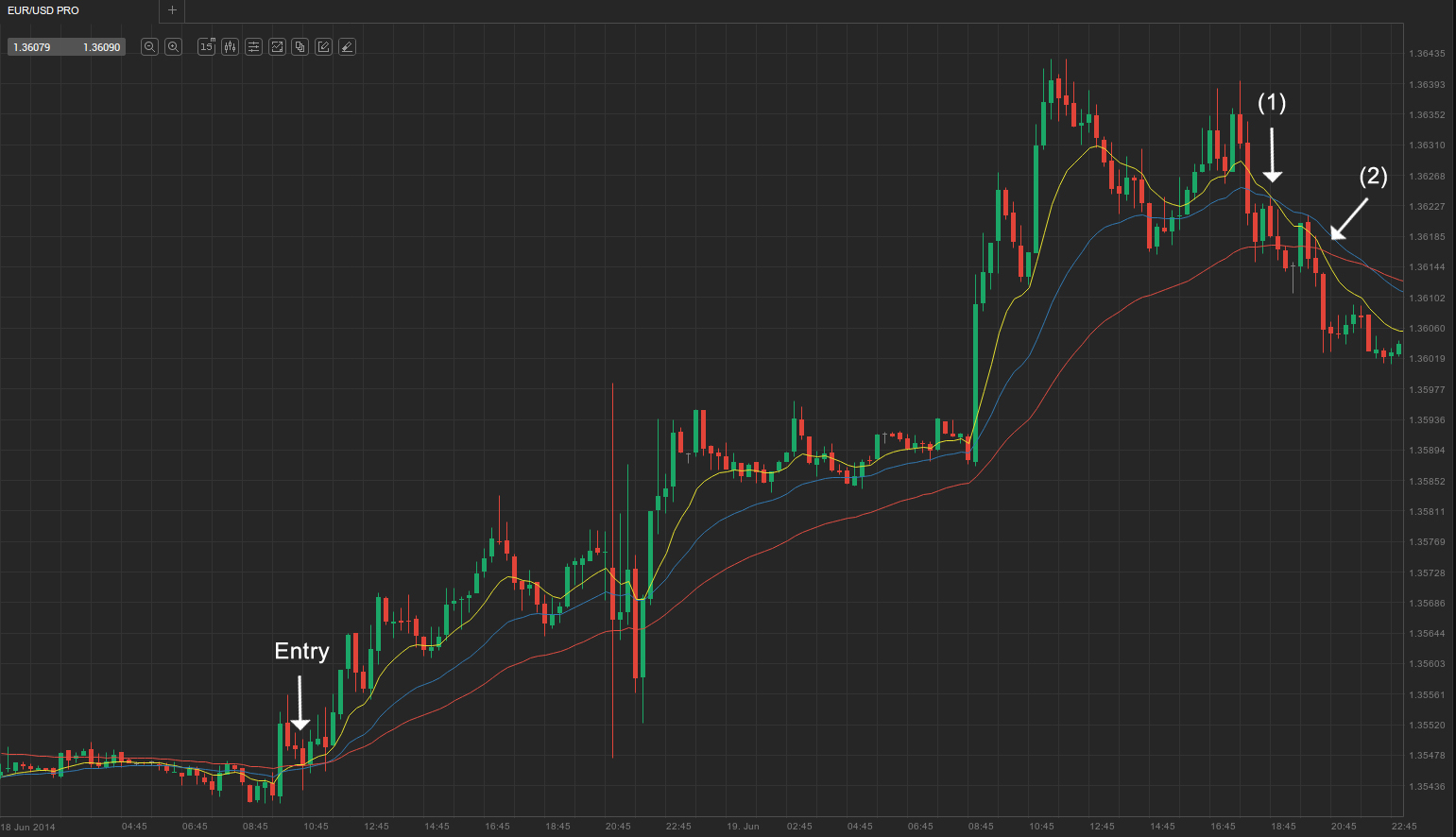
As you can see, our entry was around the 1.3550-1.3552 area. The 10-period EMA did not cross below the 25-period EMA until (1), where some traders would have closed their positions. Alternatively, some who hoped the upward move would extend would have waited for a 50-EMA crossover, which happened at (2), and the first bar below it closed at 1.3605. Even with the riskier exit approach, you would have earned a little over 50 pips.