
Combining stochastic oscillator and two EMAs
This lesson will cover the following
- Full stochastic oscillator
- Exponential moving averages
- Combination between the two
In this article, you will be introduced to another fairly simple, yet effective, trading strategy that combines exponential moving average crossovers with the stochastic oscillator.
It is designed for the daily time frame, but lower time frames, such as the hourly, should also work well despite the occasional whipsaws. The setup uses a 2-period EMA, a 4-period EMA and the stochastic oscillator. The logic behind the strategy is to buy or sell on the EMA crossover, while the stochastic oscillator filters out false signals.
The entry and exit signals are quite straightforward. Go long when the 2-period EMA crosses above the 4-period EMA from below and continues higher, with the stochastic oscillator below 50. Conversely, go short when the 2-period EMA crosses below the 4-period EMA and continues lower, while the stochastic is above 50.
Exit the position when the EMAs cross back over, or when the stochastic enters the overbought or oversold zones (70-80 and 30-20 respectively). As for the stop-loss, you can use a trailing stop with an absolute or percentage value according to your preference, or set an exact stop-loss level. This should be the low of the entry day for a long position, or the respective high for a short position. In any case, aim for a risk-to-reward ratio of at least 1:2.

- Trade Forex
- Trade Crypto
- Trade Stocks
- Regulation: NFA
- Leverage: Day Margin
- Min Deposit: $100
Example
Have a look at the following example.
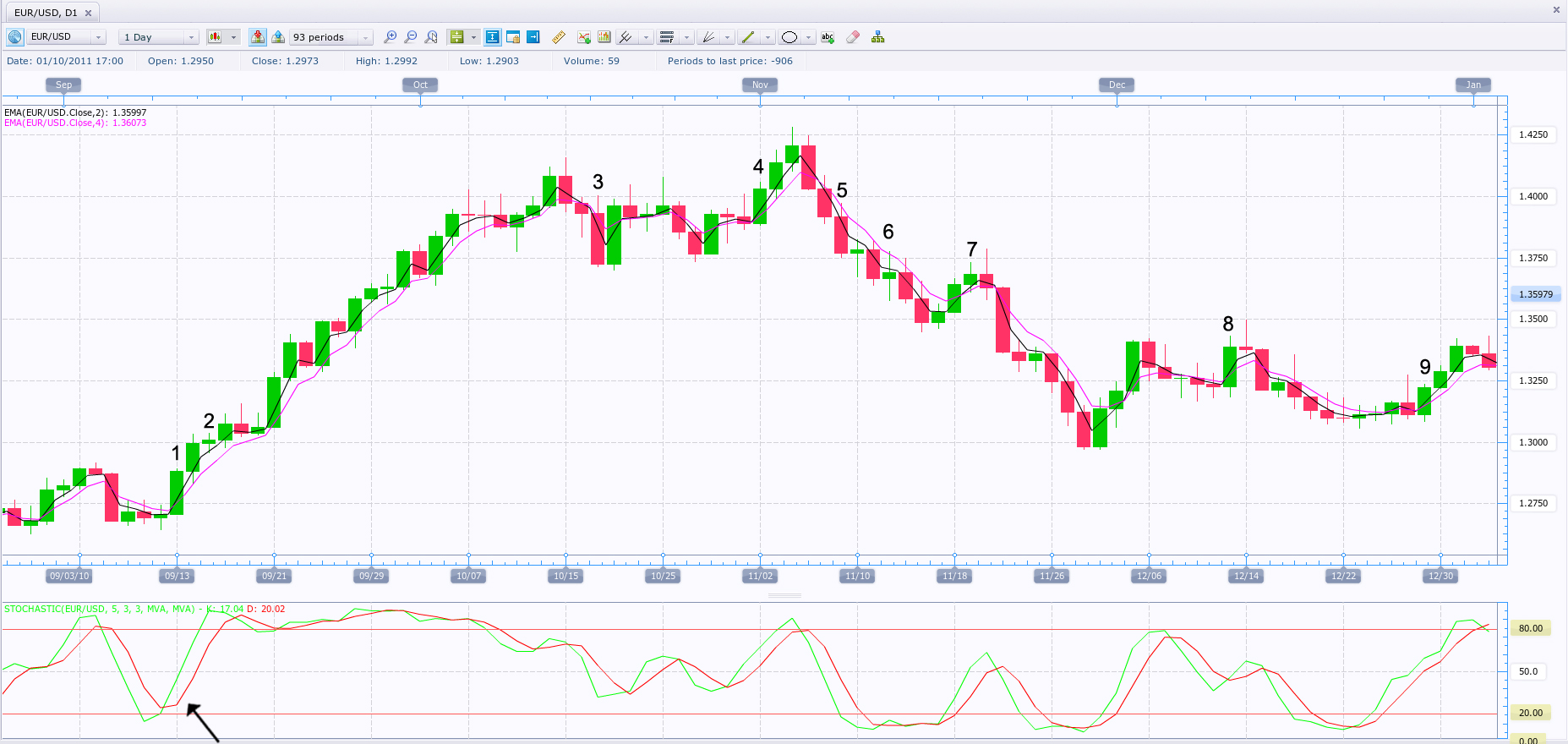
You are looking at the daily EUR/USD chart. The general trend is bullish, so we will restrict our entries to long, with-trend positions. Our first signal is generated at bar 1, when the 2-period EMA (black line) crossed above the 4-period EMA (purple line) and the stochastic oscillator was below 50 but edging higher. We enter on the next bar, at the high of bar (1), i.e., at 1.2892 US dollars, and set our stop-loss several pips below bar 1’s low. Because this low is at 1.2703, close to the double-zero level, we need to place our stop further down, so it doesn’t get gunned by institutional traders. In this article you can read why. Thus, we decide to place our stop at 1.2675. Although the stop seems quite wide, the subsequent move shows that it was well worth it.
As the price advances, we have several choices. We can exit the entire trade as soon as the stochastic oscillator reaches the overbought zone, which, however, does not always mean that the price is about to reverse. Alternatively, we can scale out part of the position when the overbought zone is entered and keep the remaining portion on the market. Third, we can aim for a 1:2-1:3 risk-to-reward ratio unless the moving averages produce a bearish cross.
If we choose the first scenario, we would exit the trade at the close of bar (2) at 1.3040, securing a profit of almost 150 pips. If, instead, we decide to scale out half of the position at that point, we can let the other half run and move our stop-loss to break-even, ensuring the trade remains in profit by the previously earned 150 pips. Alternatively, if we ignore the stochastic entering the overbought zone, we can aim for a profit target twice the amount risked, at 1.3326 dollars, as marked by the green horizontal line. Afterwards, we can either exit the entire position or scale it out and trail our stop, keeping the remaining portion until the EMAs make a bearish crossover.
There were several other entry signals. The first appeared at bar 4, but we ignored it because the stochastic oscillator was already above 50. At bar 5, we could have gone short, but we chose not to trade against the prevailing trend (had we done so, the position would have been closed at bar 6 when the stochastic entered the oversold area, or at the bullish EMA crossover at bar 7).
Another possible long order could have been placed above the high of bar 8, but there was no follow-through buying and our stop would likely have been gunned. Bar 9 also generated a bullish signal.