
Combining SMAs and EMAs
This lesson will cover the following
- Simple Moving Averages
- Exponential Moving Averages
- Combining them in a viable strategy
The following strategy uses a combination of two types of moving average. A set of Exponential Moving Averages with long look-back periods helps us determine the trend’s direction, while a pair of Simple Moving Averages with short look-back periods generates the entry signals. Here are the specifics.
This strategy is best applied on a 4-hour time frame, but you can also use an hourly chart if you can stomach the whipsaws. A 144-period EMA and a 169-period EMA help you determine the trend’s direction (if the 144 EMA is below the 169 EMA, the trend is bearish, and vice versa).
The Simple Moving Averages are used to generate trend-following and counter-trend entry signals, although we have repeatedly advised novice traders to avoid trading against the market. A 5-period SMA produces buy or sell signals in the direction of the trend, as indicated by the two EMAs, while a 14-period SMA is used to generate signals against the trend.
If any misunderstandings have arisen, let’s clarify. If the 144-period EMA is above the 169-period EMA, we have an uptrend. During this uptrend, if a bar closes above the 5-period SMA, it generates a buy signal, while a close below the 14-period SMA produces a sell signal.

- Trade Forex
- Trade Crypto
- Trade Stocks
- Regulation: NFA
- Leverage: Day Margin
- Min Deposit: $100
Conversely, if the 144-period EMA is below the 169-period EMA, we have a downtrend. During the downtrend, a bar that closes below the 5-period SMA generates a trend-following short entry signal. Meanwhile, a close above the 14-period SMA triggers a counter-trend long entry signal. However, remember that counter-trend trading is strongly inadvisable for novice traders. To read more about trend trading, you can visit several of our articles dedicated to the subject, including ‘The trend – a trader’s best friend’, ‘Basics of trends and trend lines’, ‘What defines a strong trend’, ‘Trend-trading guidelines’.
Profit target, stop-loss
 As for profit targeting and protection, you can either use a trailing stop configured to your own preferences, or set a static stop-loss level at the low or the high of the signal bar (the bar prior to the entry bar). When determining your profit target, you should aim for a risk-to-reward ratio of at least 1:2.
For example, you can target a profit that is double the amount risked while using a fixed stop-loss (the high or low of the signal bar). Upon achieving the 1:2 risk-reward ratio, you can close a portion of your position, thus locking in partial profit, and keep the remaining part in the market to further exploit the trend, while protecting it with a trailing stop. Should you choose not to use a trailing stop at all, another exit point can be a close on the opposite side of the 5-period EMA.
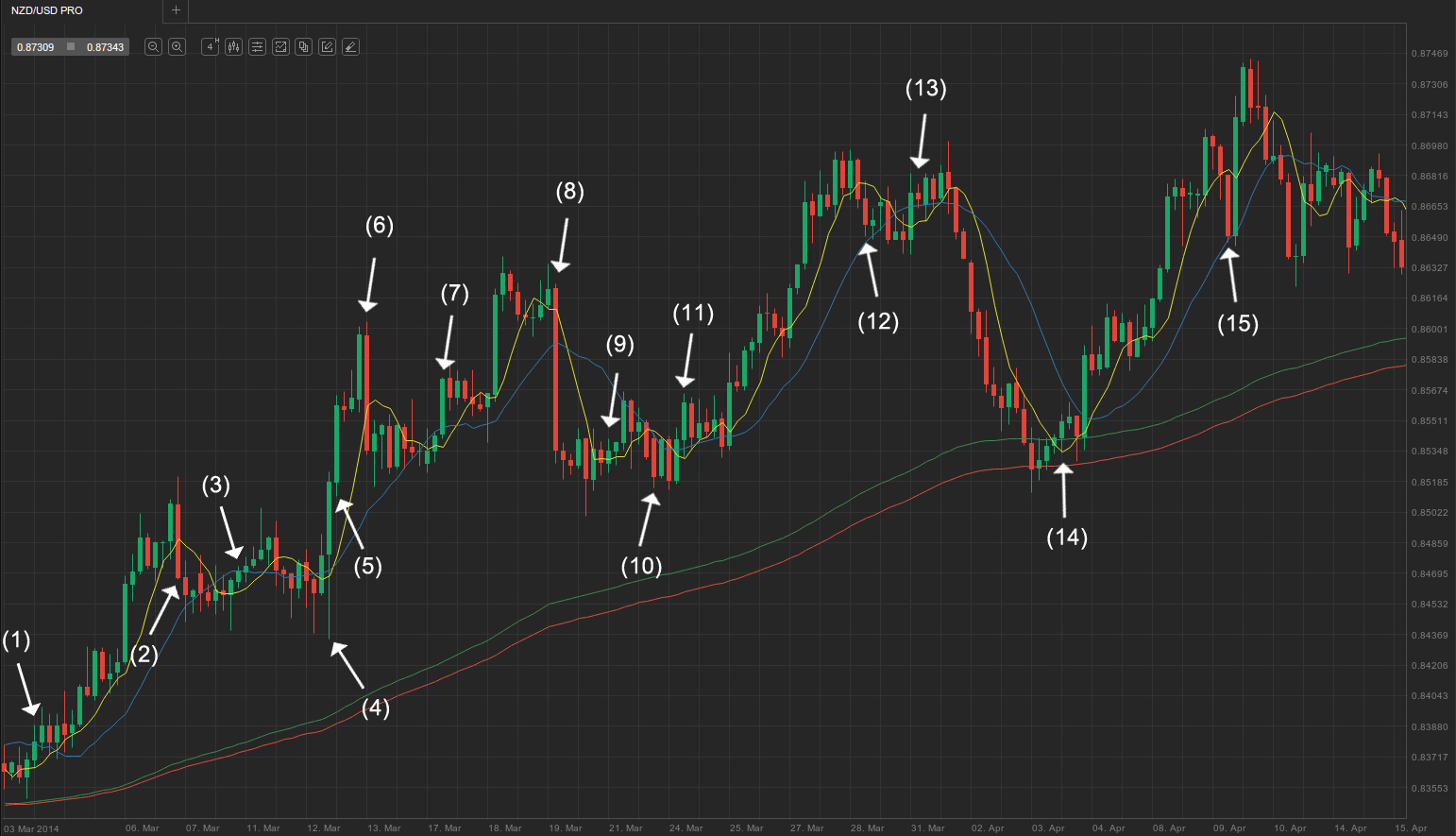
In the example above we have focused only on trend-following entries. The green line is the 144-period EMA and the red line is the 169-period EMA. The 5-period SMA is shown in yellow, while the blue line represents the 14-period SMA.
We enter long at (1), with a stop-loss at the previous bar’s low. We can exit either after achieving a profit that is double or triple the amount risked or, if we were using a trailing stop, we would have been stopped out at the large bearish trend bar (2).
We enter our next trade at (3), but it fails to reach our profit target, with our stop-loss being hit at bar (4). However, bar (4) acts as a signal bar for our next entry at bar (5), which would have been a minor winner after the bar (6) trailing stop pushed us out of the market. Bar (7) would be our next entry point, with a stop-loss below the previous bar’s low, and the exit would be at bar (8) when the trailing stop kicked in.
The next long position at bar (9) would be a minor loser, as the bearish trend bar (10) would hit our stop. We re-enter at bar (11) and exit via the trailing stop at bar (12). The trade entered at bar (13) would also be a loss as the subsequent market sell-off would hit our stop, but the trade entered at bar (14) and exited at bar (15) would completely offset all of the session’s losses. Upon recapping the entire trading session, you will undoubtedly be struck by the notably positive balance of earned pips.