
Combining fast and slow stochastic oscillators with EMA
This lesson will cover the following:
- Slow and fast stochastic oscillators
- EMAs
- Combining them into a viable trading strategy
In this article we present yet another combination of a stochastic oscillator and an Exponential Moving Average, but this time we use both a slow and a fast stochastic simultaneously. Moreover, we will be confirming our entry points with reversal bar patterns.
The logic behind this strategy is to look for points where the price is rebounding from the Exponential Moving Average, confirmed by a reversal bar pattern, while the slow and fast stochastics are in opposite overbought-oversold areas. Let’s get to the specifics.
For the slow stochastic oscillator we will use the following settings: %K 21, %D 4 and Slowing 10. For the fast stochastic oscillator we will use %K 5 and %D 2. Both will use overbought and oversold thresholds of above 80 and below 20. The Exponential Moving Average will be a 20-period EMA.
Trend required
 As with any trading system based on moving averages, this one should also be used in trending markets. Thus, for an entry signal to be generated there are two conditions: a strong trend must be in motion, and the two stochastics must be in opposite extreme areas (overbought and oversold). When those requirements are met, you can look for an entry signal when the price bounces off the 20-period EMA and continues in the direction of the trend. It is best to wait for confirmation by a reversal bar pattern and enter after its completion.

- Trade Forex
- Trade Crypto
- Trade Stocks
- Regulation: NFA
- Leverage: Day Margin
- Min Deposit: $100
Your stop-loss order should be placed about 10-15 pips above the reversal pattern’s high in a bear trend, or beneath its low in a bull trend. Meanwhile, the profit target should be around the previous swing extreme (swing low in a bear trend or swing high in a bull trend). Typical reversal patterns that may be used for confirmation include bearish and bullish engulfing patterns, evening and morning stars, and others. If you want to read more about single, double and triple bar patterns, read our articles “Patterns Including One Candlestick. Doji Candlesticks“, “Patterns Including Two Candlesticks” and “Patterns Including Three Candlesticks“.
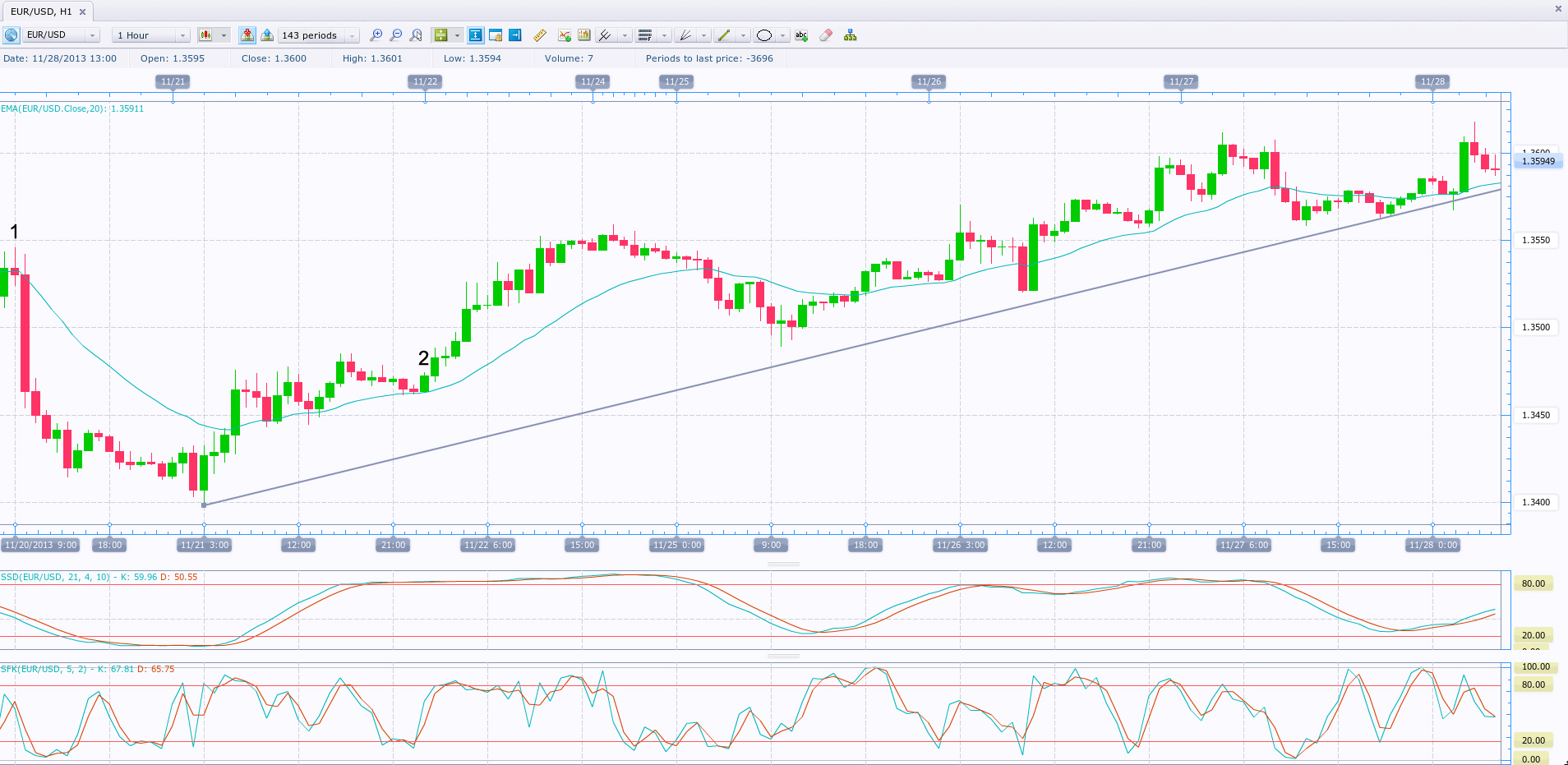
On the screenshot above you can see that a very strong and prolonged bull trend was in motion, thus our strategy’s first requirement was met. The slow stochastic was initially in the overbought area for well over 30 bars, which gave us a couple of good long-entry opportunities.
First, there was a rebound from the 20-period EMA at bar (2), which completed a bullish reversal pattern (bar 2 was a strong bull trend bar, which was also bottom-shaved, signifying bullish momentum). The slow stochastic had been firmly in the overbought area for some time, while the fast stochastic had just entered the oversold area, giving the green light for a long entry.
We enter above bar 2’s high, at 1.3475. Our stop-loss is placed 10-15 pips below the reversal pattern’s low, at 1.3450, so our capital exposure is 25 pips. Our profit target, the previous swing high, should be the high of bar (1) at 1.3546, 71 pips away from the entry level. This yields a risk-reward ratio of nearly 1:3 and was reached at bar (3). A more conservative management strategy would have been to scale out half of the position after achieving a profit double the amount risked and trail the stop to breakeven, which would secure a considerable profit and ensure the remainder of the trade did not become a loser.
Another possible long entry signal was generated at bar (4). It was a bull trend bar that broke out of a tight trading range and reversed the previous bearish bars, rebounding from the EMA. Although it was not a perfect entry because the slow stochastic was a little below the overbought area, the rebound from the EMA was still decisive enough. We enter above bar 4’s high with a 15-pip-wide stop beneath its low. A considerable two-bar reversal followed several bars later but it did not trigger our stop as its low was only 6 pips beneath bar 4’s low.
The previous swing high was almost immediately exceeded, so we could switch our profit target to double the amount risked. At that point we could choose either to exit the whole position or to scale out and trail the stop to breakeven for the remainder.