
Combining Average Directional Movement Index and EMAs
You will learn about the following concepts
- Average Directional Movement Index
- EMAs
- How to combine them
In the Trading Pedia Forex Trading Guide, we introduced you to the Average Directional Movement Index, the Parabolic SAR, and a very easy-to-grasp trading strategy that combined the two. In the article ‘Forex Trading Strategy – Combining Moving Average Convergence Divergence and Parabolic SAR’, we presented an alternative, viable trading system. Now we will show you how to combine the Average Directional Movement Index with Exponential Moving Averages to produce yet another easy-to-use and reliable strategy.
 It can be used on a daily timeframe, or on smaller ones, although the former may yield better results. It involves two EMAs – a 3-period and a 10-period – coupled with a 14-period Average Directional Movement Index with Positive and Negative Directional Indicators (+DI and -DI).
The logic behind this strategy is simple. Because moving average crossovers are effective as signal generators only in trending markets, we use the ADX to determine the trend’s strength. Thus, if the Average Directional Movement Index is showing the existence of a strong trend (ADX is above the 20-25 area), you may proceed to enter in line with the EMA crossover signals.

- Trade Forex
- Trade Crypto
- Trade Stocks
- Regulation: NFA
- Leverage: Day Margin
- Min Deposit: $100
Entry and exit spots are fairly straightforward. A buy set-up arises when the 3-period EMA crosses the 10-period EMA from below and continues higher, while the +DI line is above the -DI line and the ADX line is above 25. Conversely, a short set-up is generated when the 3-period EMA crosses the 10-period EMA from above and continues lower, with the -DI line above the +DI line and the ADX line again above 25. For additional confidence, you may wish to wait for the ADX to be rising when you enter the trade, rather than merely being above 25.
An exit signal is generated when the 3-period EMA crosses back over the 10-period EMA. Alternatively, you can use a trailing stop based on a percentage or an absolute pip value. See the following example.
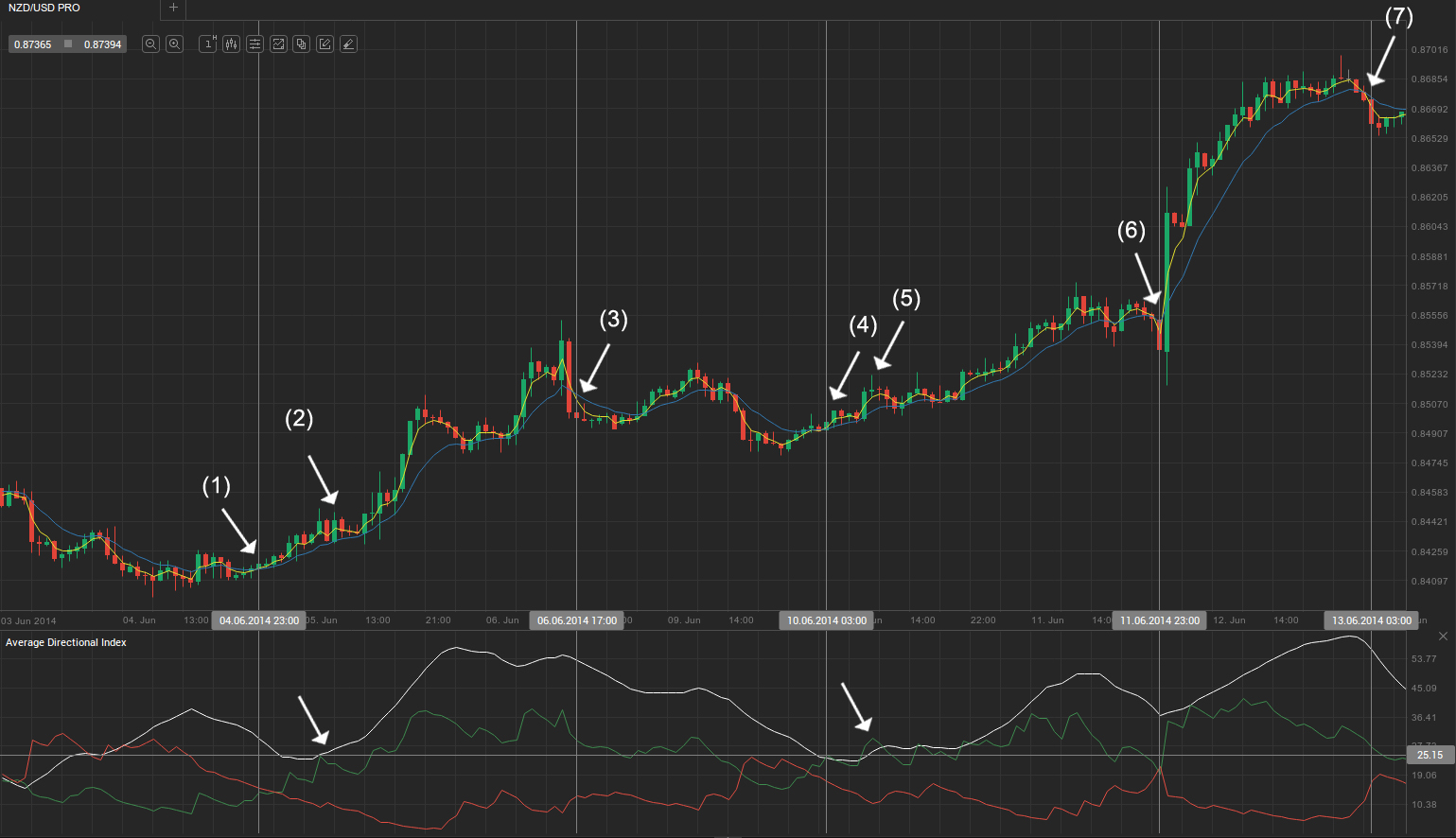
As you can see in the example above, the EMA crossover at (1) was not a suitable entry at that time because the ADX was declining. Instead, you could have waited to see how the market would move after the crossover. A bullish trend developed and we could enter at (2), at which point the ADX was rising and had exceeded 25. We exited at the bearish crossover at (3) and refrained from entering short because we were unsure whether a bearish trend would develop (always avoid entering against the trend until solid evidence of a reversal is at hand).
The market pulled back and the next bullish crossover occurred at (4). However, it was again unsupported by the ADX, which was flatlining just below 25, so we decided to enter only if there was follow-through buying and the indicator moved above 25 – which it did. We entered long again and exited at the (6) crossover. Although it was a minor crossover, seeing it in real time would still have produced an exit signal unless you were using a wide trailing stop. Even if you had exited your position, you could re-enter long right after the immediate bullish crossover, at the close of the substantial bull trend bar, and exit the long position at (7).