
Trading via the Accumulation/Distribution indicator
You will learn about the following concepts
- Basics of the Accumulation/Distribution indicator
- Calculation formula
- Interpretation and example
This is a volume indicator that attempts to measure supply and demand for a currency pair by determining whether investors are generally accumulating or distributing the pair. It is a variation of the more commonly used On Balance Volume indicator. It is based on the assumption that volume may be a leading indicator of price action.
The Accumulation/Distribution indicator tracks the relationship between opening and closing prices, combined with volume. Here is the formula:
[((Close – Low) – (High – Close)) / (High – Low)] * Periods Volume = A/D
 If prices close higher than they opened, it means bulls overcame bears and A/D is positive; the opposite is also true. Similarly, if prices close at the day’s open, then it is a draw and A/D is zero. The larger the spread between the opening and closing prices relative to the daily range (high to low), the greater the change in the indicator.
However, only a portion of the daily volume is attributed to the winning party. If the daily range is 10 cents, but the close is only 5 cents above the open, then only half of this day’s volume is credited to the winning party.

- Trade Forex
- Trade Crypto
- Trade Stocks
- Regulation: NFA
- Leverage: Day Margin
- Min Deposit: $100
Changes in the A/D indicator provide more value to trading than its absolute level. For example, if the market is on the rise, people tend to eye the new highs, often disregarding the underlying developments. If at the same time the market opens higher but closes lower, A/D will decline, signalling that the bullish trend is weaker than it appears. The same logic applies to the reverse scenario.
The significance of the open and close lies in the information these two price levels contain. The open reflects everything that has happened since the previous close while the market was inactive – news, shifts in sentiment, etc. As for forex, due to its decentralisation the market operates around the clock, but it closes at the weekend. This makes the open late on Sunday particularly important because a lot of events might have occurred during those two days. Closing prices reflect the events and sentiment that have shaped the trading day and are especially important for the daily settlement of trading accounts.
Trading from the open is often dominated by amateurs, while professional traders are active throughout the entire day and especially into the close. Thus, A/D reflects the battle between amateur and professional traders. If it rises in value, then the day’s close is higher than the open, as professionals are more bullish than amateurs. If A/D declines, then the close is below the open, as professional traders are more bearish than amateurs.
Trading principles
A/D is best traded on the basis of divergences with the price. If the market rallies to a new peak while A/D marks a lower high, it generates a short signal, as it implies professional traders are selling into the rally. Conversely, if the market is marking a lower low while the indicator reaches a higher low, the bullish divergence generates a buy signal, as professional traders are buying into the dip. See the example below.
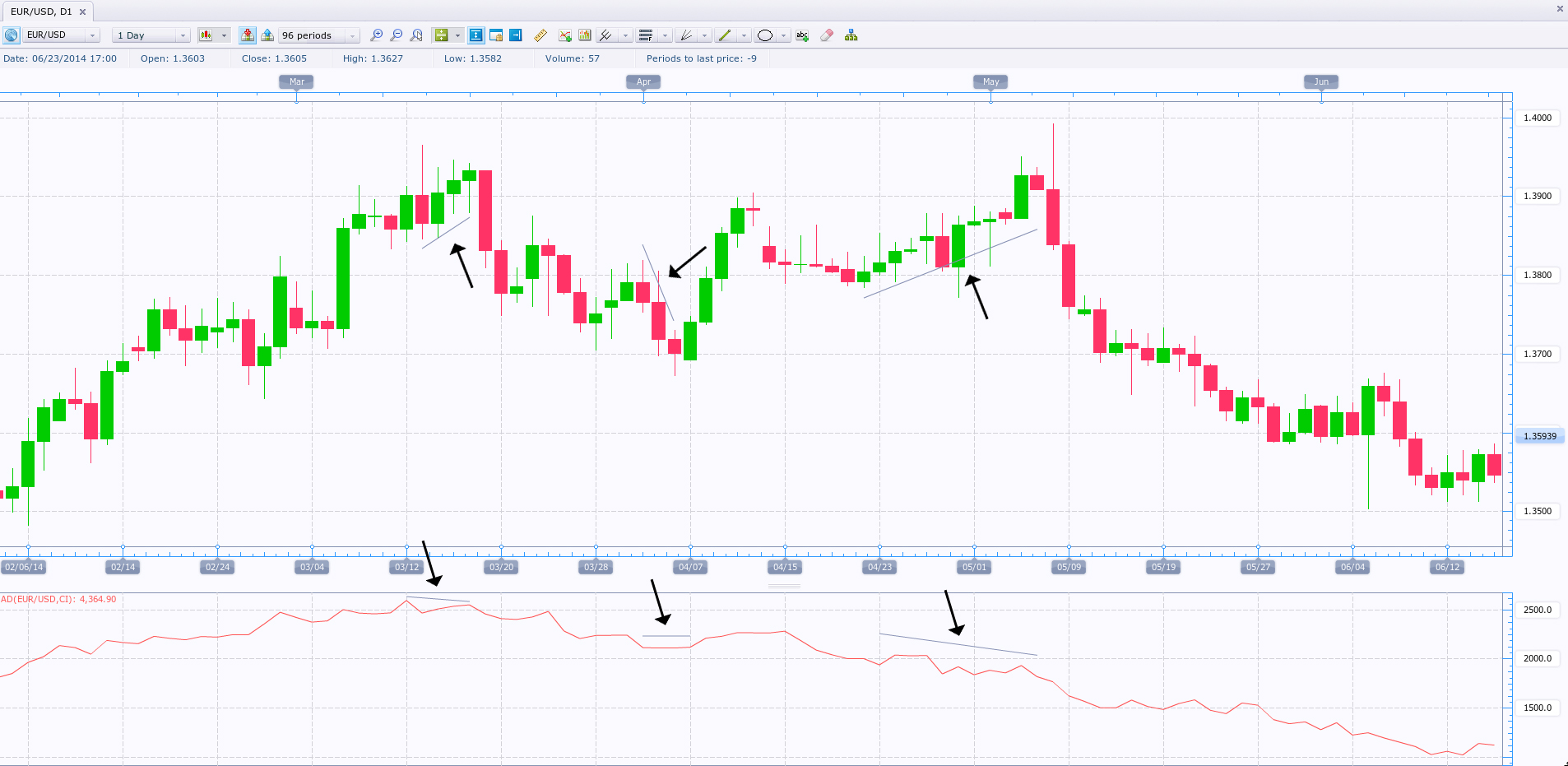
On the screenshot above, you can see several major areas where the market movement and the A/D indicator diverged, which were followed by price reversals. You can’t use A/D solely as a method for decision-making, but, thanks to its predictive value, it is a very handy tool that can be combined with other indicators and can certainly improve your trading strategy.