Amid ongoing global trade debates and the impending enforcement of tariffs, concerns about everyday prices are mounting, especially for beverages woven into Europe’s morning ritual. Coffee, cocoa, and tea are part of countless kitchens, cafés, and corner bistros, so when prices jump, the shock is felt across households and hospitality alike. Since early 2025, sharp price hikes have forced many to rethink their consumer behaviour when it comes to this daily ritual.
Coffee, in particular, is once again making headlines due to its sharp rise in prices, driven by climate disruptions in major producing countries like Brazil and Vietnam. As inflation remains steady and consumers uncertain, the team at Tradingpedia has analysed the current trends in Europe concerning the world’s second most traded goods and outlined the countries where price change is the most palpable.
To identify which countries faced the biggest increase in coffee, tea, and cocoa prices, our team made use of Eurostat’s Food Price Monitoring Tool to gather data on both month-to-month and year-over-year changes in the prices of tea, coffee, and cocoa.
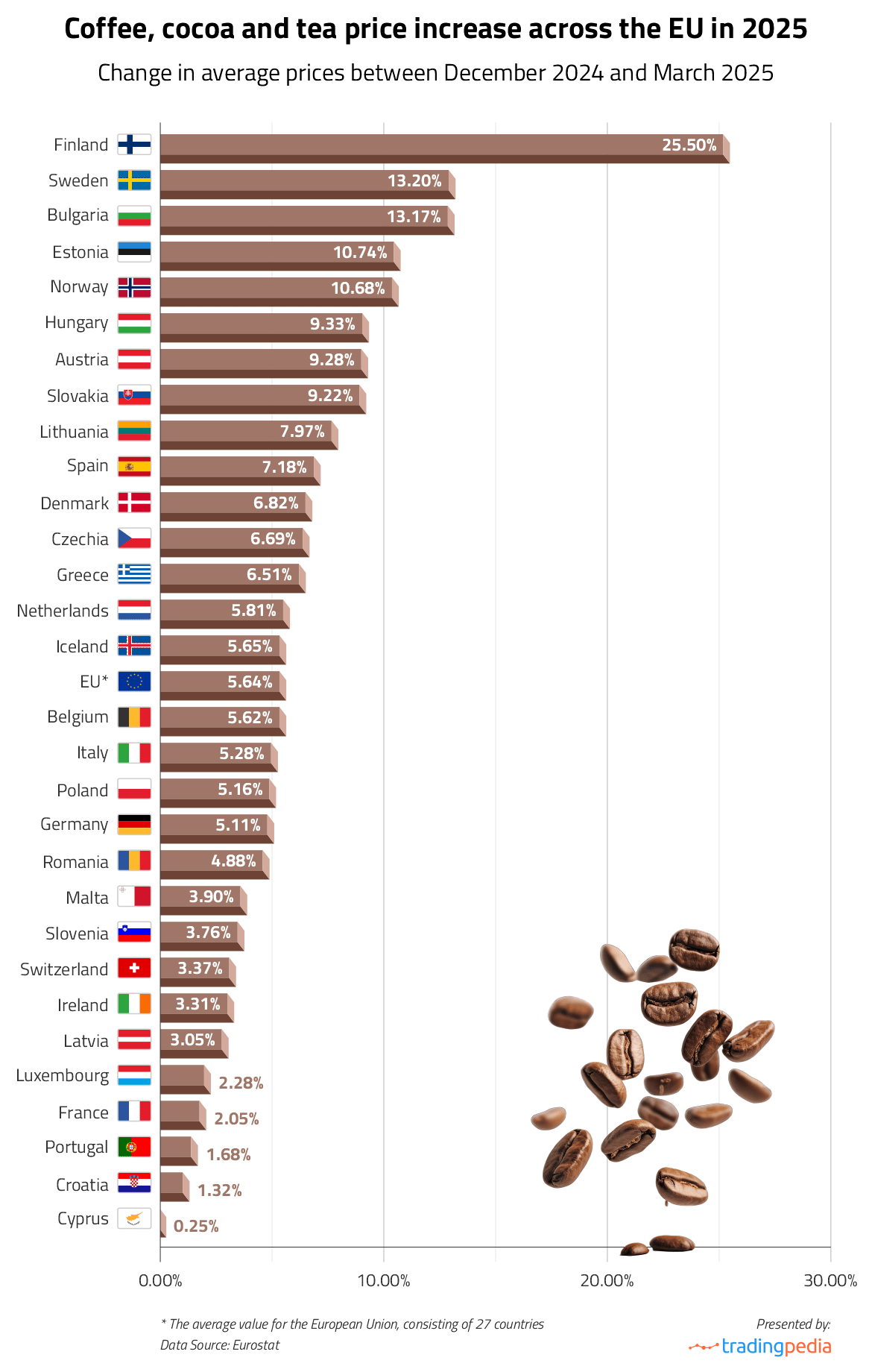
Since January 2025, coffee, tea, and cocoa prices in the European Union on average have experienced an increase of 5.26%. However, a deeper dive into individual European countries shows us that the increase is uneven, especially considering Finland’s 25.50% and Sweden’s 13.20% increases in price for the first three months of the year. From February to March 2025, coffee prices rose by 1.81%. When compared to March 2024, Europe experienced a year-over-year increase of 11.46%, highlighting the sustained upward trend.
Among European countries, Finland recorded the highest increase in coffee, tea, and cocoa prices, with a surge of 25.50%. It was followed by Sweden (13.20%), Bulgaria (13.17%), and Estonia (10.74%).
Here are a few key highlights from our analysis:
- Coffee, tea, and cocoa prices have increased the most in Finland, with a staggering 43.59% year-over-year increase. From February to March 2025, the price was up by 3.20% and the increase for the first three months of 2025 amounts to 25.50%. Fins consume more coffee than anyone else – a surprising 12 kg per capita, per year. That works out to 3 to 5 cups of light roast coffee every day. Far more than anyone else.
- Sweden takes the second spot on our list, with a 13.20% increase in coffee, tea, and cocoa prices during the first three months of 2025, and a year-over-year rise of 25.18%. Bulgaria follows closely, recording a 13.17% increase so far in 2025 and a 19.55% rise compared to the same period last year.
- From February to March 2025, five countries reported a decrease in the prices of coffee, tea, and cocoa. Ireland saw the largest drop at -0.69%, followed by Croatia and Lithuania (both at -0.32%), Denmark at -0.30%, and Cyprus with a slight decline of -0.08%.
How has this change affected the everyday consumer?
In Sweden, coffee prices have risen by approximately 15–20 kronor (around €1.35–€1.80), prompting many everyday consumers to cut back on their weekly coffee intake. In contrast, Danes, despite paying the highest coffee prices in Europe, still consume an average of 8.7 kg of coffee per person each year. Bulgaria, meanwhile, has seen the third-highest price increase in 2025 at 19.6%, yet remains the country with the cheapest coffee, averaging just €1.13 per cup. Interestingly, Bulgarian coffee enthusiasts report that the rising prices have not affected their daily habits – and they have no plans to give up their beloved brew anytime soon.
The countries with the biggest surge in cappuccino price
Although Croatia remains one of the countries with the cheapest regular cappuccinos in restaurants, it recorded the biggest yearly price increase – rising from €1.82 in January 2024 to €2.15 in April 2025, according to Numbeo figures. That marks an 18.12% surge in just over a year. Close behind are Slovenia with a 17.88% increase, Portugal with 13.25%, and Spain with 12.99%. This suggests that even in countries where coffee remains relatively affordable, prices are also rising at a faster pace, reflecting the pressure caused by inflation and the fluctuating market dynamics across all Europe.
The countries with the most expensive cappuccino in 2025 are Denmark, where a regular cup costs €5.51, and Switzerland, where customers pay €5.31 per cup. Norway and Finland follow, with prices at €4.22 and €4.19, respectively. A price increase is evident in these countries as well, with each showing a rise of around 3%. While the pace is more gradual compared to the top climbers on our list, prices in these nations continue to trend upward.
 TradingPedia.com is a financial media specialized in providing daily news and education covering Forex, equities and commodities. Our academies for traders cover