
 | Updated:
 - Jump to:
- Overview
- Individually Managed Accounts
- Pooled Managed Accounts
- PAMM Accounts
- LAMM Accounts
- MAM Accounts
- Key Features
- Reasons to Invest
- Who Should Use It
 Many brokers now offer managed accounts to Forex traders. This type of account is particularly useful for foreign-exchange novices. It takes a good deal of time to become acquainted with all the intricacies of Forex trading, even if you have unrestricted access to various educational materials and free training courses.
Becoming a consistently profitable trader requires significant effort and preparation; otherwise, failure is imminent. With managed accounts, traders can participate indirectly in the Forex market, just as they might in the stock market via mutual funds.
You employ a market professional who uses your capital to execute trades on your behalf in exchange for a predetermined fee. This article explains how managed accounts work and outlines their key features. We also examine who should use a managed account and who should refrain from opening one.
Managed Forex Accounts – What Are They?
 Unlike standard accounts, in which traders actively open and close their own positions, managed Forex accounts are run by experienced professionals who buy and sell currency pairs on their behalf. This account type incurs higher costs because account managers charge extra fees for their services. These fees can vary considerably depending on where you trade.
Of course, you first need to open a live account with a reliable brokerage and transfer the necessary amount of capital to its balance. Note that managers are not in full control of the accounts they handle; their access is limited.
The trader controls functions such as deposits and withdrawals. Upon creating one such account, the trader and the manager are required to sign a Limited Power of Attorney (LPOA) agreement, which ensures high levels of safety and transparency for the trader.
Through this legal document, the two parties agree that the manager may conduct trades on behalf of the account holder without being able to deposit or withdraw funds. Once the LPOA is signed, the managed account is moved to what is known as a ‘master block’.
The actual account holder can review their balance, make deposits and withdrawals, and monitor all trading activities that take place there. The trader may cancel the LPOA at any time. They cannot execute trades on the managed account unless they first cancel this agreement.
Most beginner traders leave signal and strategy decisions to their managers. However, if you are more experienced and already have a specific strategy in mind, you can always instruct your personal manager to implement it.
Another important point is that most managers have specific requirements regarding timeframes and minimum deposits. If you request an early withdrawal, they might even penalize you with additional charges. Moreover, managed accounts usually require significantly higher minimum deposits than standard trading accounts.
It is essential to ensure that the person you choose as your account manager has considerable expertise and a good track record before you allow them to trade on your behalf. Go through the steps below before you set up a managed Forex account:
- Ensure the risk level of your chosen account and manager corresponds to your individual risk tolerance.
- Check the fees and costs associated with running the managed account, along with the minimum deposit requirements. Charges can vary widely across brokerages, account types and risk levels. The high-water mark is also worth considering; this is a monthly fee charged on managed accounts whose net balance has exceeded a predetermined percentage. Depending on the brokerage, you might also have to pay an account-management fee or an account-termination fee.
- Finally, check whether your chosen broker provides a performance history for the managed account. If so, it should cover several years.
There is a common misconception that managed accounts guarantee profits. This is untrue because of the volatility inherent in the Forex markets. All reputable brokers that support managed accounts post disclaimers to warn customers about the possibility of incurring losses.
Types of Managed Accounts
 Managed accounts, also known as slave accounts, are divided into several main groups, each with its own characteristics and features. Brokers that cater to customers with such services usually offer individual or pooled accounts (MAM, LAMM, or PAMM). These acronyms can seem a little intimidating to Forex beginners, so let’s have a look at their main differences.
Individually Managed Accounts
 Individual accounts are the most basic and straightforward category of managed accounts. This is a fully segregated account in which your money manager executes trades on your behalf and follows all your instructions. The manager’s trading decisions depend on your individual risk tolerance and the strategies you map out for them.
The minimum required deposit for an individually managed account is often quite high because the funds are not shared between multiple investors, as is the case with pooled accounts. Customarily, you need to start with an investment of at least $10,000 to open one such account.
It is very important to choose a highly skilled and competent manager since deposits are high and all trades are handled individually for you. Do your research and check other customers’ testimonials before you make your pick.
Pooled Managed Accounts
 This type of account operates much like a mutual fund. As the name implies, the funds of multiple individual investors are pooled together into the same managed account. Each investor who contributes to the pool may have a different level of risk tolerance, a distinct trading strategy, and a unique portfolio of currencies. Fees and costs may also vary between traders.
As with choosing an individual account, you need to do your homework before you decide which pool is best suited to your needs. Obviously, the main difference here is that the same account manager handles the trades of multiple investors.
To determine which pool to join, you must research how different funds have performed over the past several years. The minimum deposit amount is typically lower ($2,000 or less in some cases) because many different people invest in the same pool.
Percent Allocation Management Module (PAMM) Accounts
 This is a subtype of pooled accounts that uses percent-allocation money management. Alpari was the first brokerage firm to launch this type of service back in 2008. The same manager executes trades on behalf of multiple investors, enabling them to work with larger volumes and potentially achieve higher returns.
One professional can simultaneously manage the trading activities of an unlimited number of investors. With PAMM accounts, the positions, profits and losses of the manager are allocated among the different portfolios they handle.
Each trader’s account has an individual PAMM ratio based on the amount they have deposited, hence the name ‘percent allocation money management module’. The risk is distributed among the portfolios of all traders involved in the module.
Each participant can monitor the trading activities of the PAMM manager in real time. This bolsters confidence and gives investors a greater sense of control. Of course, the money manager charges a percentage-based fee outlined in the LPOA agreement.
Below is an example of how PAMM accounts work. We have a single manager who works with three individual investors and charges a 10% fee for their services. The total pool contains investments amounting to $20,000, which is distributed among the four parties involved as follows:
- The trader, i.e. the account manager, contributes 40% to the fund, or $8,000.
- Investor A accounts for 20% of the pool’s value, or $4,000.
- Investor B has provided 30% of the funds, or $6,000.
- Investor C has invested 10% into the fund, or $2,000.
Suppose that after one month, the trader who manages the account boosts the pool’s initial capital to $28,000, which corresponds to a 40% increase. The manager would then apply their 10% fee to the net earnings, i.e. $800. The remaining earnings of $7,200 will be distributed among all four parties as follows:
- The trader/account manager collects $7,200 × 40% = $2,880 in net profit.
- Investor A pockets $7,200 × 20% = $1,440 in net profit.
- Investor B gets $7,200 × 30% = $2,160 in net profit.
- Investor C receives $7,200 × 10% = $720 in net profit.
Since the manager has also contributed capital to the pool, they are less likely to act unfairly toward investors or be sloppy with their money. Of course, no matter how thorough the manager is in their work, there is always the possibility of sustaining losses during a given trading term. If this happens, they will obviously not charge their 10%.
Suppose the manager loses 10% of the account’s capital during the next month. The $28,000 pool would then drop by $2,800 to $25,200. Accordingly, the individual investment of each pool participant would also decrease by 10%.
Lot Allocation Management Module (LAMM) Accounts
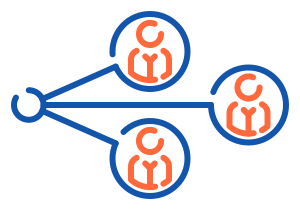 LAMM accounts are considered the predecessors of PAMM accounts. They function in a similar way, with one key difference-here investors determine the number of lots traded on the market. Their gains and losses correspond to the multiples of currency lots they have invested.
Accordingly, if the trader who manages the trades purchases one standard lot, the account of each investor will also increase by a single standard lot. The size of the investors’ accounts is irrelevant in this case.
Of course, this typically works when the managing trader and the investors have assets that are relatively similar in size. LAMM accounts are mostly suitable for people who trade with significant volumes of capital.
Percentage allocation has little significance in this case. Liquidity could be an issue for investors who operate with such large amounts of money. Sometimes, it is impossible to fill their orders in full at the current market price when there is insufficient liquidity in the respective market.
Other than that, LAMM is essentially a copy-trading system. The trader who manages the LAMM account requires the investors to pay a fee. Both the investors and the manager use their individual funds for trading.
The positions the manager opens in the parent account are copied and executed in the sub-accounts of the investors who follow them. The followers can keep track of all trading activities in real time. Each investor can determine their individual copying ratio to manage risk.
Multi-Account Management (MAM) Accounts
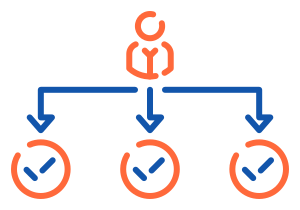 As the name suggests, a MAM account controls multiple sub-accounts. The account manager can increase the leverage on individual sub-accounts when investors instruct them to do so. Similarly, risk levels can also be adjusted separately. The manager can also determine how many lots are traded by each sub-account.
As a general rule, this type of managed account is best suited to the needs of traders with higher risk tolerance and a solid understanding of the market. As with the PAMM account, gains and losses are settled at the end of the trading period under the terms of the agreement investors have signed with their MAM manager.
MAM accounts offer a variety of useful features. Positions are opened instantly on all sub-accounts. Investors have the chance to see comprehensive statistics on executed trades along with a detailed transaction history. They can also monitor the commissions and the manager’s performance in real time.
Key Features of a Good Forex Managed Account
 Now that we have introduced you to the main types of managed accounts, let’s see what features you should consider before you sign up for one. First and foremost, you should register with a reliable and properly regulated brokerage firm that ensures fairness and a transparent environment for managed account holders.
Next, you should consider the track record of your chosen account manager. The person should demonstrate consistent overall profitability. Choosing a manager with a low maximum drawdown level is essential.
The Importance of Low Maximum Drawdown When Trading With a Managed Account
 Drawdown is important because it indicates the amount of capital the manager has lost to unsuccessful trades. Suppose a person starts to trade with a balance of $50,000. After an unsuccessful trade, their equity drops to $42,000, which means their account has suffered a drawdown of $8,000.
In the context of trading with a managed account, the manager’s drawdown reflects the difference between the highest point of the account balance and its next lowest point. The drawdown is calculated by subtracting the equity’s low net value from its high net value and then dividing the result by the equity’s high net value.
Here is a simple example so you can better understand it. Let’s suppose you start with a balance of $20,000. It then skyrockets to $40,000, drops to $15,000, increases to $30,000, again drops to $12,000, and finally increases to $42,000.
In this case, your equity’s highest net value is obviously $42,000 while its lowest net value is $12,000. Therefore, your maximum drawdown equals ($42,000 − $12,000) / $42,000, or 71.4%. Keep in mind this is considered a high drawdown percentage.
Such massive slumps and upturns in one’s equity usually result from high-risk trading decisions. A lower maximum drawdown, on the other hand, can indicate less-volatile investments. It is advisable to compare the account statements of different managers so you can pick the one with the lowest maximum drawdown. The statements should span three to five years.
Apart from the manager’s overall profitability and drawdown, your choice should be based on several other factors, including the trading system the manager uses, whether they deal with derivatives, the signals they rely on, and the software they trade with. Below we post a list of some good Forex brokers that accept managed Forex trading so you can choose one.
Reasons to Invest in a Managed Forex Account
 Some of you are probably wondering why someone would let another person manage their capital for them. Well, there are several valid reasons why people choose to invest in managed Forex accounts. If you open a managed account with a reputable brokerage, you will benefit from high levels of security, transparency and regulatory control.
This is the ideal solution for beginner traders who are not confident enough in their trading skills and knowledge of the markets. Managed Forex accounts enable them to generate healthy profits over a short period.
It is always a better idea to entrust a successful trading professional with your funds rather than opening and closing your positions on hunches. A skilled manager can help you accelerate your learning curve through adequate guidance and advice. Sure, the person will charge you for the service, but you must not forget you are paying for their competence and extensive experience as well as for their time and effort.
Plus, a trader can always cancel their LPOA if they feel they have gained sufficient experience to confidently trade the markets on their own. Then again, some people are interested in investing in Forex but have no time to spare for trading. Using the services of a good account manager will inevitably help them earn something on the side.
Who Should Use a Managed Forex Account?
Setting up a managed Forex account is a great solution for traders who meet the criteria we cover in brief below:
- People who lack sufficient time to observe and trade the markets on their own. Traders who have full-time jobs cannot afford to spare enough time to watch price movements, but success in Forex requires full commitment. Managed accounts enable such people to keep their regular jobs while still earning something extra on the side.
- People who lack sufficient experience are also recommended to give managed accounts a test drive. Forex trading requires knowledge and experience. In their absence, traders are doomed to failure. You are better off in the hands of a skilled manager who knows the markets inside and out rather than trading on intuition. Once you build enough experience, you can revoke your LPOA and start executing trades on your own.
- People who are psychologically unfit to trade. Some traders are simply incapable of keeping their emotions at bay. It is common for such people to desperately hold on to positions that are clear losers. Others consider Forex trading very exciting and have a predisposition to overtrade, which is harmful.
If you recognize any of these qualities in yourself, you are better off leaving a professional trader to manage your positions.
Who Should Refrain From Opening a Managed Forex Account?
As appealing as it seems to have someone else making decisions for you, managed Forex accounts are not for everyone. Carefully read the points below and refrain from setting up a managed account if you cover one or more of them.
- People who have insufficient capital. As we already explained, managed accounts are associated with higher costs. You have to pay a commission to the person who trades on your behalf, not to mention minimum deposits here are significantly larger than those for standard Forex accounts.
- People who insist on retaining full control over their trades. While it is always possible to instruct your manager what signals and strategies they should follow, managed account holders typically have little control over their trading activities.
- People who are unwilling to go through the process of setting up a managed account. We already talked about how one needs to sign an LPOA agreement with a manager before they can open this type of account. In essence, this is a legal document that serves as proof the manager is authorized by the account holder to trade on their behalf. This might be quite a time-consuming process.
- People who lack enough time to conduct proper research on different account managers. With such a broad choice of managers, it is highly recommended to check and compare the track records and performance of as many professionals as possible before making a pick. Otherwise, you risk ending up with a person who has a high maximum drawdown and insufficient experience, which would ultimately cost you money.