
 | Updated:
 - Jump to:
- Main features of the best NFA Forex brokers
- NFA
- CFTC
- Responsibilities and Jurisdiction
- License Requirements
- NFA and CFTC Brokers
- Forex.com
- IG
- TD Ameritrade
Dive into our top list of National Futures Association (NFA)-regulated Forex brokers, tested by our expert team with real money.
 Plus500 USThis content applies only to Plus500 US and clients from the United States. Trading futures involves the risk of loss.
- eToro50% of retail investor accounts lose money
Below, you can find a comparison table of Forex brokers that are regulated by the National Futures Association (NFA). We rank them according to several factors, including regulation, spreads and commissions, Trustpilot rating, trading instruments, trading platforms, and deposit and withdrawal methods.
Our team has thoroughly evaluated all brokers listed below using TradingPedia’s exclusive methodology.
Main Features of the Best NFA Forex Brokers
- Brand
- Trading platforms
- Minimum deposit
- Regulations
- Trading instruments
- Spreads
- Leverage for Forex CFDs
- Leverage for Crypto CFDs
- Leverage for Indices CFDs
- Deposit methods
- Withdrawal Methods
- Commission per Lot
- Contact details
- Trustpilot Rating
 4.2
4.2 - Trading platforms
- Proprietary Mobile
- Plus500Futures
- Minimum deposit$100 (debit cards), $200 (wire transfers)
- Regulations
- CFTC (United States, Licence №: 0001398)
- Trading instruments
- Agriculture futures
- Crypto futures
- Currency Futures
- Energy Futures
- Index Futures
- Interest Rate Futures
- Metal Futures
- Spreads
- Leverage for Forex CFDs
- Leverage for Crypto CFDs
- Leverage for Indices CFDs
- Deposit methods
- Google Pay
- Apple Pay
- Mastercard
- Visa
- Wire Transfer
- Withdrawal Methods
- Mastercard
- Visa
- Wire Transfer
- Commission per LotStandard contract commission* - $0.89, Micro contract commission* - $0.49, and Liquidation fee per contract - $10; *Per side
- Contact details
- Phone Number:
- Email: support@plus500.com
- Headquarter Address: MATAM, Building 22, Haifa, 31905, Israel
- Trustpilot Rating4.1
- Trading platforms
- MetaTrader 4
- Oanda Web
- TradingView
- Minimum deposit$0 ($25 for Trustly, Visa, Mastercard)
- Regulations
- CFTC (United States, Licence №: 0325821)
- CIRO (Canada)
- FCA (United Kingdom, Licence №: 542574)
- JFSA (Japan, Licence №: 4010001122945)
- KNF (Poland, Licence №: KPWiG-4021-54-1/2004)
- MAS (Singapore)
- MFSA (Malta)
- ASIC (Australia, Licence №: 000412981)
- BVIFSC (Virgin Islands, British, Licence №: SIBA/L/20/1130)
- Trading instruments
- Bonds CFDs
- Commodity CFDs
- Crypto CFDs
- Forex CFDs
- Index CFDs
- Metal CFDs
- Spreads
- AUDUSD: AVG 1.4 pips
- EURGBP: AVG 1.7 pips
- EURUSD: AVG 1.4 pips
- GBPUSD: AVG 2 pips
- NZDUSD: AVG 1.7 pips
- USDCAD: AVG 2.2 pips
- USDCHF: AVG 1.8 pips
- USDJPY: AVG 1.4 pips
- Leverage for Forex CFDs
- Leverage for Crypto CFDs
- Leverage for Indices CFDs
- Deposit methods
- Credit & Debit Cards
- Mastercard
- NETELLER
- Bank Transfer
- Skrill
- Visa
- Withdrawal Methods
- Credit & Debit Cards
- NETELLER
- Bank Transfer
- Skrill
- Visa
- Commission per Lot$3.50 on Zero Accounts
- Contact details
- Phone Number: +853 6825 8512
- Email: frontdesk@oanda.com
- Headquarter Address: Kingston Chambers, PO Box 173, Road Town, Tortola, British Virgin Islands
- Trustpilot Rating3.7
- Trading platforms
- Proprietary Mobile
- Proprietary Web
- Minimum deposit$0
- Regulations
- Trading instruments
- Bond Futures
- Bonds CFDs
- Commodity CFDs
- Crypto CFDs
- ETF CFDs
- Forex CFDs
- Index CFDs
- Metal CFDs
- Mutual Funds
- Share CFDs
- Stock Options
- Spreads
- AUDUSD: MIN 0.2 pips
- EURGBP: MIN 0.3 pips
- EURUSD: MIN 0.2 pips
- GBPUSD: MIN 0.2 pips
- USDCAD: MIN 0.2 pips
- USDCHF: MIN 0.2 pips
- USDCNY: MIN 2.9 pips
- USDJPY: MIN 0.2 pips
- Leverage for Forex CFDs
- 1:30 (ASIC | IBKR Lite)
- 1:30 (CBI | IBKR Lite)
- 1:30 (FCA | IBKR Lite)
- 1:25 (JFSA | IBKR Lite)
- 1:20 (MAS | IBKR Lite)
- 1:500 (Pro Account)
- Leverage for Crypto CFDs
- 1:2 (IBKR Lite)
- Leverage for Indices CFDs
- Deposit methods
- Bank Transfer
- Check
- ACH
- Withdrawal Methods
- Bank Transfer
- Check
- ACH
- Commission per LotFrom 0.08 to 0.20 bps x trade size
- Contact details
- Phone Number: 00800-42-276537
- Email: help@interactivebrokers.com
- Headquarter Address: One Pickwick Plaza, Greenwich, CT 06830 USA
- Trustpilot Rating1.6
- Trading platforms
- Thinkorswim
- StreetSmart Edge
- Minimum deposit$0
- Regulations
- CFTC (United States, Licence №: 0477394)
- FCA (United Kingdom, Licence №: 225116)
- FINRA (United States, Licence №: 5393)
- MAS (Singapore, Licence №: 200902152D)
- SEC (United States)
- HKSFC (Hong Kong, Licence №: ADV256)
- Trading instruments
- Agriculture futures
- Crypto futures
- Currency Futures
- Energy Futures
- ETFs
- Index Futures
- Interest Rate Futures
- Metal Futures
- Mutual Funds
- Options
- Spot Bonds
- Spot Stocks
- Spreads
- Leverage for Forex CFDs
- Leverage for Crypto CFDs
- Leverage for Indices CFDs
- Deposit methods
- Wire Transfer
- Check
- Withdrawal Methods
- Wire Transfer
- Check
- Commission per Lot$0 base commission
- Contact details
- Phone Number: +14156677870
- Email:
- Headquarter Address: 1945 Northwestern Drive El Paso, TX 79912-1108, USA
- Trustpilot Rating4.6
- Trading platforms
- MetaTrader 4
- MetaTrader 5
- Forex.com
- Minimum deposit$100
- Regulations
- CFTC (United States, Licence №: 0339826)
- CIMA (Cayman Islands, Licence №: 25033)
- CIRO (Canada, Licence №: StoneX Financial (Canada) Inc.)
- CySEC (Cyprus, Licence №: 400/21)
- FCA (United Kingdom, Licence №: 446717)
- JFSA (Japan, Licence №: 2010401047199)
- MAS (Singapore, Licence №: StoneX Financial Pte. Ltd.)
- Trading instruments
- Bond Futures
- Bond Options
- Bonds CFDs
- Commodity CFDs
- Commodity Futures
- Commodity Options
- Crypto CFDs
- Crypto Options
- Currency Futures
- Energy Futures
- Energy Options
- ETF CFDs
- ETF Options
- Forex CFDs
- Forex Options
- Index CFDs
- Index Futures
- Index Options
- Interest Rate Futures
- Metal CFDs
- Metal Futures
- Metal Options
- Share CFDs
- Stock Options
- Spreads
- AUDUSD: AVG 1.3 pips
- EURGBP: AVG 1.6 pips
- EURUSD: AVG 1.3 pips
- GBPUSD: AVG 1.8 pips
- NZDUSD: AVG 2.1 pips
- USDCAD: AVG 2.8 pips
- USDCHF: AVG 2 pips
- USDJPY: AVG 1.6 pips
- Leverage for Forex CFDs
- 1:30 (ASIC)
- 1:50 (CFTC)
- 1:200 (CIMA)
- 1:30 (CIRO)
- 1:30 (CySEC)
- 1:30 (FCA)
- 1:200 (MAS)
- 1:400 (Pro Account)
- 1:25 (JFSA)
- Leverage for Crypto CFDs
- 1:20 (Pro Account)
- 1:2 (Standard Account)
- Leverage for Indices CFDs
- Deposit methods
- Mastercard
- NETELLER
- Skrill
- Visa
- Wire Transfer
- Withdrawal Methods
- Mastercard
- Visa
- Wire Transfer
- Commission per Lot$0 for Standard accounts; $5 per standard lot per side for Raw accounts
- Contact details
- Phone Number: +1 908 315 0653
- Email: global.support@forex.com
- Headquarter Address: 30 Independence Blvd Suite 300 (3rd floor), Warren, NJ 07059, USA




Although the foreign exchange market is decentralized and not controlled or monitored by any single authority, it is regulated on a national level. In the United States, one of the most important regulatory bodies is the NFA. The National Futures Association (NFA) works closely with other authorities to establish fair, secure, and transparent practices in the Forex market.
When discussing regulated Forex trading, we should keep in mind that the United States enforces some of the toughest rules and regulations in the world. With its banks, mutual funds, and financial services firms, it is nevertheless one of the biggest players in the Forex market. The US dollar (USD), issued by the Federal Reserve, is the most traded currency on the planet, accounting for 88.3% of daily turnover, which already exceeds $6 trillion.
Clearly, the United States and its economy are extremely important for the global foreign exchange market. However, how does NFA regulation affect traders? This article focuses on the Association, its history and responsibilities, and its role in supervising Forex brokers in the US.
The National Futures Association
 The National Futures Association, or NFA, was established in 1981 after it received a formal ‘registered futures association’ designation from the Commodity Futures Trading Commission (CFTC) in the US. It began operations the following year and, since then, has worked to safeguard the integrity of the derivatives markets in the country, protect and educate investors, and combat fraudulent activities and malpractices. It is based in Chicago and also has an office in New York City.
Unlike the financial regulators in many countries around the globe, the NFA acts as a self-regulatory organization for the US derivatives industry. It is an independent, industry-wide, nonprofit organization that operates at no cost to taxpayers. Instead, it is funded exclusively by membership and assessment fees paid by market participants. Moreover, membership is mandatory for all firms acting as counterparties to retail Forex transactions, Forex pool operators, trading advisers, and introducing brokers.
There are several business entities that are NFA members:
- Introducing brokers — an individual or organization that accepts orders to buy or sell futures contracts, Forex, commodity options, or swaps but does not accept money or other assets from customers to support these orders. All Forex and futures accounts must be carried by a futures commission merchant (FCM) or retail foreign exchange dealer (RFED).
- Futures commission merchant — a firm that accepts orders to buy or sell futures contracts, options on futures, retail off-exchange Forex contracts, or swaps, and accepts money or other assets from customers to support such orders. Customers who trade futures through an introducing broker (IB) have their trades executed and cleared through an FCM. FCMs also collect margin from clients.
- Forex dealer members (FDMs), or retail foreign exchange dealers (RFEDs) — firms that act as counterparties to off-exchange, over-the-counter (OTC) foreign currency transactions in which buying and selling financial instruments do not involve an exchange.
In addition, the NFA offers membership to several other categories of organizations and businesses, including commodity pool operators, commodity trading advisers, and swap dealers. Overall, the NFA requires almost every participant in the futures and Forex markets to register. Applicants must meet stringent requirements and pass all background checks before being granted membership status. They also need to comply with a wide set of rules regarding integrity, financial stability, advertising and marketing policies, and many others.
Traders should understand that while Forex trading is legal and regulated in the country, contracts for difference (CFDs) are not allowed. This is why Forex brokers based in the USA typically have limited product offerings compared with European brokers, who usually give access to stock, index, and commodity CFDs.
NFA and the Commodity Futures Trading Commission
 When discussing the NFA, we should also mention the Commodity Futures Trading Commission (CFTC) because the two authorities work in cooperation and cannot provide effective regulation of the futures and Forex industry separately. The CFTC was founded by Congress in 1974 as a government agency with full jurisdiction over the futures trading sector in the country. The Commission enabled the creation of the NFA and several other associations in the following decade.
While the CFTC provides government oversight for the entire industry, the NFA has a specific area of authority—it regulates every firm that offers futures trading services to public customers. As mentioned above, the NFA is an industry association, but it is not a trade association; it does not operate any markets and is not directly linked to any single market or exchange. Its work is overseen by the CFTC.
NFA’s Responsibilities and Jurisdiction
 The self-regulatory organization provides various services, including education for investors and trading professionals, market surveillance, and regulatory services. The NFA has introduced rigorous registration requirements for anyone who wishes to conduct futures trading with the public. Firms (or individuals) must pass comprehensive proficiency tests. They are screened and must provide fingerprint cards for background checks. If brokers cannot meet NFA standards, the authority can revoke, deny, restrict, or impose conditions on registrations.
The compliance rules set by the NFA cover multiple areas, including risk disclosure, discretionary trading, disclosure of fees, minimum capital requirements, proficiency testing, advertising, telephone solicitations, and many others. The regulator performs regular audits and inspections of its members. To enforce compliance with NFA and CFTC rules, it also conducts financial surveillance.
The NFA provides educational resources for investors, as well as licensing and disciplinary information for market participants, brokers, and other intermediaries. Its Background Affiliation Status Information Center (BASIC) is an online database that can be accessed freely from its official website. Traders can use it to check whether a firm is authorized to offer its services in the United States legally and whether any disciplinary actions have been taken against it.
The authority also offers arbitration and mediation services to resolve disputes in any area of futures and Forex trading. It accepts complaints and arbitration claims online as well. Even more important, the NFA has the authority to take disciplinary action against firms or individuals who violate the rules. These measures include warning letters and official complaints that can result in serious penalties—reprimand, censure, expulsion, or suspension for a fixed period.
Moreover, the NFA may prohibit a firm from associating with NFA members in the future. It also issues fines of up to $250,000 per violation. To ensure effective prosecution, the authority collaborates with the CFTC, the FBI, and other law-enforcement agencies.
License Requirements for US Forex Brokers
 To offer Forex brokerage services to traders based in the United States, firms must be registered with the CFTC and the NFA. Typically, they are registered as retail foreign exchange dealers and introducing brokers. To receive authorization, they need to have offices in the country and comply with all requirements of the CFTC and the NFA. They must provide transparency and the highest levels of investor protection.
According to current rules, firms registered as futures commission merchants and acting as counterparties to a Forex transaction must maintain an ‘adjusted net capital’ of at least $20 million. Forex brokers are also required to keep clients’ funds in segregated accounts and are not allowed to use these funds for operational activities. In addition, they must submit regular financial reports, and their staff must pass special exams.
Brokers also have to collect and maintain a minimum security deposit for every transaction from their clients. The deposit must be 2% of the notional value of transactions in GBP, CHF, CAD, JPY, EUR, AUD, NZD, SEK, NOK, and DKK, or 5% for all other currencies. The leverage offered to traders is limited to 1:50 for major currency pairs and 1:20 for minor pairs. Hedging is not allowed, and the FIFO (First In, First Out) rule has been implemented. Additionally, traders cannot fund their Forex accounts using a credit card; CFDs are banned.
NFA- and CFTC-Regulated Forex Brokers
 Due to strict regulation and multiple restrictions regarding the futures and Forex markets in the United States, only a few Forex brokers operate in the country. This limited selection should make traders’ choices much easier than expected.
Forex.com
 Operated by Gain Capital Holdings, Inc., a company founded in 1999, Forex.com is currently the most popular Forex broker in the United States. Its website is user-friendly, and account registration takes just a few minutes. The broker offers competitive spreads and overall attractive pricing, coupled with fast execution of orders through several different platforms—MetaTrader 4, mobile apps for iOS and Android, its own proprietary platform, and additional services through APIs and NinjaTrader.
Forex.com is a registered FCM and RFED with the CFTC and an NFA member. It provides clients with high levels of security, professional customer support, and excellent educational tools and guidance. Traders can sign up for a demo account or trade live through a standard, commission, or DMA (direct market access) account. The minimum deposit for the standard account is $50, and the maximum leverage is 1:50.
IG
 Based in London, IG is one of the leading Forex and CFD brokers in the world. Established in 1974, it has since expanded globally, including into the United States, where it offers clients access to more than 80 Forex markets. With spreads from only 0.8 pips, it provides competitive pricing and both web-based and downloadable desktop and mobile platforms. In addition, clients can access ProRealTime, an online charting program for technical analysis and trading that is integrated with the IG trading platform.
The broker features a comprehensive educational section on its website where traders can learn more about Forex risk management, strategies and planning, technical analysis, fundamental analysis, Forex volatility, and more. IG is registered as an RFED and IB with the NFA and the CFTC. However, IG US accounts are not available to residents of Arizona or Ohio.
TD Ameritrade
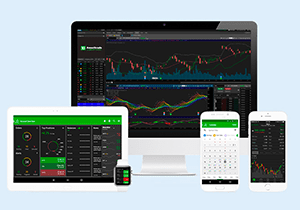 TD Ameritrade is best known as one of the top US stock brokers, but through its electronic trading platform it also offers trading in futures contracts, exchange-traded funds, options, cryptocurrency, mutual funds, and Forex. The company also deals in fixed-income investments, cash management, fixed and variable annuities, and managed portfolios and is a preferred provider of retirement plans and solutions.
Through its thinkorswim platform, TD Ameritrade provides access to more than 75 FX pairs. Traders can take advantage of its fast, intuitive mobile app, as well as its professional-grade desktop trading platform. The platform offers advanced tools to perform analyses and test strategies, social signals, financial news from Yahoo! Finance, educational resources, and much more. TD Ameritrade is publicly traded and registered with the NFA and CFTC.