
 | Updated:
 - Jump to:
- How NDD Brokers Work
- ECN
- Straight-Through Processing
- STP Brokers Explained
- Benefits of the STP Model
- ECN Brokers Explained
- Benefits of ECN Brokers
- NDD and DD Models Brokers
There are three main types of brokers: market makers, ECN and STP. Each of these types has its pros and cons, and inexperienced traders often struggle to determine which broker is best suited to their needs.
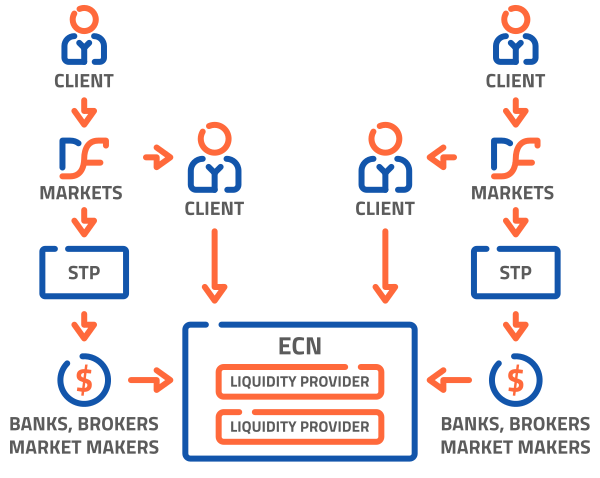
Market makers are very popular but are also among the worst broker types because they profit when you lose—and vice versa. If you want to work with reputable, trustworthy and friendly brokers, you should focus on ECN or STP brokers.
In this article, you’ll learn about the differences between STP and ECN brokers and why they may be better than market makers. We also look at a new breed of hybrid brokers that combine these two models and outline the main benefits STP and ECN trading can offer to investors.
How No Dealing Desk Brokers Work
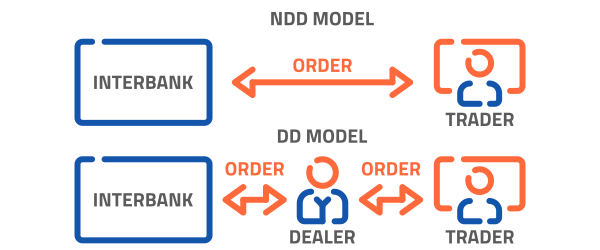
There are two main categories of brokers on the Forex market, and the first one comprises the so-called Dealing Desk (DD) brokers, also known as market makers. As the name implies, such brokerage companies ‘make the markets’ by determining the bid-ask spreads via their dealing desks.
Customers’ orders are never quoted at the exact market prices because of the built-in spread that ensures a profit for DD brokers. Another peculiarity of market makers is that they sometimes issue requotes because customers’ orders are not routed directly to the interbank market.
The market maker chooses to accept or decline a client’s order depending on factors such as volatility and news reports. In the best-case scenario, your positions are matched against those of other customers. However, if this proves impossible, a DD broker will either take the counterparty position or pass the order to another liquidity provider.
A DD broker usually pays for winning trades straight from its own account. Accordingly, such a brokerage earns money when its customers close their positions at a loss, and vice versa.
This is not the case with No-Dealing-Desk (NDD) brokers, which rely on straight-through processing (STP) or electronic communication network (ECN) technologies to route their clients’ orders straight to other liquidity providers.
This provides traders with direct access to the interbank market, where their orders are filled faster and at better prices. An NDD broker essentially acts as a bridge between its customers and the liquidity providers.
There are no requotes when one works with an NDD broker. The trader is exposed to multiple liquidity pools, which enables them to obtain the best bid and ask prices. Another difference is that NDD brokers charge additional commissions for passing the spreads from liquidity providers to customers.
Electronic Communication Networks (ECN)
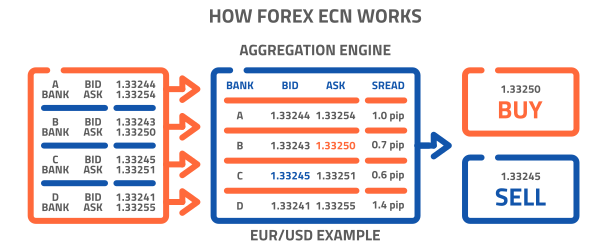
ECN brokers rely on Electronic Communication Networks (ECN) for their operations. An ECN is a digital system that automatically matches buy and sell orders for financial products. Forex currency pairs and stocks are the two most common products traded via this computerized network.
The most well-known electronic communication networks to date include the prototype Instinet (launched in the late 1960s), NYSE Arca and SelectNet. Some of these systems are intended for institutional investors, while others were created specifically with retail investors in mind.
The ECN links major brokers, individual traders and liquidity providers, enabling them to execute trades directly among themselves without the services of any middlemen. This ensures a high level of anonymity for traders who use ECN brokers.
Another benefit of the ECN is that it enables investors to trade outside conventional hours. This is a great solution for people who cannot actively participate in the markets during normal trading hours or who are looking for broader availability and more flexibility.
The ECN model offers several other advantages for retail traders, including lower spreads, faster order execution, improved liquidity and price transparency. The ECN also enables financial institutions to decrease their overall costs because it reduces manual effort.
Straight-Through Processing (STP)
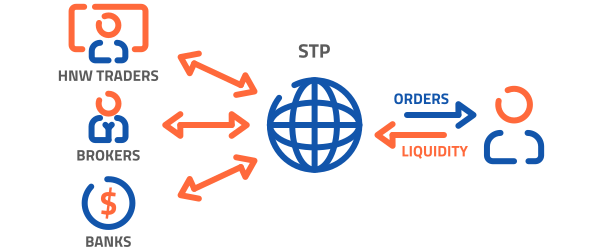
Many major financial institutions and large corporations utilize the straight-through processing (STP) method. STP systems allow fully automated financial transactions with no manual intervention, hence the name ‘straight-through processing’.
Such systems were first devised in the early 1990s and were intended for use in the equity markets. The biggest benefit of STP is that it saves time. The entire trading cycle, from the orders’ initiation to their final settlement, is handled automatically without human intervention.
Orders are processed in real time. They are sent directly from the trader to different liquidity providers in the interbank market without any broker intervention. Traders’ orders are filled at better prices because they have direct access to the interbank market.
The orders do not pass through dealing desks. Instead, the STP broker passes them ‘straight-through’ to different liquidity providers such as banks or larger brokerages. In turn, this prevents requotes and order execution delays. The STP system comes with several advantages, including shorter processing times, decreased settlement risk and lower operational costs.
STP Brokers Explained
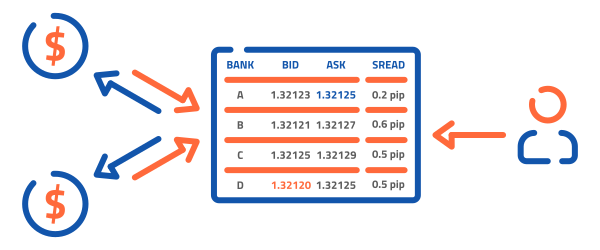
STP brokers are less common, but many traders still consider them the best choice—and for good reason. Interestingly, they combine the characteristics of ECN brokers and market makers. Their method of operation is a bit complicated, so read carefully if you want to learn more about STP brokers and how they work.
When a Forex broker uses a straight-through processing system, it routes traders’ orders directly to different liquidity providers in the interbank market. These could be large banks, counterparty investors, major investment corporations or hedge funds. An STP broker connects traders directly with the interbank market.
No intermediaries are involved because customers’ orders do not pass through a dealing desk. The absence of a middleman eliminates delays in filling the orders and the need to issue requotes. Since customers have direct market access, their orders are filled at the most competitive prices.
This leads us to the question of how STP brokers earn money. The answer is by adding a nominal mark-up to the bid-ask spreads offered by their liquidity providers. STP brokers offer floating spreads that depend on market conditions, while the mark-up is usually fixed.
STP brokers also allow their customers to execute trades during financial news releases, which is something that cannot be said about dealing desk market makers. This, combined with the lightning speed of order execution, renders STP brokers the perfect choice for scalpers and news traders.
There is more anonymity and zero conflict of interest here. STP brokers aggregate buy and sell prices from multiple liquidity providers, adding the nominal mark-up mentioned earlier. A trader places an order and the brokerage transfers it to one of its liquidity providers, retaining the profit from the tiny difference in the spread.
The STP system sorts the buy and sell prices from the best to the worst and then applies the mark-up. Accordingly, if liquidity providers increase their spreads, the STP broker responds by widening theirs with a larger mark-up.
Investors are, in essence, trading against fellow market participants rather than the brokerage, which does not benefit from the losses of its customers. In fact, the opposite is true. If the clients of an STP broker lose too much money, they will stop placing new orders, and the broker will no longer earn money consistently from the market.
Why Forex Brokers Prefer the STP Model
 You can probably guess why an increasing number of traders prefer STP brokers. The model’s advantages from a trader’s perspective are obvious. However, straight-through processing systems are also beneficial to brokers for several reasons.
The first and most compelling reason concerns the reduction in operational costs. Using an STP system is often less costly than operating a dealing desk because the broker saves on salaries.
Less work is involved when it comes to risk management since an STP broker merely passes traders’ orders to its liquidity providers. Unexpected market movements therefore do not affect the broker itself.
The STP model translates into fewer headaches for brokers. They do not have to worry about crucial news releases and unexpected adverse movements in market prices. Much like traders, brokerage firms are also at the whim of market conditions. As a general rule, market makers who set their own buy and sell prices have it easier when dealing with volatile market conditions compared to quieter periods.
Nevertheless, it is challenging for a DD broker to make accurate revenue predictions because they can never be absolutely certain when, and by how much, market prices will move. This is no issue for an STP broker, whose revenue normally remains consistent regardless of adverse price movements and poor market conditions.
Human errors in order execution are also impossible when a fully automated STP system is in place. Orders via an STP system are filled faster, which leads to a better experience for customers. The STP brokers themselves benefit from these higher levels of client satisfaction.
Such brokerages profit from the mark-ups on spreads rather than from their customers’ losses, as is common with market makers. If customers are pleased with the overall service, they will continue to trade on the respective STP platform, generating consistent revenue for the broker through the mark-ups.
Benefits of the STP Model From the Traders’ Perspective
Brokers are not the only ones to benefit from straight-through processing systems. The STP model offers many advantages to traders as well. We outline the main positives of trading with an STP brokerage below.
- There is no conflict of interest because of the way traders’ orders are executed. Unlike market makers, STP brokers do not have to resort to hedging, i.e., taking positions opposite to those of their clients. Instead of profiting from customers’ losses, brokers using this model generate revenue from the small commissions (the mark-up) they charge on each trade.
- The STP system ensures higher levels of anonymity because it directly connects traders with the liquidity providers the broker works with. As a result, customers gain instant access to more liquidity and better interbank prices. This is especially beneficial for scalpers, who do not have to deal with issues such as slippage and requotes. This also benefits news traders. The exposure of a market maker increases beyond certain predetermined levels after important news releases, which may cause them to reject some customers’ orders. A news trader is spared these hassles when trading with an STP broker.
- STP brokers provide traders with deeper access to the markets. Companies that rely on this model aggregate market prices from multiple liquidity providers. This translates into better trade execution, greater transparency and more competitive pricing for customers.
- Orders are filled more quickly because they do not go through a dealing desk. Everything is processed automatically by the system, which eliminates delays and the need for requotes.
ECN Brokers Explained
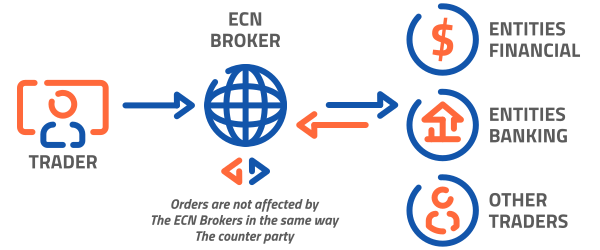
Just like STP trading platforms, ECN brokers give traders direct access to the real interbank market. This means the broker’s profits and losses are not based on the success of traders. Instead, ECN brokers rely on commissions to make money.
The electronic communication network connects traders directly with the broker’s liquidity providers. In terms of execution, it functions identically to an STP system. Rather than trading against your broker, you trade against other market participants such as banking institutions, larger brokerages, hedge funds, private traders and so on.
All of these entities are essentially trading against one another by offering their sharpest buy and sell prices to others. This provides ECN brokers’ customers with access to the depth of the market, which makes manipulation of market prices impossible. The depth of market contains all quoted prices for a given market along with the proposed trading volume for each bid-ask quote level.
Traders can compare their order execution prices with those of other market participants who have access to the same price feed. Another important point is that liquidity providers compete with each other for greater trading volumes, which motivates them to offer better quotes. ECN orders are executed at the most competitive prices; when liquidity is insufficient to fill them, the second-best prices are used.
One main difference between ECN and STP brokers is that the former do not rely on bid-ask spreads or mark-ups to generate revenue. Instead, they profit by charging customers a nominal fixed commission on each position they open. In most cases, this commission is $10 per round lot, but it might be less or more depending on different factors.
The absence of a mark-up leads to ultra-tight spreads, which can gravitate toward zero pips. Much like their STP counterparts, ECN brokers quote only floating spreads. Fixed spreads are impossible in such an environment because prices are aggregated from many different sources of liquidity. This makes true ECN brokers easy to spot—you only need to look for variable spreads.
Keep in mind that ECN brokers have very high requirements for minimum deposits and lot sizes. This makes them unsuitable for most retail customers and small-scale investors. It has become the norm for ECN brokers to impose a minimum trade size of one mini lot, which is 1/10 of one micro lot. Minimum deposits vary from $50,000 to $100,000 in some instances.
Benefits of ECN Brokers
Despite the higher minimum deposits and larger lot sizes ECN brokers require, they are becoming the preferred choice of many traders because they offer multiple advantages, including the following:
- The interests of customers and brokers are perfectly aligned because ECN brokers never trade against their clientele. Your orders are matched with those of other market participants. The ECN broker merely serves as an intermediary between participants. Whether your trades win or lose is irrelevant because the broker profits from the commissions it charges. It is actually beneficial for an ECN broker if its clients win money. This enables them to grow their accounts and trade larger volumes, which works well for the broker.
- The manipulation of market prices is impossible with ECN brokers, which ensures fair and fully transparent trading conditions. This is because such brokerages display market prices from multiple liquidity providers instead of setting their own bid-ask prices, as market makers do. ECN clients also have direct access to the depth of market, which further enhances transparency.
- Trades are executed immediately and at much tighter spreads than those offered by market makers. Many different liquidity providers compete for trading orders. This motivates them to offer the tightest possible prices in an attempt to win traders over and beat the competition.
- Access to real-time interbank prices prevents the issuing of requotes, a common problem for those who use the services of market makers. Requoting has a negative influence on long-term trading performance. It normally occurs when a broker declines to fill an order due to changes in the traded asset’s market price. The requotes offered by market makers rarely work to the advantage of traders.
Forex Brokers Combining the NDD and DD Models
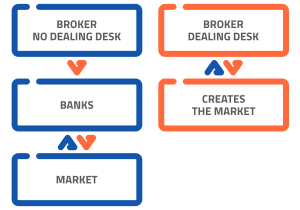 Some Forex brokers rely on a combination of NDD and DD models, as this enables them to cater to a broader spectrum of customer preferences. It is common for such firms to provide clients with a choice of both ECN and STP account types while at the same time still acting as market makers.
Professionals and larger-volume traders can set up ECN accounts. Meanwhile, the trades of retail small-scale investors must still pass through a dealing desk because major liquidity providers are generally uninterested in handling their small trading volumes.
In this way, hybrid brokerages can focus on other important areas, such as customer support, market analysis and educational resources. The combination of ECN and STP also furthers the complete automation of order entries, trade execution and spread pricing.