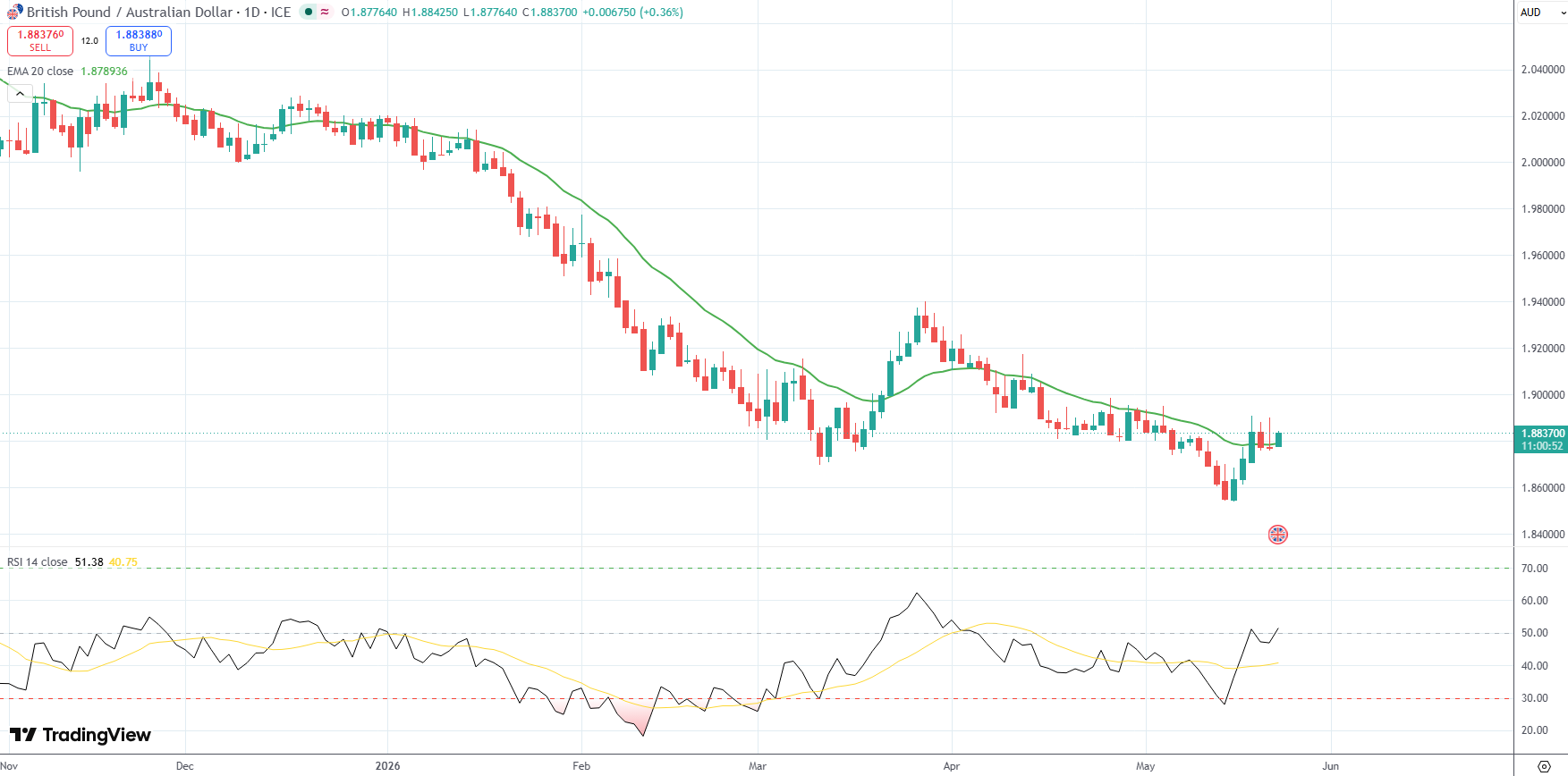
The Australian Dollar was largely weaker against the British Pound on Friday, with the GBP/AUD pair trading not far from a 2-week high of 1.8909, as Australian labor data reinforced expectations that the Reserve Bank of Australia might delay any additional policy tightening at its upcoming June meeting.
Australia’s unemployment rate has risen to 4.5% in April, marking its highest level since late 2021.
The unexpected increase has shifted market pricing for RBA policy, as investors now see the data as giving the central bank greater justification to pause rather than proceed with a fourth rate hike this year.
Swaps indicated an 11.7% probability of a rate hike at the RBA’s next meeting in June, signaling that traders are largely discounting further tightening in the near term.
Meanwhile, the British Pound showed a rather muted reaction to recent weak UK macroeconomic data, which did little to dampen market expectations of future BoE policy tightening.
New data by the UK Office for National Statistics showed that retail sales had decreased 1.3% in April, following a revised 0.6% drop in March.
This followed softer UK consumer inflation readings and an unexpected increase in the UK unemployment rate.
Market participants continued to factor in the likelihood of at least one interest rate hike by the BoE in 2026.
BoE Governor Andrew Bailey stated on Wednesday that a rise in market interest rates since the start of the Iran war had given the central bank more time to evaluate the economic implications of the conflict.
Sterling bulls, however, remained cautious amid serious leadership challenges facing UK Prime Minister Keir Starmer.
GBP/AUD was last up 0.36% on the day to trade at 1.8837.
 TradingPedia.com is a financial media specialized in providing daily news and education covering Forex, equities and commodities. Our academies for traders cover