Key Moments:
- Three analysts lowered their price targets for Apple (AAPL) ahead of its March earnings report.
- Tariff-related concerns triggered downward adjustments in future iPhone and wearable unit estimates.
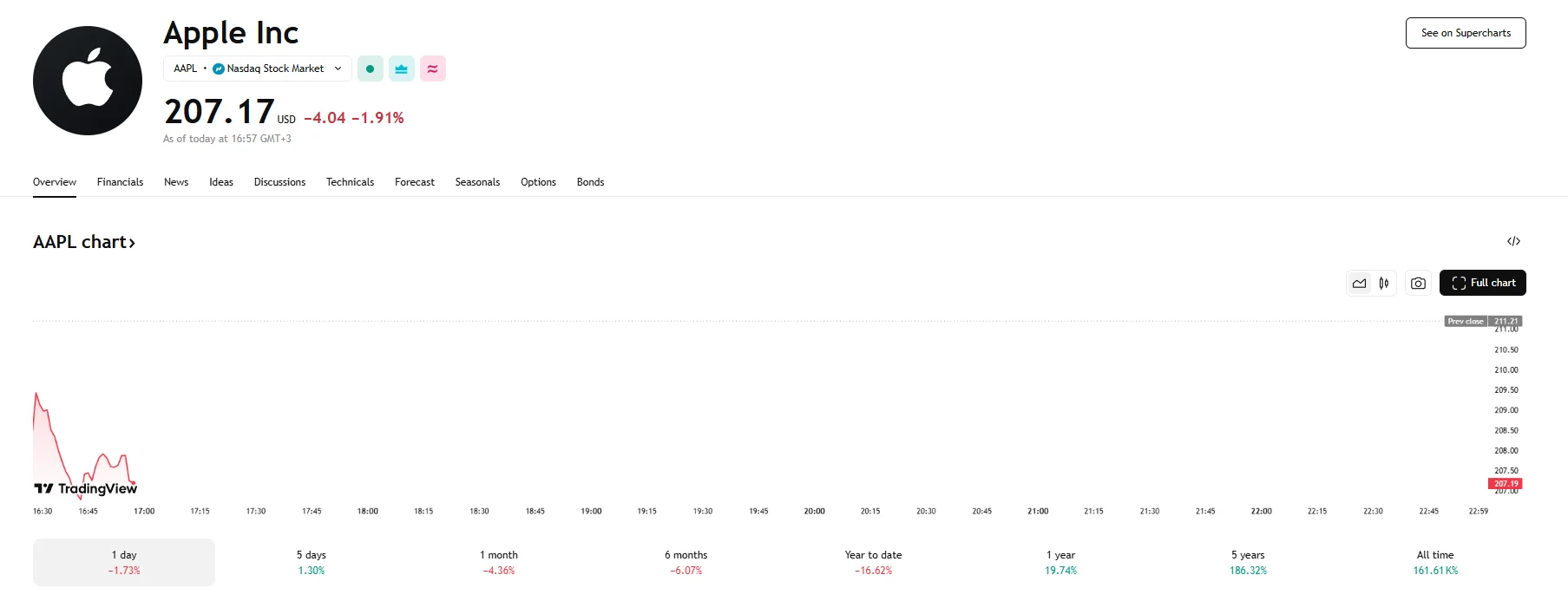
- Apple shares slipped 1.9%, hitting $207.17.
Analysts Turn Cautious on Apple Before Earnings
Several analysts on Wall Street have reduced their price targets for Apple Inc on Wednesday. These revisions were announced in advance of the company’s fiscal second-quarter earnings, which are scheduled to be released later this week. April 30th also saw Apple’s stock price drop shortly after the opening bell, falling by nearly 2% to $207.17.
Loop Capital’s Ananda Baruah adjusted his price target downward from 230 to 215. His decision stemmed from supply-chain data linked to iPhone production. He did, however, keep his hold rating when it comes to Apple shares.
In addition, Tim Long of Barclays maintained an underweight rating as he trimmed his price target to 173, down by 24. According to Long, the March and June financial quarters should remain relatively stable owing to inventory restocking, which will not be impacted by the US administration’s tariff politics. However, he sees mounting pressure in the latter half of 2025, when Trump’s duties on electronic goods are set to affect global markets.
Long continued, stating that Barclays was reducing its September quarter and fiscal 2026 unit estimates for iPhones. He attributed this to weakening demand, possible cost increases, and the delayed release of Siri, which in turn would postpone the widespread use of Apple Intelligence. He added that Barclays’ unit estimates for wearables and AirPods for the second half of calendar year 2025 were also being decreased. He explained that these product categories were more sensitive to economic conditions and, therefore, more vulnerable to price hikes, decreased demand, and macroeconomic deceleration.
Tuesday witnessed Srini Pajjuri of Raymond James lower Apple’s share price target to 230 from the previous 250. Although he also maintained the outperform rating, he suggested tariffs could weigh down Apple’s earnings per share by between 8% and 10%. According to Pajjuri, Raymond James expects Apple to raise prices for US clients, which in turn is likely to dampen demand. He noted that the net effect could still lead to lower earnings per share (EPS). Regarding the stock’s near-term performance, Raymond James anticipates continued volatility due to tariff-related news. Pajjuri did note, however, that any downward movement in the stock price should be seen as a chance to increase holdings.
 TradingPedia.com is a financial media specialized in providing daily news and education covering Forex, equities and commodities. Our academies for traders cover