Yesterday’s trade saw USD/JPY within the range of 123.33-124.01. The pair closed at 123.95, soaring 0.32% on a daily basis, or the most considerable daily gain since July 15th, when it appreciated 0.32%. The daily high has also been the highest level since July 24th, when the cross registered a high of 124.12.
At 8:44 GMT today USD/JPY was up 0.17% for the day to trade at 124.16. The pair touched a daily high at 124.25 at 7:15 GMT. It has been the highest level since July 21st, when a high of 124.50 was recorded. The cross managed to overcome the range resistance level (R3) and is set to test the key range breakout level (R4) at 124.32.
Today the cross may be influenced by a number of macroeconomic reports as listed below.
Fundamentals
United States
Initial, Continuing Jobless Claims
The number of people in the United States, who filed for unemployment assistance for the first time during the week ended on July 24th, probably increased to 270 000, according to market expectations, from 255 000 in the prior week. The latter has been the lowest number of claims since November 1973 The 4-week moving average, an indicator lacking seasonal effects, was 278 500, marking a decrease of 4 000 compared to the preceding weeks unrevised average.
Jobless claims are usually more volatile during the summer period, as a number of plants close, mostly automakers, and also due to school vacations. Since the first week of March the number of claims has been below the 300 000 level, which suggests an improving labor market.
Initial jobless claims number is a short-term indicator, reflecting lay-offs in the country. In case the number of claims dropped more than projected, this would have a bullish effect on the US dollar.
The number of continuing jobless claims probably rose to the seasonally adjusted 2 211 000 during the week ended on July 17th from 2 207 000 in the prior week. The latter has been the lowest number of continuing jobless claims since the week ended on May 22nd, when 2 196 000 claims were reported. It also represented a decrease by 9 000 compared to the revised up number of claims, reported in the week ended on July 3rd. This indicator reflects the actual number of people unemployed and currently receiving unemployment benefits, who filed for unemployment assistance at least two weeks ago.
The Department of Labor is to release the weekly report at 12:30 GMT.
Gross Domestic Product – preliminary estimate
The preliminary estimate of the US Gross Domestic Product probably pointed to an annualized rate of growth of 2.6% in the second quarter of the year. The final GDP estimate for Q1, reported on June 26th, pointed to an annual growth of -0.2%. The latter missed the second GDP estimate, which pointed to a deeper contraction (-0.7%). It has also been the first GDP decline since Q1 2014, when economy shrank at an annualized pace of 2.1%. The decline in real GDP in Q1 primarily reflected negative contributions from exports, non-residential fixed investment, and state and local government spending. This negative influence was partly offset by positive contributions from Personal Consumption Expenditures, private inventory investment and residential fixed investment.
Real personal consumption expenditures rose 2.1% in the first quarter, compared with an increase of 4.4% in Q4 2014. Real non-residential fixed investment dropped 2.0% in the first quarter, compared to an increase of 4.7% during the fourth quarter of 2014. Real exports of goods and services went down 5.9% in the first quarter, following an increase of 4.5% in Q4 2014, while real imports of goods and services rose 7.1% in Q1, after another 10.4% surge in the preceding quarter. Real federal government consumption expenditures and gross investment remained unchanged in the first quarter, following a decrease of 7.3% in Q4 2014, according to the report by the Bureau of Economic Analysis.
In case the preliminary GDP estimate outpaced expectations, this would certainly heighten the appeal of the US dollar. The preliminary data is due out at 12:30 GMT.
Bond Yield Spread
The yield on Japanese 2-year government bonds went as high as 0.013% on July 29th, or the highest level since July 22nd (0.014%), after which it slid to 0.010% at the close to gain 0.004 percentage point on a daily basis, while marking the first gain in the past six trading days.
The yield on US 2-year government bonds climbed as high as 0.724% on July 29th, or the highest level since July 23rd (0.727%), after which it fell to 0.712% at the close to gain 4.2 basis points (0.042 percentage point) for the day, while marking a second daily increase in a row.
The spread between 2-year US and 2-year Japanese bond yields, which reflects the flow of funds in a short term, rose to 0.702% on July 29th from 0.664% during the prior day. The July 29th yield spread has been the most notable one since July 22nd, when the difference was 0.705%.
Meanwhile, the yield on Japans 10-year government bonds soared as high as 0.416% on July 29th, or the highest level since July 27th (0.419%), after which it slid to 0.405% at the close to lose 0.001 percentage point compared to July 28th, while marking a fourth straight day of decline.
The yield on US 10-year government bonds climbed as high as 2.297% on July 29th, or the highest level since July 23rd (2.343%), after which it closed at the same level to add 4.7 basis points (0.047 percentage point) on a daily basis, while marking a second consecutive day of gains.
The spread between 10-year US and 10-year Japanese bond yields expanded to 1.892% on July 29th from 1.849% during the prior day. The July 29th yield difference has been the largest one since July 22nd, when the spread was 1.911%.
Daily and Weekly Pivot Levels
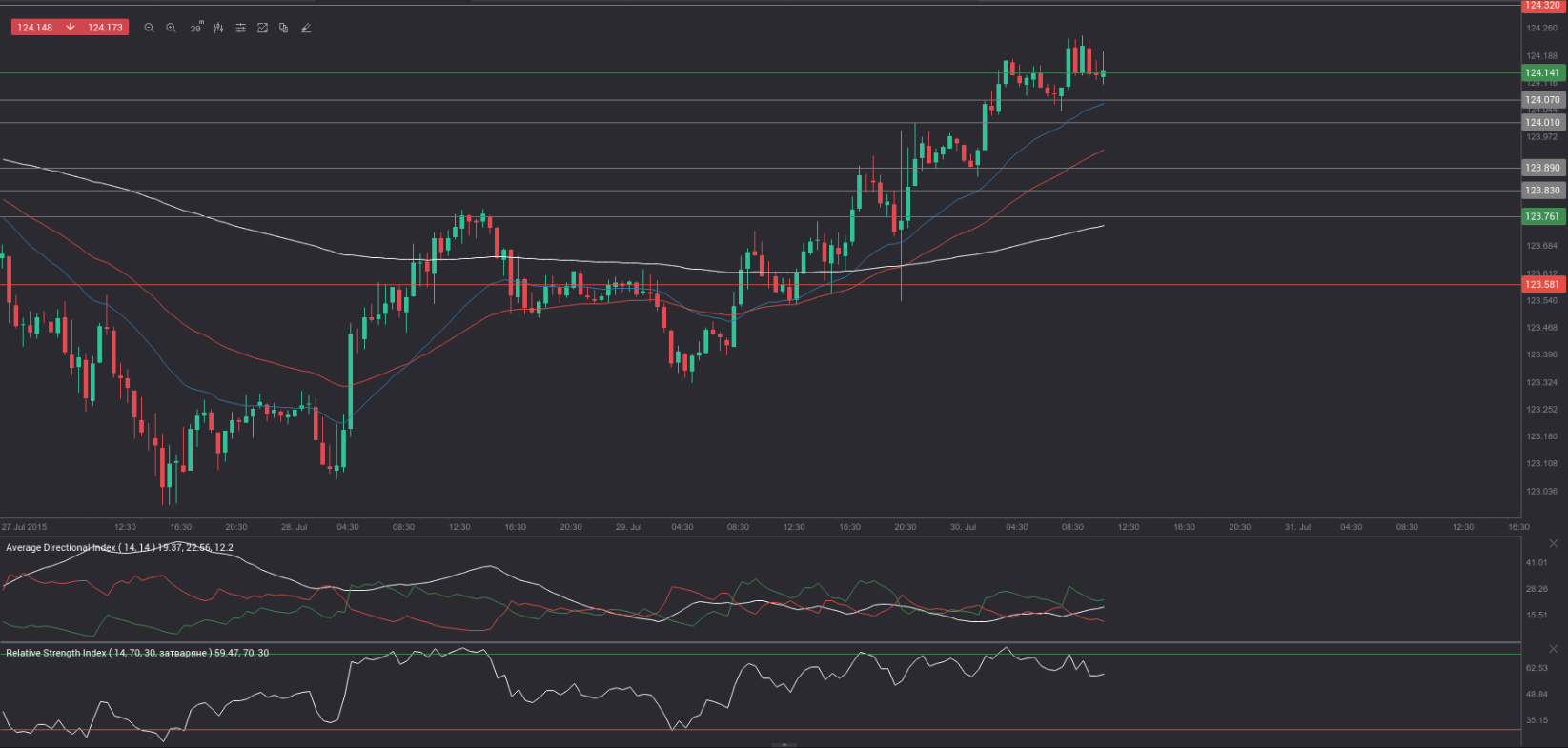
By employing the Camarilla calculation method, the daily pivot levels for USD/JPY are presented as follows:
R1 – 124.01
R2 – 124.07
R3 (range resistance – green on the 30-minute chart) – 124.14
R4 (range breakout – red on the 30-minute chart) – 124.32
S1 – 123.89
S2 – 123.83
S3 (range support – green on the 30-minute chart) – 123.76
S4 (range breakout – red on the 30-minute chart) – 123.58
By using the traditional method of calculation, the weekly pivot levels for USD/JPY are presented as follows:
Central Pivot Point – 123.96
R1 – 124.37
R2 – 124.93
R3 – 125.34
S1 – 123.40
S2 – 122.99
S3 – 122.43
 TradingPedia.com is a financial media specialized in providing daily news and education covering Forex, equities and commodities. Our academies for traders cover