Friday’s trade saw EUR/CHF within the range of 1.2026-1.2070. The pair closed at 1.2060, losing 0.03% on a daily basis and 0.01% for the whole week.
Fundamental view
Euro zone
German Balance of Trade
The surplus on German seasonally adjusted trade balance probably expanded to 16.8 billion EUR during July from a surplus figure of 16.2 billion EUR, registered in June, which has been the least since January. German total exports amounted to 93.4 billion EUR, while total imports were at the amount of 77.0 billion EUR in June. Imports increased at the seasonally adjusted rate of 4.5% in June compared to May, which has been the most considerable monthly gain since November 2010. In May imports dropped 3.4%. Germanys exports grew at a monthly pace of 0.9% in June, which followed a 1.1% fall in May. According to Destatis, exports of goods to countries outside the European Union amounted to 38.6 billion EUR in June, while imports from those countries totaled 25.8 billion EUR.
The trade balance, as an indicator, measures the difference in value between country’s exported and imported goods and services during the reported period. It reflects the net export of goods and services, or one of the components to form country’s Gross Domestic Product. Generally, exports reflect economic growth, while imports indicate domestic demand.
Germany registers surpluses on its trade balance on a regular basis, due to nations strong export of automobiles and other machinery. The country also exports chemical products, hardware, electronic equipment, metals and pharmaceuticals, while its main imports include electronic devices, fuel, vehicle parts and metals.
In case the trade balance surplus increased more than anticipated, this would have a bullish effect on the euro. Statistisches Bundesamt Deutschland (the Federal Bureau of Statistics) will release the official trade data at 6:00 GMT.
Euro zone SENTIX
Confidence among investors in the Euro zone was probably lower during the current month, with the corresponding index coming in at a reading of 2.0. In August it stood at 2.7, or the lowest level since August 2013. The index is based on results from the SENTIX survey, one of the most prominent surveys, reflecting investors’ opinion in Germany. It encompasses 2 800 respondents, with 510 of them being institutional investors. Respondents present their expectations regarding ten different markets for a period of one and six months. Readings above zero indicate that respondents were predominantly optimistic, while readings below zero signify pessimism. Lower than expected readings would mount selling pressure on the common currency. The official result is due out at 8:30 GMT.
Switzerland
Unemployment
Seasonally adjusted rate of unemployment in Switzerland for August is to be reported at 5:45 GMT on Monday by the State Secretariat for Economic Affairs (SECO). In July and June the unemployment rate stood at 2.9%. In July there were 127 054 unemployed people enrolled at the regional employment centers, or 422 more in comparison with the preceding month. Compared to the same month a year ago, the unemployed were 1 462 less. The number of people looking for a job reached the total 180 822 in July, or 133 more in comparison with the number in June, according to data by SECO.
The rate of unemployment represents the percentage of the eligible work force that is unemployed, but is actively seeking employment.
There is a strong correlation between consumer spending levels and labor market conditions in the country. Low rates of unemployment are accompanied by increased spending, which causes a favorable effect on corporate profits and also leads to overall growth acceleration. Therefore, in case the unemployment rate fell further, this would have a bullish effect on the franc.
Retail sales index
Annualized retail sales in Switzerland probably rose at a pace of 2.6% in July, according to the median estimate by experts, following another 3.4% climb in June. The latter has been the fastest annualized rate of increase since November 2013. This indicator reflects the change in the total value of inflation-adjusted sales by retailers in the country and provides key information regarding consumer spending trend, while the latter is a major driving force behind economic growth. In case retail sales index increased at a faster than expected pace, this would provide support to the franc. The Federal Statistical Office (FSO) is expected to release the official report at 7:15 GMT.
Consumer inflation
Also at 7:15 GMT the FSO is to report on the performance of the Consumer Price Index (CPI) in August. In July and June the annualized CPI remained flat, following a 0.2% gain in May. In July a drop in prices of clothing and house equipment was sufficient to offset higher costs of alcoholic beverages, tobacco and energy products. Prices of food and non-alcoholic beverages rose 0.3%, prices of alcoholic beverages and tobacco climbed 1.1%, costs of housing, water, electricity, gas and other fuels also added 1.1%, while costs of recreation and culture increased 0.8%. Prices dropped for clothing and footwear (1.6%), furnishings and household equipment (1.0%), health (0.8%), transport (0.5%) and communications (3.1%), according to data by the FSO. In case the annualized CPI continued to slow down, this would lead to a sell-off in the local currency.
Technical view
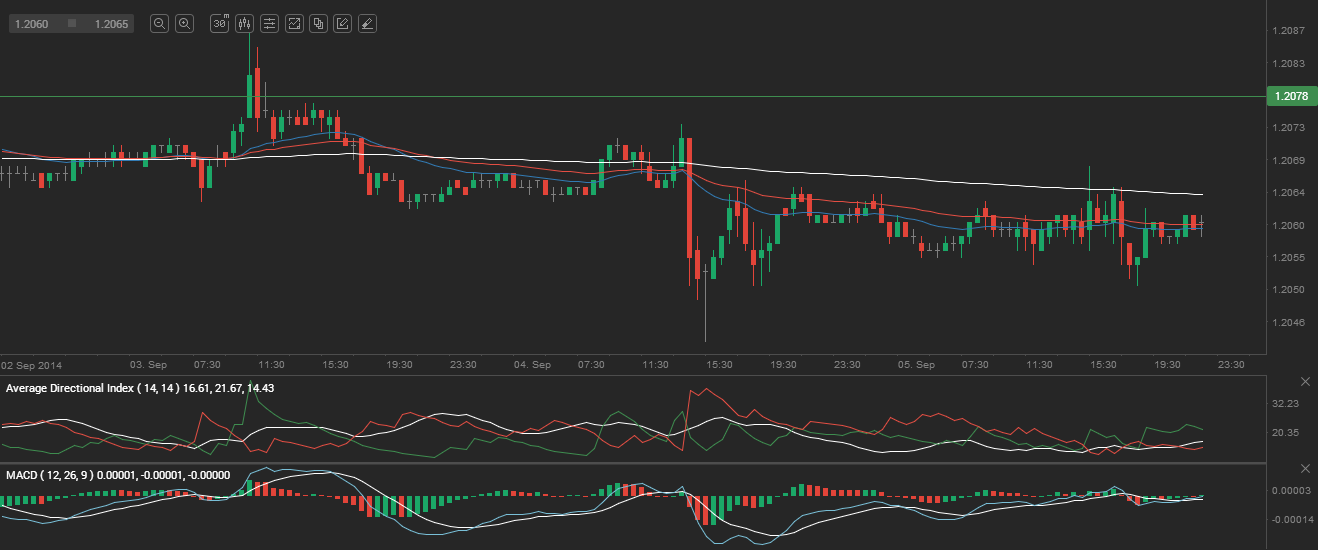
According to Binary Tribune’s daily analysis, the central pivot point for the pair is at 1.2052. In case EUR/CHF manages to breach the first resistance level at 1.2078, it will probably continue up to test 1.2096. In case the second key resistance is broken, the pair will probably attempt to advance to 1.2122.
If EUR/CHF manages to breach the first key support at 1.2034, it will probably continue to slide and test 1.2008. With this second key support broken, the movement to the downside will probably continue to 1.2000.
The mid-Pivot levels for Monday are as follows: M1 – 1.2002, M2 – 1.2021, M3 – 1.2043, M4 – 1.2065, M5 – 1.2087, M6 – 1.2109.
In weekly terms, the central pivot point is at 1.2063. The three key resistance levels are as follows: R1 – 1.2101, R2 – 1.2141, R3 – 1.2179. The three key support levels are: S1 – 1.2023, S2 – 1.2000.
 TradingPedia.com is a financial media specialized in providing daily news and education covering Forex, equities and commodities. Our academies for traders cover