
As summer approaches and travel demand begins to surge, millions of consumers are already securing flights, whether through travel agencies or direct online bookings. Yet, the booking experience remains fraught with friction, particularly due to the growing number of additional charges levied by airlines for services that were once standard, ranging from seat selection to name corrections.
With airfares projected to rise by 2.8% this year, flying abroad is set to become even more expensive, posing a challenge for travellers from Europe and the United Kingdom already contending with a persistent cost-of-living squeeze. While low-cost carriers may appear to offer relief, the reality is often more complex. In this report, the team at Tradingpedia investigates the true cost of flying in 2025, analysing base fares and the full extent of hidden and ancillary fees charged by major European airlines. The findings shed light on whether budget airlines are genuinely cost-effective or merely perceived as such.
The Most Common Hidden Costs of Airline Fares
Travellers who hope to secure affordable flights may be booking at just the right moment, as many airlines and travel agencies roll out seasonal discounts and package deals ahead of the summer surge. Historically, March and April have proven to be optimal months for locking in lower fares. However, as budget carriers lower base ticket prices to attract customers, they increasingly rely on ancillary fees to recover margins.
To their credit, these surcharges, ranging from seat selection to name-change fees, are not entirely hidden. They are disclosed during the booking process, screen by screen. But they are rarely included in headline prices or promotional fare ads, meaning the true cost of a flight only becomes apparent toward the end of the purchase journey.
For this comparison, we focused on fares promoted as “value,” “budget,” or “standard” options (the ones most frequently booked by cost-conscious travellers) rather than premium fare classes. Our comparison is based on one-way flights from London to Rome on 21 July, a peak season for travel.
Baggage Fees
Typically, budget airlines charge fees for any baggage larger than a small bag that can fit under the front seat, so before booking, passengers need to check exactly what they will be required to pay if they want to bring more luggage.
Ryanair, for one, allows you to take only one small bag (40cm x 20cm x 25cm) for free, or pay for a slightly more expensive fare when booking (£6 – £36) if you want to take two cabin bags – one small and one up to 10 kg. Of course, the post-booking fee is slightly higher (£20 – £60). The cost of checked luggage is steeper – from £9.49 to £44.99 for a 10-kg bag and from £18.99 to £59.99 for checked-in luggage of 20 kg. Excess baggage can be purchased only post booking or at the airport for £13 per extra kilogram.
Jet2 passengers are allowed to carry one large piece of hand luggage free of charge if it weighs no more than 10kg and measures up to 56cm x 45cm x 25cm in size, including any wheels and handles. Additionally, handbags, laptops, and other small items can be brought into the cabin for free (as an underseat bag). Up to three 22kg hold bags (per person, per flight) are allowed if the applicable charge is paid – note that the fee will be displayed while booking but may differ depending on the date of travel, destination, and type of fare. Jet2 has not published any fixed fees on its website – we booked a one-way flight to Rome and a 20kg checked bag cost us £40. If any of the bags are heavier, passengers will need to pay the standard excess baggage rate of £12 per kilo.
If you fly with easyJet, you will also be allowed to bring one small bag for free – the maximum dimensions here are 45cm x 36cm x 20cm. A second, slightly larger cabin bag is allowed for those who purchase extra legroom and the upfront seat option – you can also pay for this second bag with a fee of at least £5.99. The standard fare does not include any checked in luggage, so you will need to pay extra – fees start from £6.99 for a bag of up to 15 kg and from £9.49 if the hold baggage weighs up to 23 kg. Depending on the flight, date, etc, for baggage alone, you could be paying as much as the base fare. The excess weight charge is £12 per
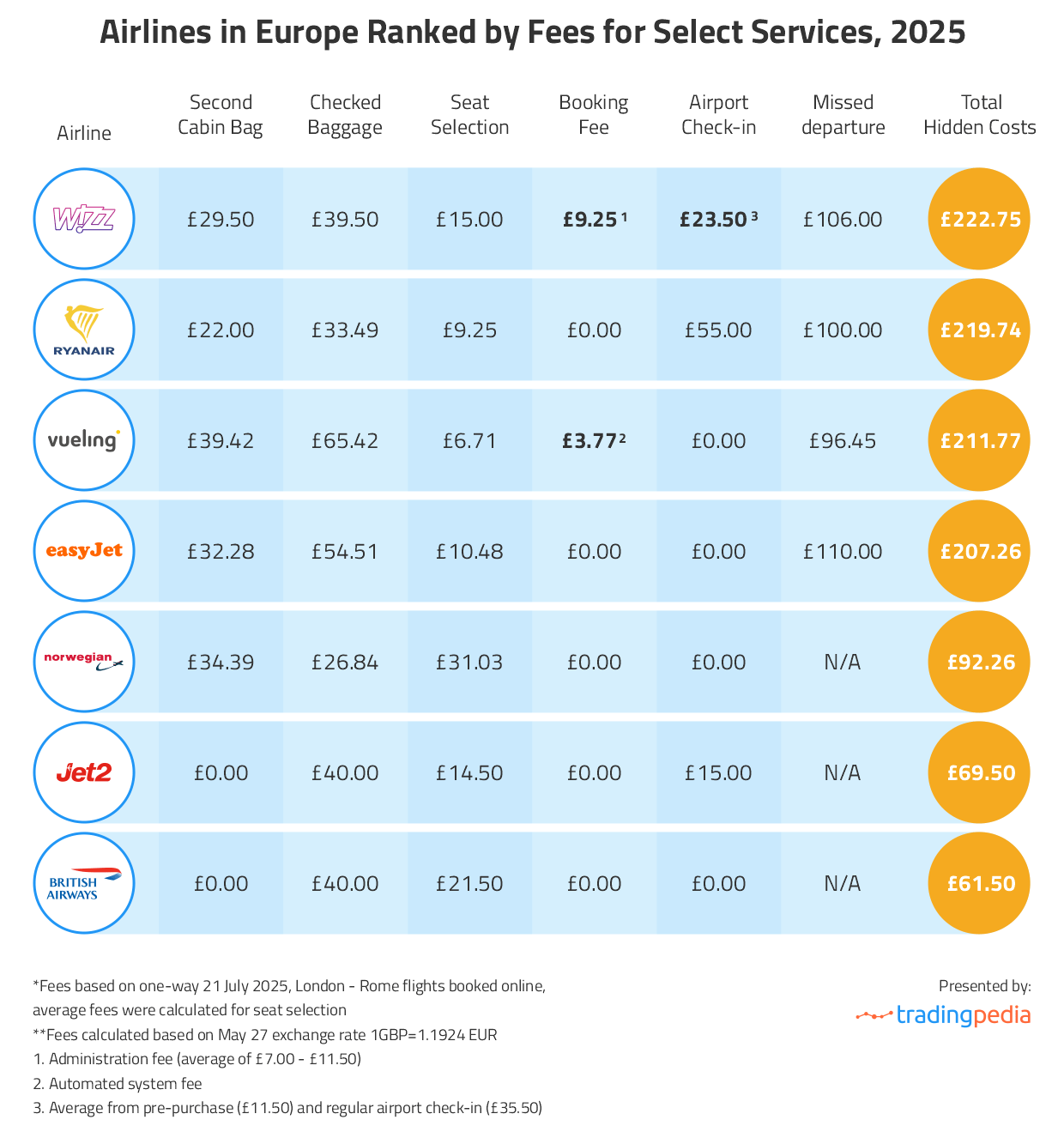
A small carry-on bag (40cm x 30cm x 20 cm) can be brought for free on board a Wizz Air flight, and passengers can also bring a larger trolley bag if they purchase a more expensive fare (Wizz Priority). From London to Rome, it cost us £29.50. Neither bag can exceed 10 kg. When it comes to hold baggage, the airline very generously allows up to 6 bags to be checked in per person. The price depends on the weight of the bag and whether it is low or peak season – charges vary from £20 to £198 during the high season. For the destination we picked, a 20kg bag was priced at £39.50. Once again, for excess weight, you will be charged £13 per kilo.
Those who fly with Norwegian and opt for a LowFare ticket will need to pay between £14.90 and £24.90 for an overhead cabin bag (max 55cm x 40cm x 23cm, 10 kg). For domestic flights, this is a fixed fee of £12.09. However, the fee can rise above £40 per bag for connecting flights. A small underseat bag can be brought on board for free. The cheaper fares do not include checked baggage, and the airline charges you £19 – £43 per bag on international flights. A second checked bag costs between £29.90 and £45 for direct flights and up to twice as that for connecting flights. The fee for excess weight is £12 per kilo.
British Airways also offers cheaper fares in its Economy Basic bundle, and includes two free pieces of small hand luggage – a handbag or a laptop bag, plus one slightly larger cabin bag. Everything else comes at an additional cost, with prices starting from £40 for the first piece of checked baggage, £65 for the second, and each following bag costs £80, with the allowed weight being 23 kg. Heavier bags are charged £65 per bag and flight.
Budget-friendly Vueling flights are also available to holidaymakers if they opt for a Basic fare. It allows for bringing one underseat bag sized 40x30x20cm and a second piece of luggage up to 10kg sized 55x40x20cm, which, however, is free only with more expensive fares. From London to Rome, the price was a little over £39 for our booking. If passengers opt for a checked cabin bag during the booking process, the price could be reduced. Checked bags and cases come at a price range of £8.51 – £136.09, depending on the weight of the bag, the destination and the date of the flight. Excess baggage costs £10.21 per kg at the check-in desk.
Seat Selection Fees
Seat selection, as well as opting for extra legroom, more space, or front seats, usually incurs an additional fee if you purchase a low-cost ticket. Some airlines also offer travel companions to sit together even if they have not picked any specific seats – this, of course, also costs a few pounds. The only exception is made for young children as companies will always try to place them next to at least one of the adults from their travelling party, so in most cases, you will not have to pay extra to sit next to your 5-year-old.
It is important to note that seat selection is always optional, even if you do not see this option anywhere at the time of booking. Most airlines urge passengers to pick a seat (rather than require that of them), but they can also complete your booking without choosing a specific seat. In this case, you will receive a random seat a few days before departing – this is completely free of charge but may be inconvenient, especially if you are travelling with other people.
Vueling has the lowest charges for standard seats, £6.71, while the fee on Norwegian flights is £31, nearly five times more since we could not find a direct London-Rome flight. With connecting flights, passengers need to pay to select a seat on each flight. Wizz Air charges passengers anything from £14 to £16 for standard seat selection, Jet2 – between £13 and £16, and easyJet – from £8.52 to £12.93. With Ryanair, you will need to pay between £8 and £10.50, whereas with British Airways, the seat selection fee ranges between £19 and £124.
Online Booking and Check-in Fees
Until a few years ago, many airlines charged some type of administration fee when booking a flight, but this is now almost non-existent, with fees being charged only for flight reservations made at the airport.
However, Wizz Air still requires passengers to pay an administration fee (£7 – £11.50) for booking via the website, the mobile app, its call centre and at the airport. It also has a System Surcharge Fee still present on their website, though an airline representative assured us it is in process to be removed since it is no longer charged.
Ryanair does not charge for online bookings, but any reservation made at the airport comes with a hefty £50 fee. There is also a £55 fee for airport check-in for those who purchased cheaper flights; there is free check-in for Plus and Flexi Plus passengers. Norwegian has free, automated check-in but charges £30 for bookings made by phone or at the airport, while changes made to the booking come at the price of £60 plus the price difference. There is also a £9 charge for connecting flights.
Other Fees That May Be Hidden
There are plenty of additional fees and surcharges when booking a flight. Typically, the services you pay for extras are optional, such as extra legroom or additional checked baggage. Of course, you would also expect to pay for any food on board the plane, rental car reservations and so on. However, in some cases, passengers have no choice but to purchase these “optional” services.
One of these is the group administration fee – it is £8.93 if you fly with Wizz Air, but with easyJet, group bookings are charged £20 per person. Also, Ryanair has a card payment fee, so you may be charged a percentage of the total transaction if you pay via a credit or debit card.
When you fly with an infant (under the age of 2 at the time of the flight), you do not need to purchase a ticket, but there is a mandatory fee. With Wizz Air, it is £27.22, while with easyJet or Ryanair, it is £25, and Jet2 charges you only £20. Norwegian, on the other hand, offers infant tickets, which cost 10% of the adult fare plus any airport taxes. Vueling also has an infant fee, ranging from £13.33 to £137.82 depending on the adult’s fare, the destination and the date of the flight.
Another fee that seems barely optional is the so-called rescue fee charged by some airlines when the passenger misses the flight. If you arrive at the airport right before or shortly after takeoff, you can pay the rescue fee, and you will be given a seat on the next flight. EasyJet charges £110 per person, Wizz Air – £106, while Ryanair’s rescue fee is £100. Vueling’s rescue fee is the cheapest at £96.45. The other airlines do not clearly state whether they charge such a fee and how much it amounts to. In some cases, the passenger is required to cancel the booking and rebook another flight at current prices.
Of course, there are many other fees you may be charged outside of the actual cost of the airfare, so you need to make sure you are aware of all carrier policies for baggage, flight cancellation, or travelling with children, just to name a few.
Methodology
To identify the airlines with the highest fees for additional services, our team checked the official websites of seven major European airlines – British Airways, easyJet, Jet2, Norwegian, Ryanair, Wizz Air, and Vueling. Where charges were not clearly stated, we booked one-way flights from London to Rome, for 21 July 2025.
We picked standard fares at the lowest possible prices and checked how much it would cost to carry a second cabin bag along with the hand baggage (the one that fits under the seat), which typically is free to take on board with all airlines. We also checked the pricing for checked baggage and calculated the average for seat selection (once again, standard seats without extra legroom), check-in, online booking (referred to as Administration fee at Wizz Air (average), Automated system fee at Vueling, and rescue fee.
A Wizz Air representative contacted us with additional information on check-in procedures, fees, and customer service. In response, we are including the following statement in full to reflect Wizz Air’s position and to provide readers with their official commentary:
“Wizz Air aims to make check-in simple for passengers and provide instructions via email on how to check-in to avoid charges. Like many other airlines, we encourage all passengers to check-in online as early as possible before their scheduled departure time.
“Customers who have not purchased seats with their booking can check-in online 24 hours before departure via the Wizz Air app or website. Customers are sent a reminder of this process to the email address they booked with. Each passenger can locate their booking and check-in on the Wizz Air app using their confirmation code.
“To ensure customers receive these updates about their booking, we always recommend booking directly. When customers book via a third party, Wizz Air does not receive any contact details of the customer — only those of the agent. The booking agent receives all flight information and details of the check-in process, which they should pass onto the passenger.”
“Passengers who fail to check-in online, or who wish to check-in within three hours of their flight, must do so at the airport. This service can be pre-booked online for £11.50 or €13 per flight. Airport check-in without pre-booking costs £35.50 or €40.00. Full details on our check-in policy can be found on the Wizz Air website.”
 TradingPedia.com is a financial media specialized in providing daily news and education covering Forex, equities and commodities. Our academies for traders cover