Behind-the-Scenes Star: How Micron Technology Is Surging Past Nvidia in Revenue Growth and Stock Price
The semiconductor sector has experienced impressive growth over the past year, driven by surging demand for AI infrastructure and data-center components. With NVIDIA’s Q4 FY2026 earnings now released, reporting another quarter of exceptional growth, including a sharp jump in data-center revenue and continued margin expansion, investors now have a clear benchmark for what ‘strong performance’ looks like at the top of the AI hardware stack.
Against that backdrop, the team at Tradingpedia looks at stock performance and quarterly revenue acceleration for six major semiconductor companies: Advanced Micro Devices (AMD), Broadcom, Micron Technology, Intel, NVIDIA, and Taiwan Semiconductor Manufacturing Company (TSMC).
Our findings show Micron Technology has seen the highest 12-month stock return growth among major semiconductor companies, including Nvidia and TSMC, with its stock surging 360% over the past year, climbing from roughly $91 to $429 as of February 25, 2026. The company also led in quarter-on-quarter revenue growth, reflecting surging demand for high-bandwidth computer memory. Tight supply and rising prices have boosted margins, positioning Micron as a critical supplier in the rapidly expanding AI infrastructure market.
Micron Outpaces the Competition in 1-Year Stock Returns
Over the past 12 months, U.S. computer memory and data storage company Micron Technology delivered the strongest stock performance in the sector, its price climbing from roughly $91 to $429 as of February 25, 2026, representing a +360% increase. This surge has been driven in part by a tightening supply of HBM3e and HBM4 memory chips, where strong AI-driven demand has allowed Micron to raise prices and expand profit margins, positioning the company as a critical supplier in the rapidly growing AI infrastructure market.
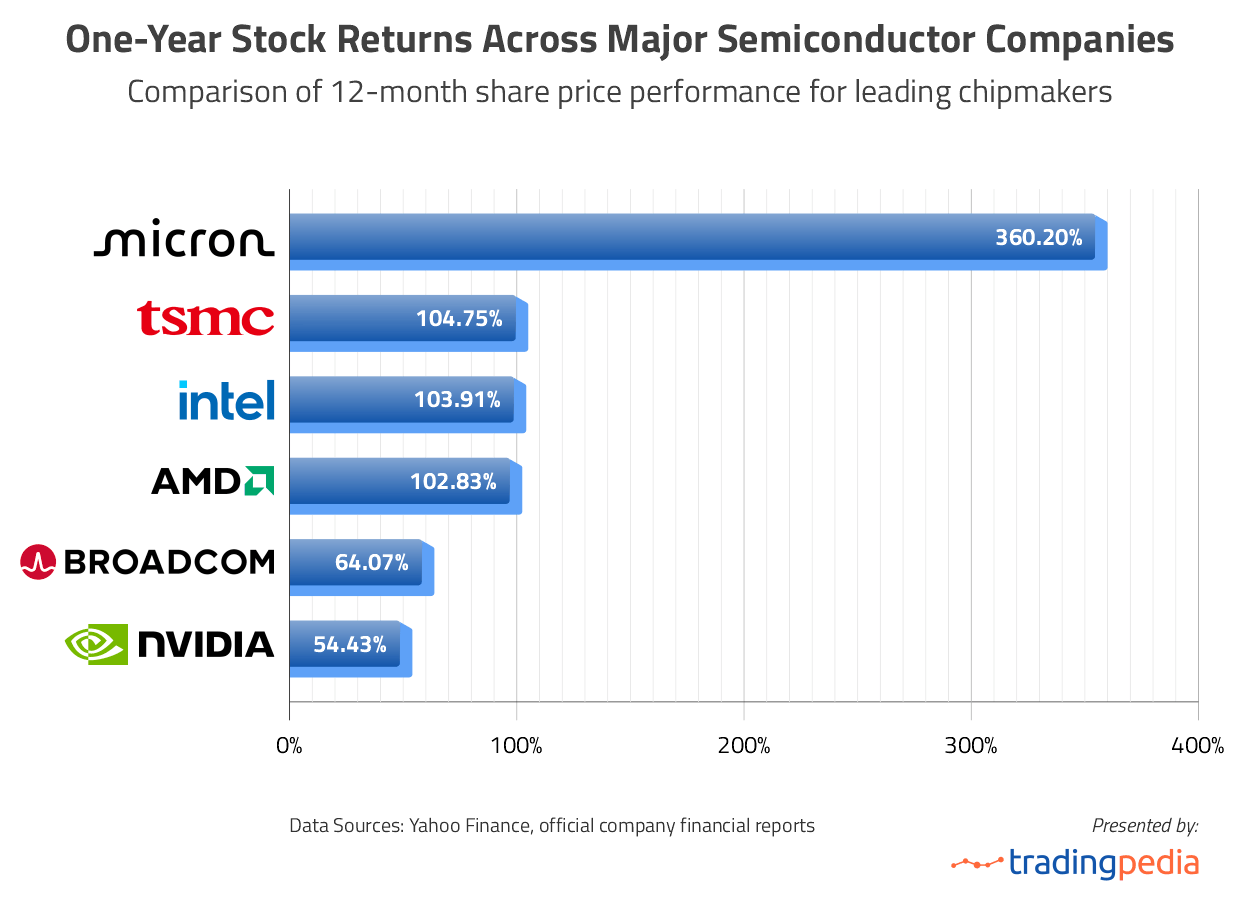
By comparison, NVIDIA posted a +54% 1-year return, despite maintaining the sector’s largest market capitalisation of $4.76 trillion. Much of NVIDIA’s expected growth from hyperscaler and enterprise AI adoption had already been priced in, limiting the scope of further expansion. Other large-cap players followed intermediate paths: Broadcom rose +64%, while AMD, TSMC, and Intel posted roughly +100% gains. This pattern illustrates a broader market rotation, with investors favoring upstream infrastructure suppliers, memory and foundry providers, over headline AI compute vendors.
Micron Outpaces Rivals in AI-Driven Quarterly Revenue Surge
Recent quarterly results reveal clear differences in growth momentum across the semiconductor sector. Micron Technology posted the highest QoQ revenue growth at +21%, increasing revenues from $11.3 billion to $13.6 billion according to the company’s Q1 financial report (released December 2025), driven by an ever-growing demand among AI companies for computer memory and storage space. The company has also stopped selling consumer RAM to focus exclusively on AI and data center clients, further concentrating its exposure to the fastest-growing segment. NVIDIA followed with +19%, rising from $57.01 billion to $68.1 billion, reflecting ongoing GPU adoption by hyperscalers and enterprise clients.
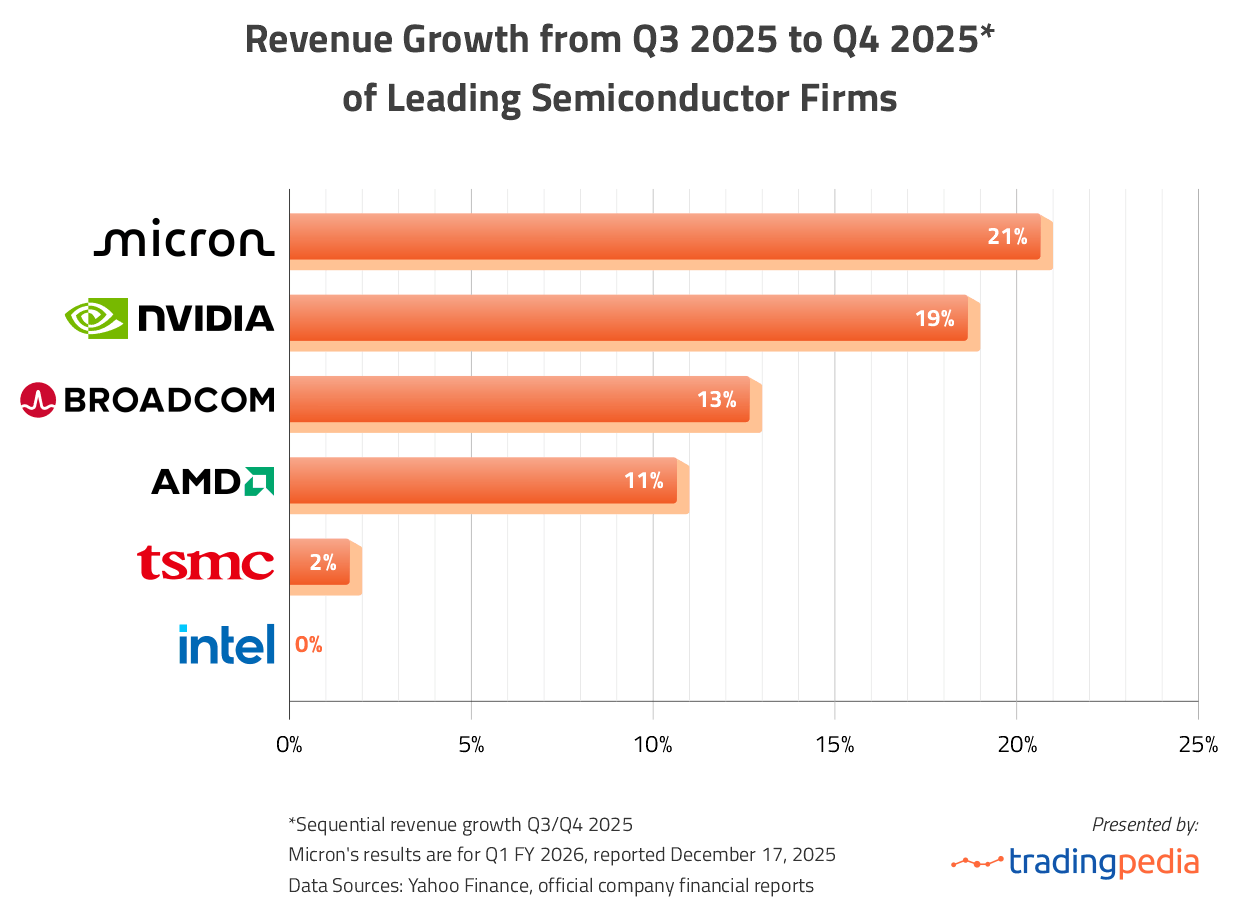
Other companies showed more moderate sequential gains: Broadcom +13% to $18.02 billion, AMD +11% to $10.27 billion, while TSMC and Intel posted only +2% and flat growth at $33.73 billion and $13.7 billion, respectively.
Year-on-year growth highlights longer-term scale expansion. NVIDIA is firmly in the lead with a +73% year on year revenue growth, up from $39.3 billion to $68.1 billion. Micron ranks second, with its revenue expanding by 57% year on year, from $8.7 billion to $13.6 billion, demonstrating the rising market value of memory infrastructure suppliers. AMD, Broadcom, and TSMC all achieved solid annual growth between 25-34%, while Intel’s -4% YoY decline illustrates ongoing challenges in legacy CPU markets amid the AI-focused industry shift. Overall, momentum is strongest among firms supplying AI infrastructure, consistent with the rotation observed in stock performance.
Methodology
This report combines official quarterly and annual financial filings with publicly available market data. Revenue figures for Q3 and Q4 (Q4 2025-Q1 2026 for Micron Technology) 2025 were collected from company earnings reports, and quarter-on-quarter and year-on-year growth rates were calculated directly from these reported values. Stock price performance metrics, including YTD, 1-year, and 5-year returns, were sourced from Yahoo Finance and cross-checked with Investing.com to ensure accuracy. This approach provides a consistent basis for comparing both financial performance and market returns across the semiconductor sector.
 TradingPedia.com is a financial media specialized in providing daily news and education covering Forex, equities and commodities. Our academies for traders cover