Global Brand Power 2026:
Discovering the Most Valuable Brands from Every Country
In 2026, when technology companies are ruling the stock market, and just two or three investment giants have an invisible yet firm control over practically everything around us, the most valuable brands are those that have a true impact on everyday life. From Google and Nvidia to Uber and Disney, the value of a brand is much more than the company’s performance on the stock market or just its appeal among the masses.
To discover the global brands exerting the most influence on markets, economies, and consumers, the team at Tradingpedia examined the latest country and industry-specific brand rankings by BrandFinance. We created a map showcasing the most valuable brand in every country in 2026 but also managed to identify the most influential brand from every nation – at least on Instagram, the digital space where the jockeying for relevance plays out in real time. So, what makes a brand strong? Welcome to the age where relevance is up for grabs, and economic might is just one piece of a much messier puzzle.
Key Findings:
- American brands continue to dominate global brand rankings, with 7 out of the world’s top 10 most valuable brands originating from the United States.
- In 2026, iPhone maker Apple keeps its position as the world’s most valuable brand with an estimated value of $607.6 billion, while sportswear behemoth Nike rules over social media, with close to 300 million Instagram followers.
- While oil giant Shell is the UK’s most valuable brand ($51.79 billion), England’s Premier League attracts the most followers on Instagram, nearly 80 million.
- Very few brands are both a nation’s most valuable and most followed brands, with TikTok, Samsung, and Thailand’s national oil and gas company PTT being among these rare gems.
What Is Brand Value?
Brand value is, above all, financial weight and market performance. Beyond the revenues, balance sheets, and daily stock fluctuations, however, there is also something else – the market’s way of pricing trust but also expectation. Investors pay for how confidently they believe people will choose a brand tomorrow, and this is a story of continuity – a fragile balance of reputation, of cultural relevance, of perceived competence. All this can crumble in the blink of an eye because of a scandal, a technological disruption, or a slight change in something as fleeting as consumer taste.
The most valuable brands are sometimes the least visible in everyday life. They may power infrastructure, software, or supply chains that feel abstract and distant, yet their influence is everywhere. They do not always need to be loved; it is enough that they are depended on. And perhaps that is the final meaning of brand value: it is not how loudly a brand speaks, but how deeply it has settled into the routines of the world – until choosing it no longer feels like a choice at all, but like something close to habit disguised as necessity. At the end of the day, value is the price someone is willing to pay for the actual brand.
The Biggest Brands Around the World in 2026
The world’s most valuable brand for 2026 began its journey in 1976 at a home on Crist Drive in Los Altos, California. This marked the start of what would become one of the most influential technology companies globally. Initially focused on personal computers, Apple’s innovative approach paved the way for groundbreaking products that revolutionised multiple industries over the years.
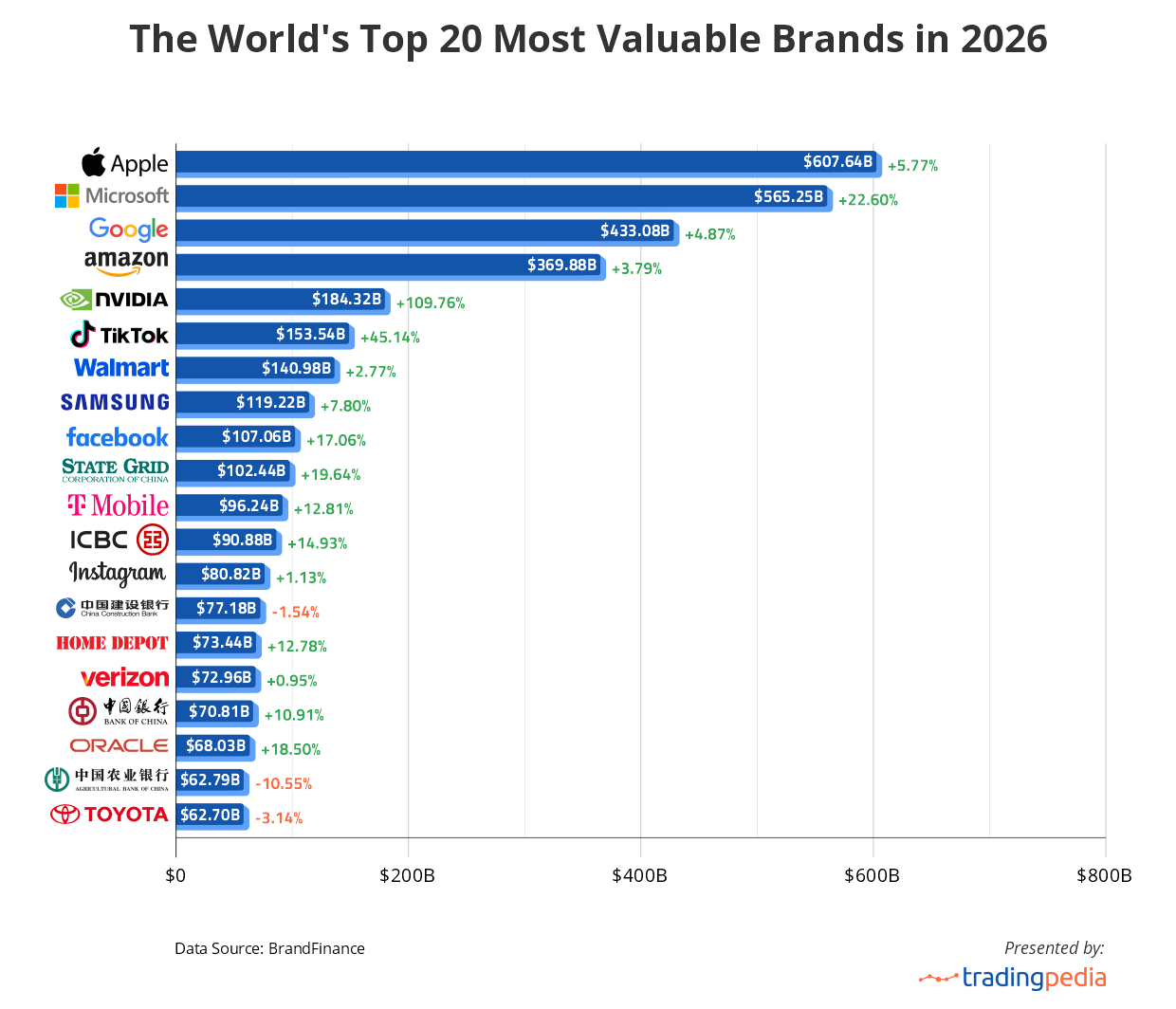
Apple Inc. is currently the most valuable brand in the world, with an estimated value of $607.64 billion, a 5.8% increase from last year. Microsoft, Google, and Amazon also retain their second, third, and fourth positions from 2025, with their brands currently valued at $565.25 billion, $433.08 billion, and $369.88 billion, respectively.
After its brand value rose by 109.8% within a year, chip maker Nvidia jumped from 9th to 5th place in the ranking, and the brand is currently worth around $184.32 billion. This is, of course, a result of the semiconductor giant’s rapid growth into the world’s largest company by market capitalisation in 2024. Fuelled by the demand for chips and critical infrastructure for the artificial intelligence boom of the past couple of years, Nvidia also quickly became the first company to reach market capitalisations of $4 trillion and $5 trillion.
TikTok, Walmart, Samsung, Facebook, and the State Grid Corporation of China round out the world’s top 10 most valuable brands in 2026, all being valued at over $100 billion.
Brand Power by Nation: The World’s Corporate Leaders in 2026
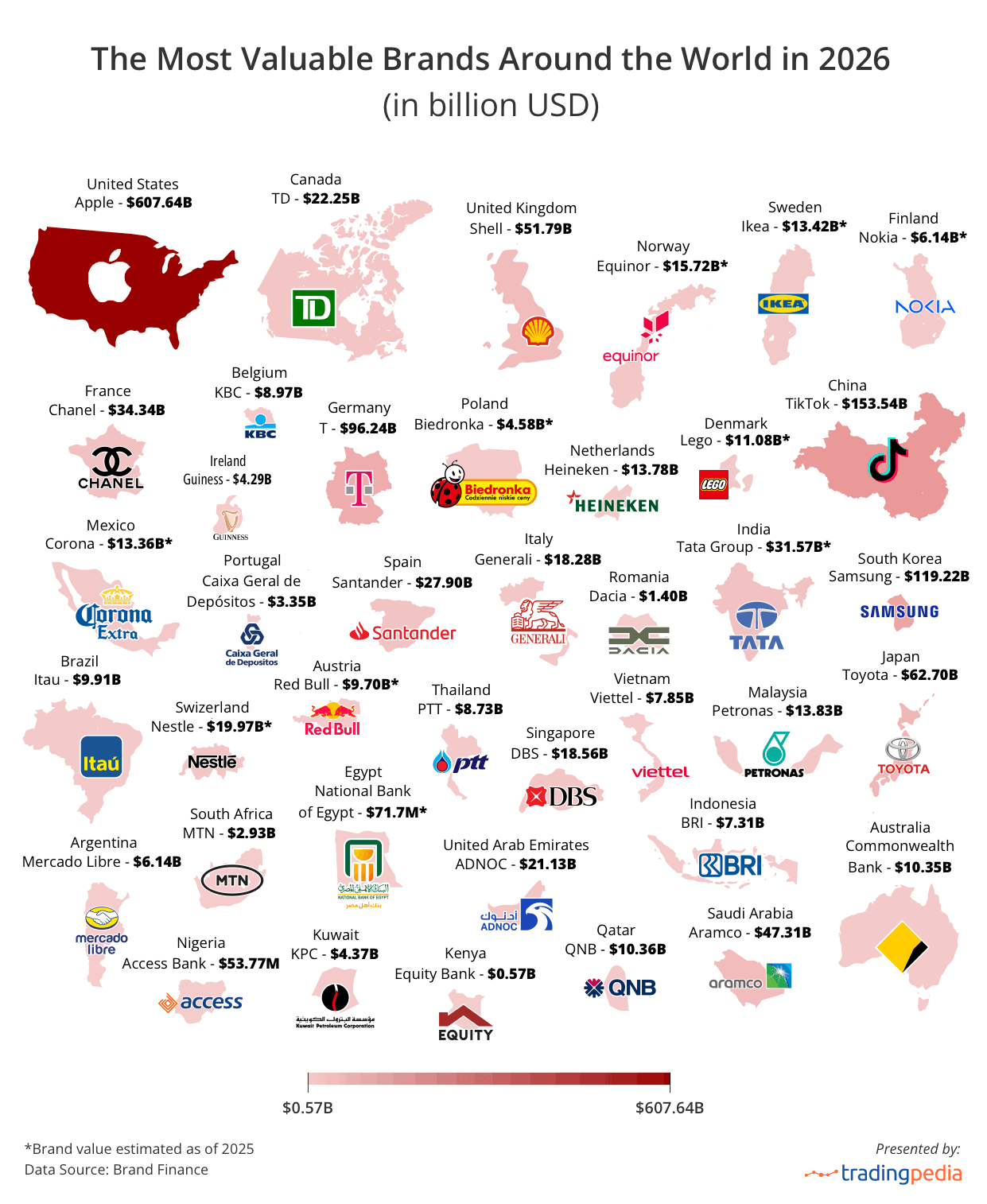
While it is true that a handful of economic powerhouses, particularly the United States and China, are home to many of the world’s most valuable brands, the 2026 brand rankings make it clear that every country has produced at least one corporate champion capable of commanding enormous economic influence, whether through technology, luxury goods, finance, telecommunications, energy, or consumer products.
The United States continues to dominate the global brand landscape, with Apple, Microsoft, Google, Amazon, and NVIDIA remaining the world’s most valuable brands in 2026, evidence of America’s continued leadership in technology and artificial intelligence. Collectively, these brands (not the actual corporations behind them) are worth more than the GDP of many advanced economies. The sheer scale of U.S. brand value – nearly $2 trillion just for the top 5, reflects the country’s unique ability to create companies that combine global reach, technological innovation, and cultural influence.
China remains the world’s second great brand superpower, although its corporate profile differs significantly from that of the United States. Rather than being dominated by consumer technology alone, China’s most valuable brands are concentrated in banking, infrastructure, telecommunications, and digital platforms. State Grid Corporation of China leads the country with a brand value exceeding $102 billion, followed by ICBC ($90.9 billion), China Construction Bank ($77.2 billion), Bank of China ($70.8 billion), and Agricultural Bank of China ($62.8 billion). ByteDance’s flagship platform TikTok/Douyin is the country’s most valuable consumer-facing brand, valued at more than $153 billion and demonstrating China’s growing influence in the global digital economy.
Germany’s most valuable brand is Deutsche Telekom, valued at over $96 billion, making it one of Europe’s corporate heavyweights. Unlike many countries where a single sector dominates, Germany’s brand strength is spread across telecommunications, automotive manufacturing, financial services, and industrial engineering. Mercedes-Benz, BMW, Porsche, Allianz, Siemens, SAP, and Bosch collectively showcase the country’s reputation for premium manufacturing and technological expertise.
South Korea‘s corporate success story continues to be led by Samsung Group, whose brand value now exceeds $119 billion. The country’s top brands reflect its global leadership in electronics, semiconductors, automotive manufacturing, and consumer technology. Hyundai and Kia remain major international players, while South Korea’s largest companies continue to benefit from strong export demand and global recognition.
In the United Kingdom, Shell remains the country’s most valuable brand, now worth an estimated $51.79 billion, while HSBC, Vodafone, Tesco, Barclays, and British Airways continue to rank among Britain’s best-known corporate names. Unlike the technology-heavy rankings of the United States, the UK’s leading brands are spread across energy, banking, telecommunications, retail, and professional services, reflecting the diversified nature of the British economy.
France remains Europe’s luxury leader, with brands like Chanel (34.3 billion), Louis Vuitton ($28.8 billion), Hermès ($21.2 billion), and Cartier ($16 billion) demonstrating the country’s remarkable ability to transform heritage, craftsmanship, and cultural prestige into economic value. At the same time, major corporate brands such as BNP Paribas, AXA, Airbus, Orange, and EDF show France’s strength across finance, aerospace, telecommunications, and energy.
Italy’s most valuable brands are similarly shaped by a combination of luxury and tradition. Ferrari, Gucci, Prada, Generali, Enel, Intesa Sanpaolo, and Eni represent industries ranging from fashion and automotive excellence to finance and energy. Ferrari, in particular, continues to stand out as one of the world’s most powerful premium brands, proving that exclusivity can be just as valuable as scale.
Elsewhere, national champions continue to define their domestic economies. TD Bank remains Canada’s leading brand, while the Commonwealth Bank dominates Australia’s ranking. Sweden’s most valuable brands are led by IKEA and Volvo, while Switzerland combines luxury and finance through brands such as Rolex, UBS, and Nestlé. In the Netherlands, ING and ASML exemplify the country’s strengths in finance and advanced technology, whereas Heineken continues to prove the nation’s strength when it comes to consumer-facing brands.
As always, some of the most interesting stories come from smaller economies. Finland’s Nokia remains one of the country’s most recognisable corporate exports, while Mexico’s Corona continues to rank among the world’s most valuable beer brands. Romania’s Dacia, Portugal’s EDP, Kenya’s Equity Bank, and Nigeria’s Access Bank show that globally recognised brands can emerge far beyond the world’s largest economies. Their success is a testament to an enduring truth of the modern economy: while size does help, a powerful brand can be built almost anywhere.
The Most Followed Brands on Instagram:
Where Attention Follows Appeal Rather Than Capital
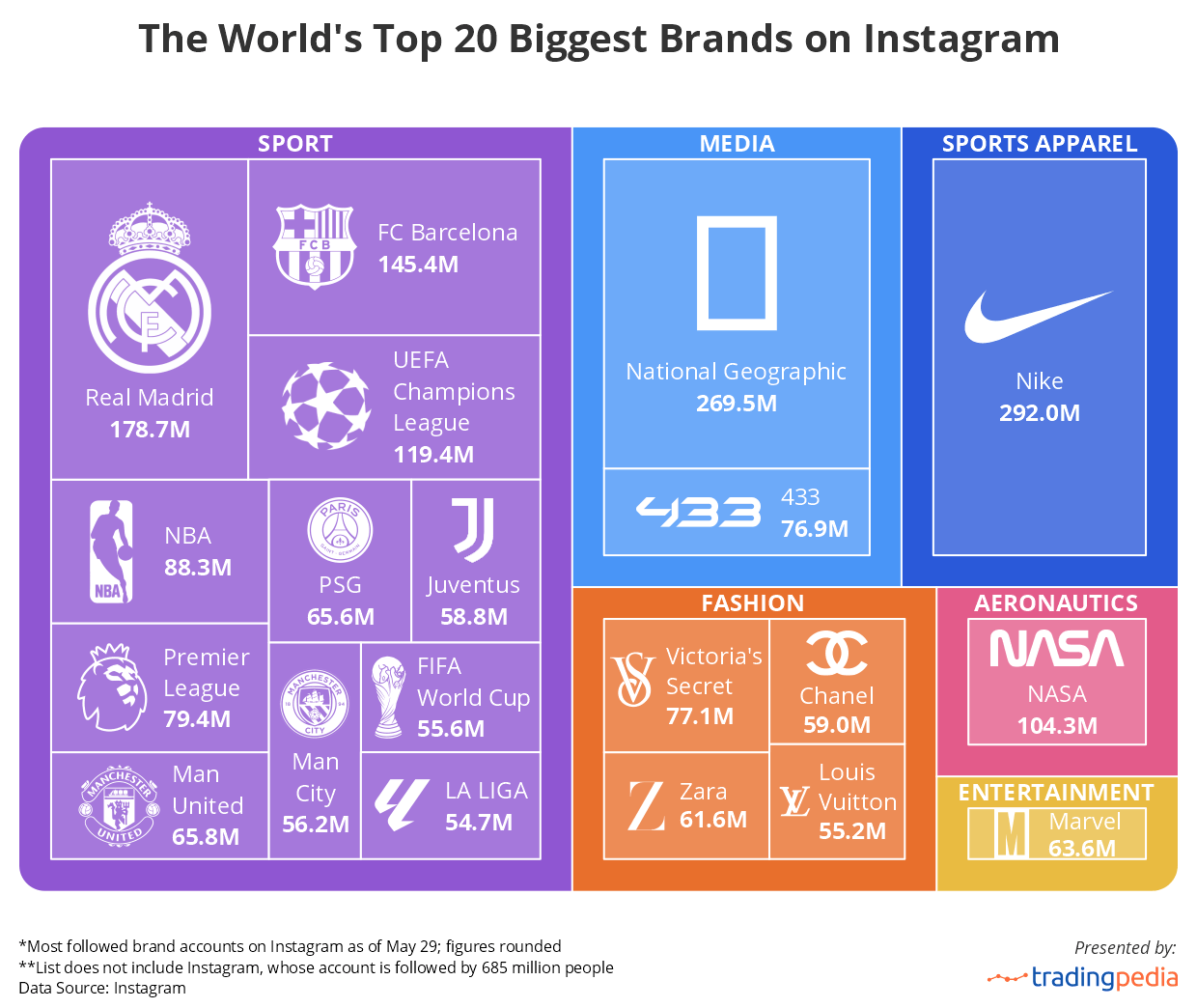
In today’s platform-dominated economy, being a heavyweight on the stock market is no longer enough to guarantee cultural clout. Nowhere is this more obvious than on Instagram, where the digital followings in the millions curiously show how corporate giants, flush with cash and market capital, are often outpaced online by football clubs and entertainment brands. Meanwhile, some of the world’s best-known luxury names, despite commanding eye-watering valuations, have surprisingly modest followings. This gives us a fractured reality in which attention and influence are scattered, and the old certainties of what makes a strong brand no longer quite apply.
And indeed, the world’s most-followed brands on Instagram reveal a very different picture from the global rankings of corporate value. While banks, telecom operators and energy companies dominate many national economies, social media attention is overwhelmingly captured by sport, entertainment, fashion and digital culture.
Football is the single most powerful force on Instagram. Real Madrid leads Spain with nearly 179 million followers, while the Premier League tops the UK with more than 79 million. Paris Saint-Germain is France’s most-followed brand, Juventus dominates Italy, FC Bayern leads Germany, and Benfica tops Portugal. Together, these clubs command audiences that many multinational corporations can only dream of.
Beyond sports, consumer-facing and digital-first brands have built extraordinary followings. Nike is the most-followed brand in the United States and globally with almost 292 million followers, while Hong Kong-based 9GAG and Cyprus-based 5-Minute Crafts have amassed more than 50 million and 49 million followers, respectively. In the Netherlands, football-dedicated community and media platform 433 has attracted nearly 77 million followers, far exceeding the reach of the country’s largest corporations.
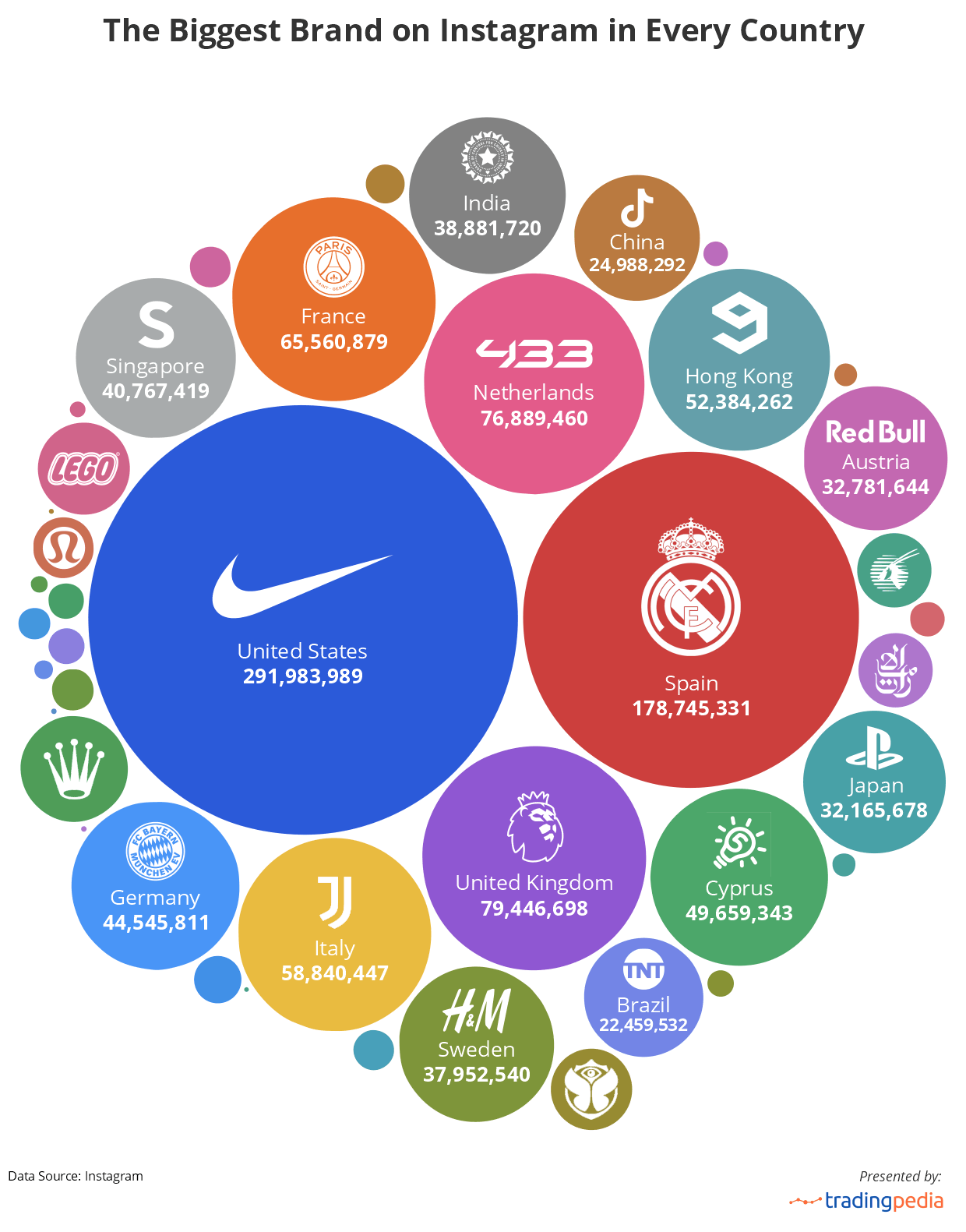
Fashion and lifestyle brands also perform strongly. H&M leads Sweden, Shein tops Singapore, Lululemon is Canada’s most-followed brand, and Marimekko ranks first in Finland. Meanwhile, globally recognised consumer names such as LEGO, Red Bull, Rolex, Canva and Ryanair have become de facto ambassadors for their home countries online.
Perhaps the most striking finding is that social media rewards cultural relevance rather than economic size. In many countries, the brands generating the most attention are not the most valuable or profitable. Instead, they are the brands that entertain, inspire, inform, or tap into people’s passions, whether through sport, fashion, travel, or digital media.

Several reputable publications, including Forbes and Brand Finance, release annual brand rankings. Each publication uses its own methodology to assess the value of a company or brand. For this analysis, the team at Tradipedia focused on Brand Finance, which employs an interesting approach known as the Royalty Relief method. Essentially, Brand Finance estimates the amount a company would be willing to pay to license its brand as if it did not own it.
We also separately identified the most-followed brand from each country using Instagram follower counts as of May 29-30, 2026. Brand values reflect estimates of the financial worth of a brand, while Instagram followers were used as a measure of online reach and audience engagement.
There are also several country-specific cases, such as Romania, where there is no single Instagram account for Dacia. Instead, the car manufacturer maintains multiple local Instagram pages, whose fans on the platform collectively vastly outnumber the followers of other major Romanian brands such as Banca Transilvania (206 thousand followers) and eMAG (around 106 thousand). For this reason, we picked Dacia as Romania’s top brand on Instagram.
 TradingPedia.com is a financial media specialized in providing daily news and education covering Forex, equities and commodities. Our academies for traders cover