Europe’s Rent Crisis in 2026:
European Cities Ranked by Rent-to-Salary Ratio
Thousands of Europeans now work hard all month, only to hand over most of their paycheck just for a place to sleep. Across Europe, from the cobbled streets of Lisbon to the bustle of London, renters are facing a crisis that’s hitting closer to home than ever before. Forget the old clichés about sky-high prices in Western European capitals; new data reveals that it’s actually Southern and Eastern European cities where the struggle is most intense after local salaries are factored in.
To identify where rents are an affordable alternative to purchasing a home and where renting no longer makes sense financially, the team at Tradingpedia examined the average monthly rent and the net salaries (the salary after taxes) across 127 cities in Europe from price tracking platform Numbeo. We discovered that in some cities, more than half of a worker’s monthly income vanishes into rent for a modest one-bedroom flat, leaving little left for groceries, let alone a night out or any other expenses. And despite flatlining economies and growing anxiety about housing shortages, rents just keep going up.
Key Highlights
- Lisbon is Europe’s least affordable rental market, with average rent consuming over 99% of net salary.
- The Ukrainian city of Odesa recorded Europe’s sharpest annual rent increase, with city-centre rents surging 26.8% year over year.
- German and Swiss cities remain Europe’s most financially comfortable for renters despite having some of the highest rents on the continent.
(Based on average rent of 1-room apartments in city centre and average net salary (after tax) as of 4 May, 2026)
Data Source: Numbeo
Europe’s Least Affordable Cities for Renters
Portugal’s capital has become the clearest example of Europe’s worsening housing affordability crisis. In Lisbon, the average monthly rent for a one-bedroom apartment in the city centre now stands at €1,331.48, while the average net salary is only marginally higher at €1,342.83. This means renters are effectively spending 99.15% of their monthly income on housing alone, leaving just €11 on average after rent is paid.
The pressure is not limited to Portugal. Albania’s capital, Tirana, ranks as the second least affordable city by rent-to-salary ratio on our list, with rents consuming more than 93% of local salaries. In Kyiv, despite significantly lower rental prices in absolute terms, wages remain so low relative to housing costs that residents still spend nearly 88% of their income on rent.
(Based on average rent of 1-room apartments in city centre and average net salary (after tax) as of 4 May, 2026)
Porto, Milan and Malaga also stand out among Europe’s most strained rental markets. In Porto, tenants spend over 85% of their salary on rent, while Milan and Malaga both require roughly three-quarters of monthly income for centrally located housing. It seems that affordability problems are no longer confined to Europe’s traditional financial capitals; they now affect mid-sized cities and tourism-heavy destinations, as well.
Southern Europe appears particularly exposed. Along with the aforementioned locations, Spanish and Italian cities dominate the upper end of the affordability rankings, with Barcelona, Valencia, Naples and Rome all requiring between 60% and 70% of average net wages for rent. In many of these cities, tourism demand, short-term rental growth and limited housing supply continue to push prices beyond what local incomes can realistically support.
Where Renters Keep the Most of Their Salaries
At the opposite end of the spectrum, several Central and Northern European cities remain comparatively affordable once local wages are taken into account. Germany appears especially affordable, with cities such as Essen, Mannheim, Nuremberg and Dresden allowing residents to retain between 76% and 81% of their salary after paying rent.
(Based on average rent of 1-room apartments in city centre and average net salary (after tax) as of 4 May, 2026)
Essen ranks as Europe’s most affordable major rental market on our list. Once known as Germany’s industrial heart, it is now one of the greenest cities in Europe, which, paired with its lower cost of living compared to cities such as Munich or Frankfurt, makes it a perfect place for an affordable life in Western Europe. Average rent for a city-centre apartment stands at just €551.56, equivalent to only 18.9% of local monthly salaries. Following in second position is Mannheim, which, along with being an industrial and commercial hub, is also a university town, hosting the prestigious University of Mannheim. Here, renters, including many students, spend an average of €804 a month or roughly one-fifth of the typical local income on housing.
Swiss cities also stand out in the ranking as good places to rent on a local wage despite having some of Europe’s highest rents. In Zurich, the average apartment costs more than €2,600 per month, the highest figure among the 127 cities we looked at, yet exceptionally high salaries (€7,424.32 per month, net) mean residents still retain nearly 65% of their income after rent. Basel, Bern and Lausanne all show similarly high rents, but in terms of rent-to-income ratio, they are even more affordable. This Swiss presence on the ranking shows how wage growth remains one of the strongest protections against housing and pricing pressures.
Nordic cities continue to demonstrate relative stability as well. In Copenhagen, Aarhus, Oslo and Bergen, rents remain high in absolute terms but are balanced by stronger earnings and lower rent-to-income ratios than many Southern European cities.
The Cities Where Rents Rose the Fastest Over the Past Year
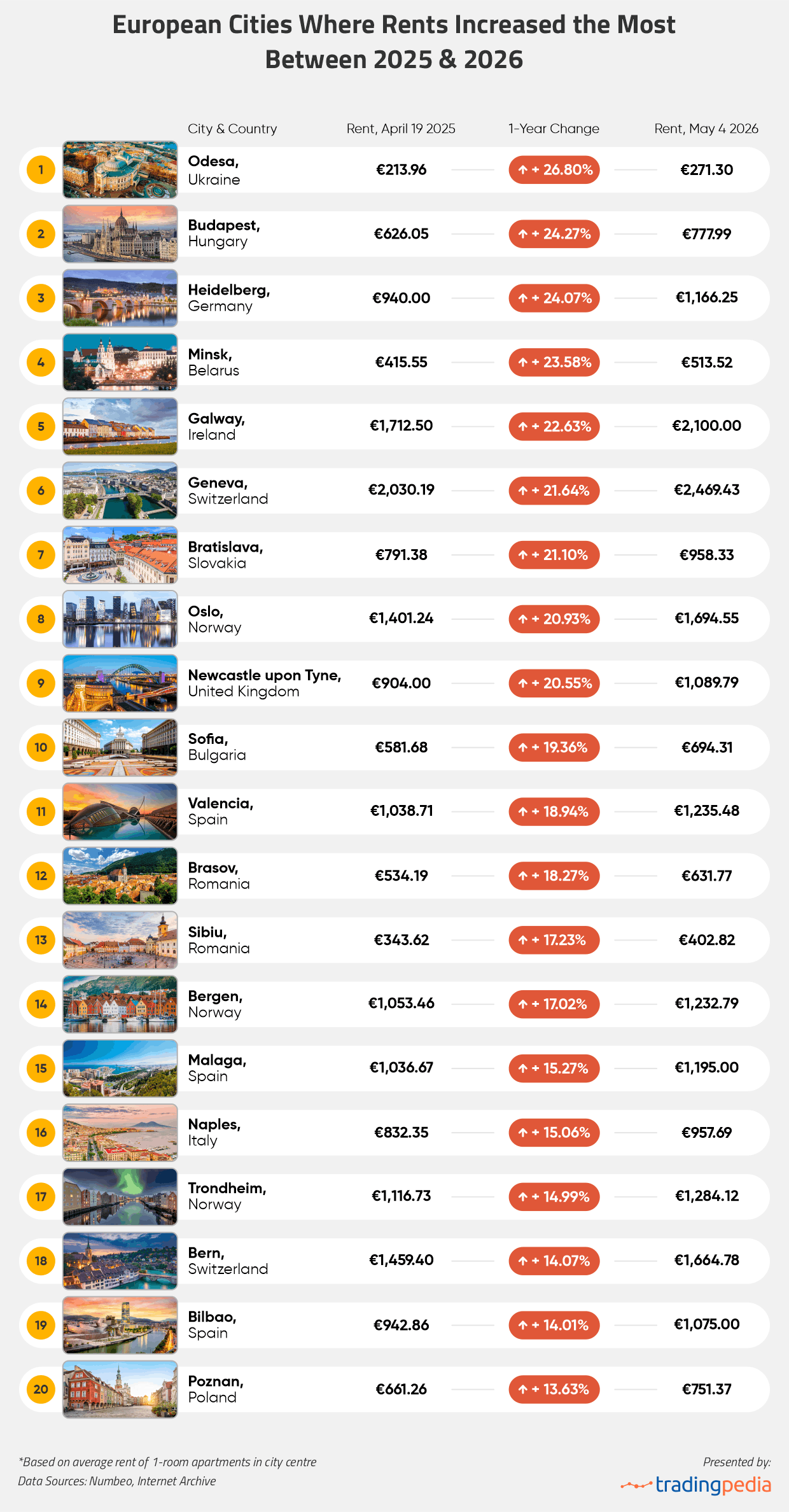
Although affordability pressures are already severe in many cities, rental inflation continues to intensify across large parts of Europe. Odesa, the third-most populous city in Ukraine, recorded the sharpest increase in annual rent prices, with average rents surging 26.8% year over year. From €213.96 per month at the end of April 2025, 1-bedroom flats in the city centre rose to €271.30 in May 2026, roughly 68.7% of the average net salary of €395.20.
Several other Eastern and Central European cities also experienced sharp increases. Budapest posted a 24.3% annual rise in rents, while Minsk saw prices jump nearly 24%. The increase was just over 24% for rents in Heidelberg, a historic town in southwestern Germany, and in Bratislava’s city centre, flats rose by 21.1%.
Other European cities where rents rose significantly over the past year are Galway, Geneva, with 21-22% increases, as well as Oslo and Newcastle upon Tyne, which both saw rents rise by more than 20%. Sofia, Brasov, and Sibiu all recorded annual increases above 17%, suggesting that affordability pressures are increasingly spreading beyond Western Europe’s traditional hotspots.
Despite broad upward momentum, several European cities have started to record modest rent declines over the past year. This is especially pronounced in Germany, where city centre rents fell by close to 15% in Essen and Dresden. Frankfurt and Nuremberg also experienced large declines, with rents dropping just over 10% annually.
In Southern Europe, Lisbon (down 5.7%) and Seville (down 6.2%) posted moderate decreases, reflecting slowing demand after years of explosive growth. London, Paris and Amsterdam also recorded either slight declines or relatively flat growth, suggesting some of Europe’s most overheated markets may finally be stabilising. However, even where rents are falling, affordability often remains severely strained due to years of accumulated price increases. In Lisbon, for example, rents dropped nearly 6% year over year, yet the city still ranks as Europe’s least affordable rental market because salaries have failed to keep pace with long-term housing inflation.
Europe’s Housing Divide Continues to Grow
The latest figures reveal a widening divide between Europe’s strongest and weakest rental markets. In wealthier economies such as Switzerland, Germany and parts of Scandinavia, high salaries continue to cushion the impact of rising rents. But across Southern and Eastern Europe, housing costs are increasingly detached from local earning power.
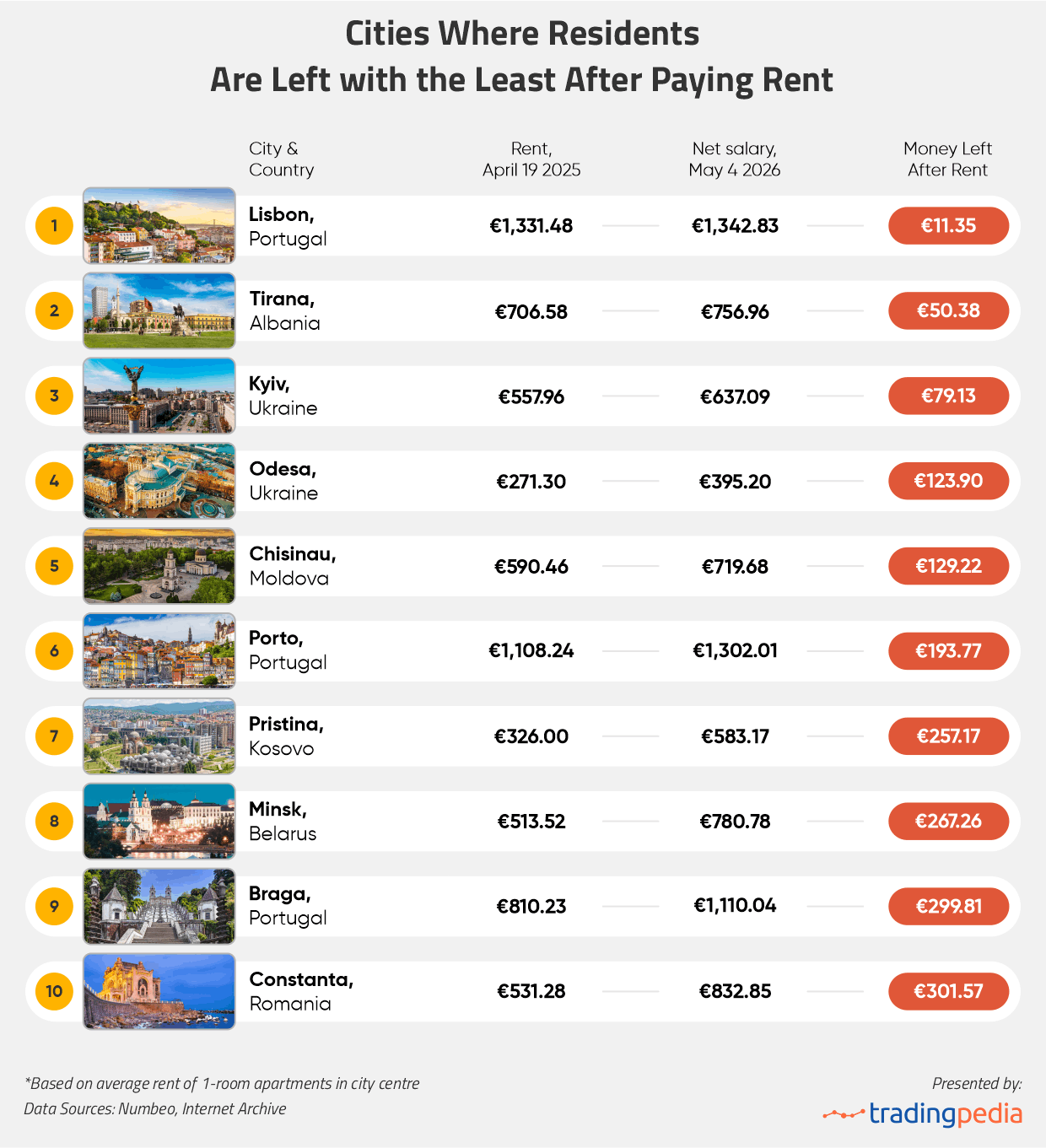
In certain cities, residents are left with close to nothing after paying their rent each month. In Lisbon, those earning the average of almost €1,343 need to pay a staggering €1,331 for a single-bedroom rental home in the centre of the city, leaving them just €11.35, an amount that is clearly not enough for buying food and other necessities, paying bills, let alone saving. The money left after rent is insufficient for any of those also in Kyiv and Tirana, considering residents truly pay such high rents and earn the salaries, as posted in Numbeo.

The analysis is based on rental price and average net salary data sourced from Numbeo, focusing on the monthly cost of renting a one-bedroom apartment in city centres across major European cities as of May 2026. Rent affordability was calculated by comparing average monthly rent against average local net salaries(monthly salaries after taxes and social contributions were already taken out), expressed as the share of income spent on housing.
Year-over-year changes were measured using historical Numbeo data from late April 2025. We accessed 2025 figures through the Internet Archive’s Wayback Machine, which archives snapshots of websites, allowing users to view how webpages looked at different points in time.
It is important to note that Numbeo is a crowdsourced database rather than an official government or statistical source. The figures are based on user-submitted data and online contributions, meaning results may vary depending on sample size, reporting frequency, and local participation levels in each city. Some cities may therefore have more reliable and frequently updated datasets than others, while smaller markets may be more vulnerable to fluctuations or limited reporting.
Additionally, average salary figures may not fully reflect income inequality, tax variations, or differences between sectors and professions within individual cities. As a result, the findings should be viewed as indicative estimates designed to highlight broader affordability trends rather than precise official measurements.
 TradingPedia.com is a financial media specialized in providing daily news and education covering Forex, equities and commodities. Our academies for traders cover